Skip to content

Smart Dog Care Blog

Tips, Guides & Insights
for Dog Owners

Expert advice on health, behaviour, training, and building a community—powered by AI and written by people who love dogs.

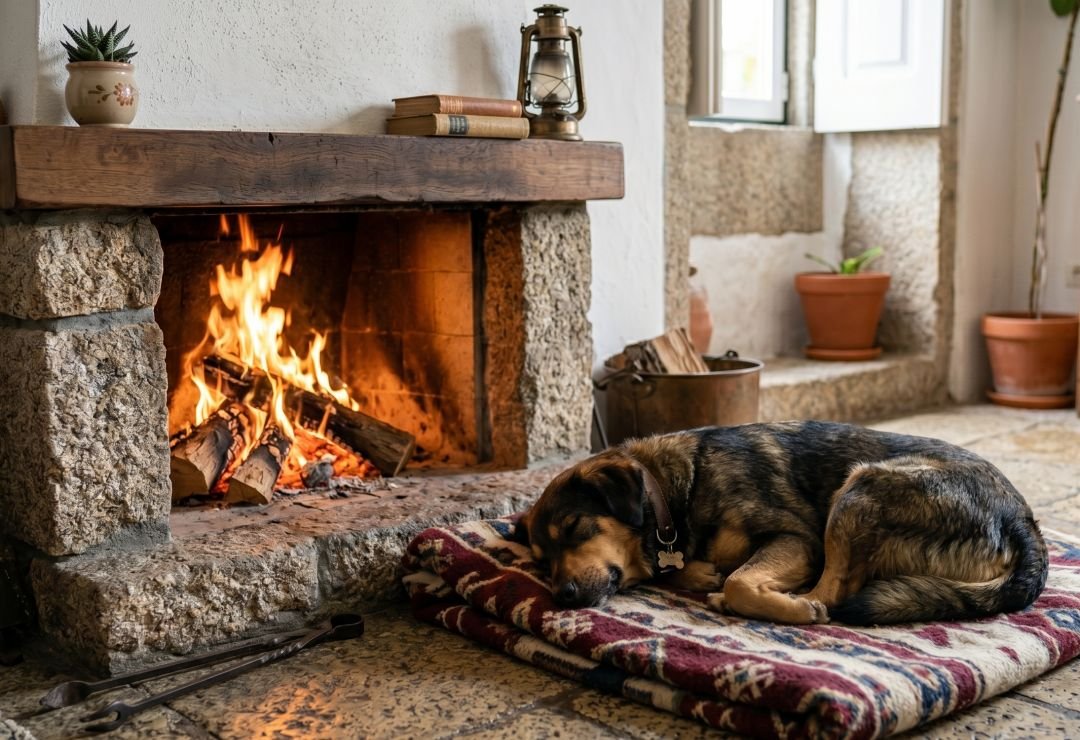
Why Does My Dog Snore?

Why Does My Dog Snore? (When It's Normal vs When It's a Problem)

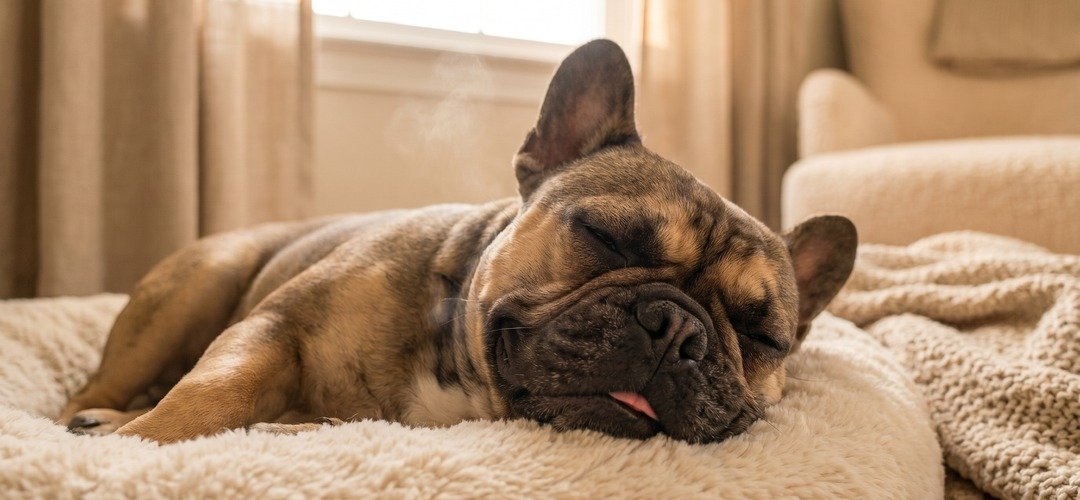
Snoring is the most under-investigated symptom in dog ownership. Owners hear it, smile, post a video, and move on. And most of the time, that's fine — most snoring is harmless. But not all of it. A 2022 survey published in The Veterinary Quarterly found that around 75% of brachycephalic-breed owners believed loud snoring was normal for the breed — when in fact many of those dogs were living with chronic low oxygen levels and a quietly progressive airway disease. If you've already read our piece on why dogs sleep so much , you know that long, fragmented sleep is normal for dogs. Snoring is the next layer — it's what's happening during all those hours of rest, and it's where small changes in the airway show up first. So this article is the honest version. The eight most common causes of dog snoring, ranked from "let your dog sleep" to "call the vet today". A 30-second test you can do tonight to know which one you're looking at. The truth about BOAS and dog sleep apnea. And the small adjustments that often make snoring better. If your dog has snored their entire life and nothing has changed — you'll probably finish this and feel relieved. If something has shifted in the last few months — you'll know what to do next. Either way, you'll never hear that night-time sound the same way again. How dog snoring actually works VCA Animal Hospitals defines it cleanly: snoring is the vibration of soft tissues in the upper airway as air passes during breathing. The structures involved — according to The Animal Medical Center of New York — include the tongue, tonsils, soft palate, larynx, and small pouches near the vocal cords called laryngeal saccules. The principle is simple. Anything that narrows or partially blocks the airway makes those tissues vibrate more, which makes the sound louder. The narrowing can be anatomical (born with it), positional (only when sleeping on the back), inflammatory (allergies, infection, swelling), mechanical (obesity, foreign object, growth), or hormonal (hypothyroidism slowing tissues and adding weight). That's why the change matters more than the snoring itself. A dog who has always snored softly is telling you about their anatomy. A dog who started snoring three months ago — or whose snoring is steadily getting louder — is telling you about something new. The 30-second snore test (do this tonight) Wait until your dog is properly asleep. Then run these seven questions. Yes or no, in your head. Has my dog snored since they were a puppy, with no real change? Yes → probably anatomical, monitor only. No, it started in the last 1–3 months → keep going. Is the snoring getting louder over time? No, it's the same as ever → reassuring. Yes → investigate. Does my dog only snore in one specific position (usually on their back)? Yes → probably positional, low concern. No, in any position → keep going. 🚩 Are there silences where my dog seems to stop breathing for 5–10 seconds, then gasps? Yes → possible sleep apnea, see vet. 🚩 Does my dog wake up suddenly choking, gasping, or making panicked noises? Yes → vet today. 🚩 Are the lips or gums ever bluish or purplish during sleep? Yes → emergency vet now (this is cyanosis). 🚩 Is my dog…
Hanna FurHanna Fur
How to Find Safe Walking Routes for My Dog

How to Find Safe Walking Routes for My Dog (and the 60-Second Pre-Walk Check Nobody Does)

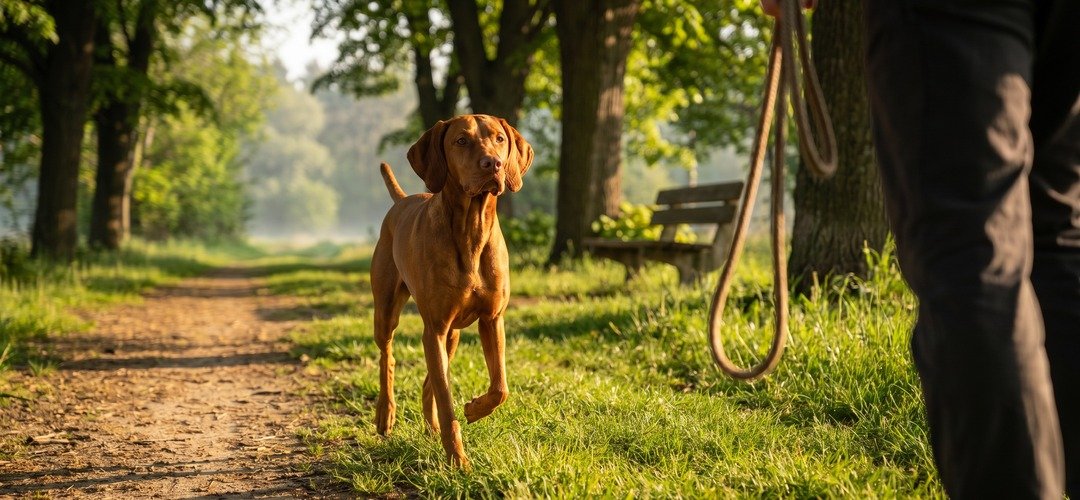
Most dog owners don't choose walking routes. They inherit them. The block they happen to live on, the park their old neighbour mentioned, the corner store loop they did on day one — and then those routes calcify. Three years later the same dog is still walking the same pavement, past the same construction site, around the same off-leash terrier who lives on the corner. That's a problem, because the route isn't neutral. The route shapes how much your dog walks, how stressed they are when they get home, whether their paws come back intact, and whether you actually enjoy the walk or just survive it. Pavement reaches 125°F (52°C) when the air is only 25°C — hot enough to burn paw pads in 60 seconds, according to Mills Animal Hospital . And research published in the International Journal of Environmental Research and Public Health found that owners in less walkable neighbourhoods walk their dogs 55 minutes less per week on-leash. The route, in other words, decides whether the walk even happens. This article is what nobody taught you about choosing where to walk. Five things, specifically: A 60-second pre-walk check you can do every time before opening the door 12 hazards to scan for, organised by season 7 rules of route design — not "what to avoid", but how to build a route that works How to read a route from your dog's eye-level (the part most people miss) How GPS and hazard alerts turn route choice from guesswork into a system Let's start at the doorstep. The 60-second pre-walk check (do this every time) Before you clip the leash, run this mental checklist. It takes less time than putting on your shoes and prevents 90% of the bad outcomes I see. 1. Test the ground. Place the back of your hand flat on the pavement and count seven seconds. If you can't hold it there, your dog can't walk on it. The Royal Kennel Club made this the official rule for a reason — paw pads are skin, not leather, and burns from hot tarmac are one of the most common summer vet emergencies. 2. Check the weather (all of it). Not just temperature. Humidity above 70% triples heat stress because dogs cool through panting and panting evaporates water. Wind chill in winter changes the felt temperature by 5–10°C. And air quality matters: when wildfire smoke or urban smog spikes AQI above 150, brachycephalic dogs (Pugs, Bulldogs, Frenchies) shouldn't go further than the kerb. 3. Pick the time. In summer, that's early — before 9 a.m. — or late, after 7 p.m. In winter, the warmest hour of the day, usually between 12 and 3 p.m. The middle of the day in July is not a walking time; it's a heatstroke window. 4. Decide the goal. Is this a sniff walk (low pace, dog leads, decompression), an exercise walk (steady pace, cardio), or a training walk (focus, recall, loose-leash work)? The goal changes the route. A sniff walk wants tall grass and slow corners; an exercise walk wants a loop with rhythm; a training walk wants a low-distraction zone. 5. Check the dog. Are they bright-eyed, loose-bodied, food motivated? Or are they hiding under the table, off their breakfast, stiff getting up? A dog that doesn't want to walk is telling you something. Listen to it. 6. Equipment audit. Lead — not…

John SpencerJohn Spencer
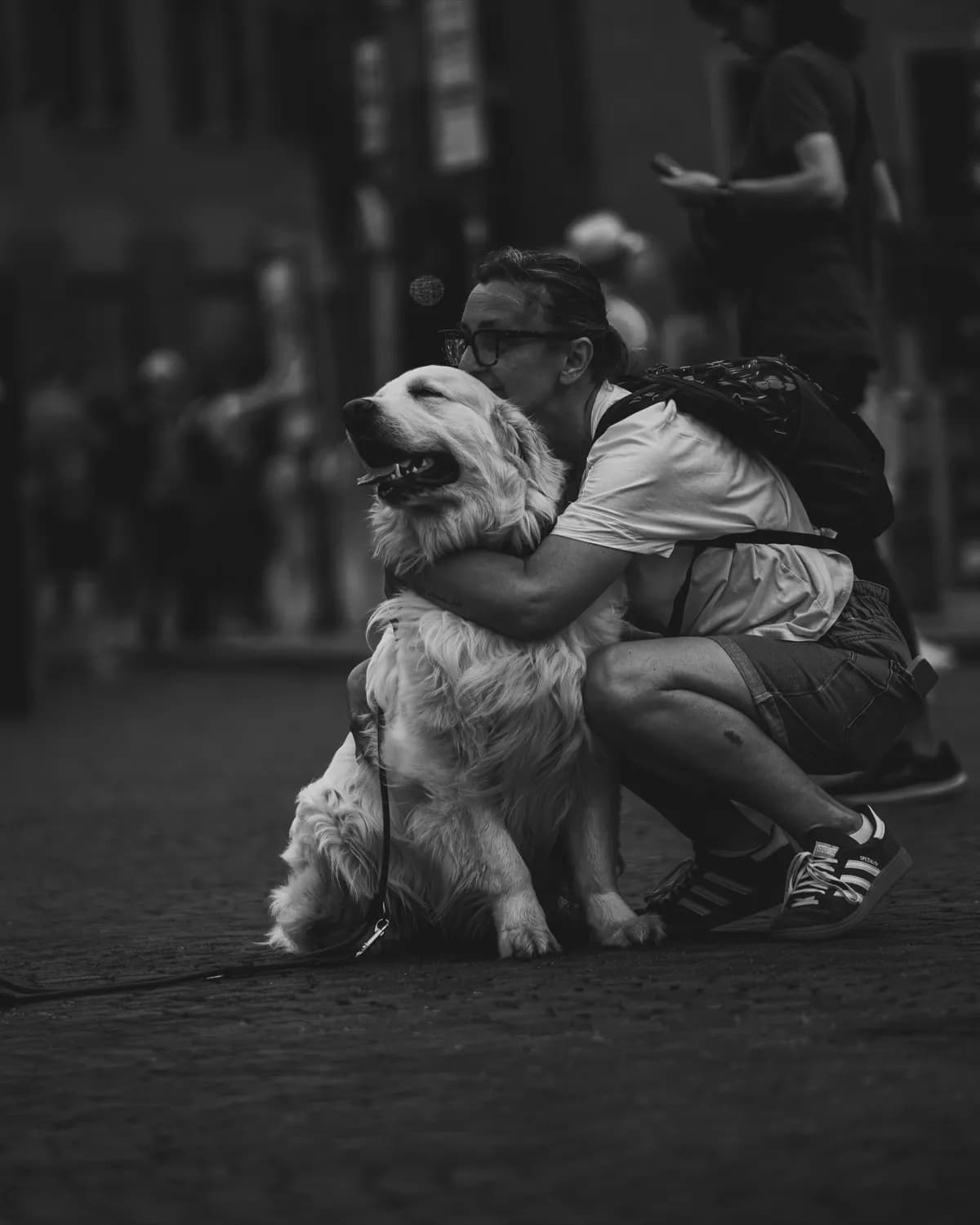
My Dog Has No Dog Friends

My Dog Has No Dog Friends — Is That a Problem? (Honestly, Probably Not)

You watch other people at the park. Their dogs sprint into the gate, get instantly absorbed into a wagging, sniffing, bouncing pile of fur, and emerge twenty minutes later with what looks like five new best friends. Then there's your dog. Your dog walks the perimeter. Your dog avoids eye contact. Your dog has a polite but firm opinion that other dogs are a thing that exists — not a thing that needs to be hugged. And so you start to wonder. Is something wrong with my dog? Is he lonely? Did I fail him somewhere? Here's the part nobody tells you at the park: most adult dogs are exactly like yours. The social butterflies you see are not the rule. They're the visible minority. The American Kennel Club's own framework on canine sociability puts most adult dogs in the "tolerant" or "selective" zone — not the "loves every dog" end of the spectrum. And a 2026 review in the journal Animals describes urban pet dogs as living in "socially crowded yet relationally sparse worlds" — they meet many dogs but know almost none ( Bonacci et al., 2026 ). What dogs actually need, the science says, isn't more dogs. It's the right dogs. This article will give you: Why "every dog needs lots of dog friends" is a myth — and where it came from The dog selectivity scale, and why your dog probably belongs in the middle Why your dog changed at 12–18 months (you didn't break anything) The honest line where it actually is a problem A 5-minute self-assessment to know if your dog is genuinely fine What to do instead of forcing friendships Let's take the guilt off the table. The myth: "every dog needs lots of dog friends" The idea that a healthy dog should have a wide, rotating cast of canine pals is surprisingly modern. It traces back to two cultural shifts: the explosion of off-leash dog parks in the 1990s and 2000s, and the rise of the doggy daycare industry. Both rest on a simple commercial premise — dogs need socialisation, daycare and parks provide socialisation, therefore daycare and parks make dogs happy. That logic conflates two completely different things: Puppy socialisation — the developmental process of safe exposure to people, dogs, sounds, surfaces, and environments during the first three to four months of life. This is essential. The American Veterinary Society of Animal Behavior calls it "the standard of care" and warns that incomplete socialisation in this window predicts lifelong fear, anxiety, and aggression problems ( AVSAB Position Statement ). Adult canine friendships — what your two-year-old dog does or doesn't do at the park. This is not the same thing. Adult sociability is shaped by genetics, breed, individual temperament, life experiences, and natural social maturation. Some adult dogs love crowds. Most don't. The worst part of the myth is that it actively harms the dogs caught in the middle of it. Dragging a dog-selective adult into a chaotic dog park "to make friends" doesn't build friendships. It builds stress, then avoidance, then sometimes reactivity. Pushing a quiet introvert into daycare so he "isn't lonely" can produce the exact opposite of the calm, confident dog you wanted. Your goal as an owner isn't to manufacture a wide social circle.…

Hanna FurHanna Fur

Reading is step one. The app is step two.

Every guide here pairs with a feature in the Smart Dog Care app — behaviour analysis, training plans, walk safety, vet chat. Free to download.

Dog Park Etiquette Rules

Dog Park Etiquette: 12 Rules Nobody Tells You (and How to Spot a Dangerous Park in 30 Seconds)

In a single year, insurer Nationwide paid out claims for almost 24,000 dogs treated for soft-tissue injuries, with the average head trauma costing owners $591 ( DVM360 ). Most of those injuries didn't happen on dangerous mountain trails. They happened at the local dog park. That stat isn't here to scare you off the park. Dog parks are still one of the best places for a confident, well-socialised dog to burn energy, sniff new things, and read other dogs. But here's the part nobody puts on the welcome sign: a dog park is a self-organising social experiment with no referee, no entrance exam, and no guarantee that the other humans there know what their own dog is doing. This guide is not another "always pick up after your dog" listicle. It's the field manual you wish someone had handed you the first time you stood at the gate, leash in hand, wondering if this was a good idea. You'll get: A 30-second safety scan to run before you even unclip the leash 12 etiquette rules most owners never get told (because they're inconvenient) 7 red flags that mean leave right now, no apology An honest answer to: is the dog park even right for your dog? Let's go. The 30-second safety scan (do this BEFORE you walk in) Stand outside the fence. Don't go in yet. Run this checklist in your head — it takes about half a minute and it will save you a vet bill. Is there a double gate (air lock)? A single gate means the second you open it, every dog inside will rush you and your dog while you're trapped. That's how fights start. How many dogs are inside? Sweet spot is roughly 4 to 8. Above 12 starts to feel like a mosh pit. Three or four loose social groups beats one chaotic mob every time. Are the humans watching, or scrolling? A park full of phone-zombies is a park where the next altercation will go on for 30 seconds before anyone notices. Is one dog being chased by three or more others, with no breaks? That isn't play. That's mobbing. More on this below. Do you see any dog with a high, stiff tail and a forward, frozen body? That's a loaded gun in a furry costume. Is there a separate area for small dogs? If your dog is under 10 kg and there isn't, this might not be your park today. Is the ground clean? Visible poop = nobody's paying attention to the basics, which means nobody's paying attention to the bigger stuff either. Vibe check. Are humans relaxed? Are dogs moving in loose, curving paths and taking breaks to sniff and shake off? Or is it tense and loud? If three or more answers are bad, walk your dog somewhere else. There's no medal for entering a sketchy park. The 12 etiquette rules nobody tells you Some of these are obvious in theory and ignored in practice. A few will be unpopular. All of them are backed either by veterinary consensus, behaviour science, or hard-earned park experience. Before you even leave the house 1. Vaccinated, dewormed, and (ideally) desexed. No exceptions. The American Veterinary Medical Association and the RSPCA both list this as the non-negotiable baseline. Shared water bowls, mouth-on-mouth play, and group sniffing of the same patch of grass make the park an extremely efficient delivery system for kennel cough, parvo, parasites, and…

Hanna FurHanna Fur
How to Teach a Dog to Come When Called

How to Teach a Dog to Come When Called: A 3-Week Plan That Actually Works

The recall is the only command that can literally save your dog's life. The car door that opens too fast. The squirrel across the road. The off-lead dog who shouldn't be off-lead. In every one of those moments, what stands between your dog and disaster is one word — and whether your dog believes that word means something good is happening. Most owners teach the recall the way they teach "sit" or "down": a few repetitions, a treat, and then they assume their dog "knows it". A month later they're standing in a park yelling "Buddy! BUDDY!" while Buddy sprints toward another dog like the word doesn't exist. The recall doesn't fail because dogs are stubborn. It fails because the way it's usually taught is almost designed to make it break. This guide shows you why, and gives you a 3-week plan that builds a recall you can actually trust — from your living room to an open field. TL;DR The recall is about value , not obedience. Your call has to be worth more than whatever your dog is doing. Never call your dog for something they hate. The word gets poisoned. Train in three phases: inside the house → garden with a long line → open space with a long line . Reward every time. Even at ten years old. The recall is expensive to maintain. If the recall breaks, go back one phase. Don't raise your voice. The Smart Dog Care app builds a personalised AI training plan for your dog's breed, age, and starting point — and tracks your progression week by week. 1. The recall isn't a trick. It's a contract. A "sit" or a "down" is a request to do something your dog can already do, in a place that isn't very interesting. The recall is something else entirely. The recall asks your dog to stop what they're doing — sniffing, chasing, playing, watching another dog — and come to you instead. You're not competing with nothing. You're competing with the entire environment. That changes the maths. To win, every single time you say the recall word, what your dog gets when they arrive has to be better than the thing they walked away from . That is the contract. And the contract has one rule, with no exceptions: The recall always means something good is happening. Not "usually". Not "most of the time". Always. The first time you call your dog and they get a bath, or their nails clipped, or their lead clipped on to leave the park forever, you have started to break the word. Do it three times and the word is dead. Your dog will hesitate, then ignore, then eventually stop responding altogether — and you'll think they're being defiant when really they're being rational. Reward-based training works because it's how dogs actually learn. A comprehensive review of training methods in the Journal of Veterinary Behavior found that aversive methods are not only less effective than positive reinforcement, they actively damage the dog's relationship with the handler. The recall is the most relationship-dependent command there is. Punish a recall once and you've taught your dog that coming to you is a risk. 2. Why most recalls fail Before we build a recall, it helps to know what breaks them. In ten years of watching owners and dogs in parks and training fields, the same five mistakes appear…

Hanna FurHanna Fur
When Is It Too Hot to Walk Your Dog?

When Is It Too Hot to Walk Your Dog? The Real Answer (And Why an App Helps)

You looked at the thermometer this morning. It said 24°C. You looked at your dog, who is currently dancing at the door with the leash in their mouth. You wondered, for half a second, whether it's safe — and then you went anyway. That half-second is the problem. Heatstroke in dogs almost never happens because owners ignored an obvious 35°C heatwave. It happens at 22, 24, 26°C, on a sunny May morning, on asphalt that the owner never thought to test. According to the Royal Veterinary College's 2024 heatstroke study published in Vet Record , 38% of UK vets saw at least one dog affected by heatstroke after a walk during the summer of 2022 — and exercise, not high ambient temperature, was the leading cause. So: how hot is too hot? The honest answer is that a single number doesn't exist. The useful answer is that there are seven variables, and a dedicated dog-walking app can read all of them in two seconds — which is what most of this article is really about. The Short Answer (For People in a Hurry) Air temperature Risk level for most dogs Action Below 20°C / 68°F Low Walk normally 20–24°C / 68–75°F Low-moderate Test pavement, prefer shade 24–28°C / 75–82°F Moderate Short walks, dawn or dusk only 28–32°C / 82–89°F High Potty breaks only, on grass Above 32°C / 89°F Severe Indoor day; vet emergency risk These are baselines for an average healthy adult dog. Add risk if your dog is brachycephalic (Bulldog, Pug, French Bulldog), obese, very young, very old, double-coated, or has heart, respiratory, or thyroid issues. Subtract risk only if you walk strictly in shade, with water available, on grass. This is a chart. It is also a lie of simplification. Read on. Why "Above 85°F" Is Misleading Most articles answering "how hot is too hot" land on a clean number: 85°F (29°C). It is wrong, or rather, it is so incomplete that following it as a rule will eventually hurt your dog. For brachycephalic breeds — flat-faced dogs whose airway anatomy makes panting structurally inefficient — the danger zone starts much lower. Stella & Chewy's, citing board-certified veterinary specialist Dr. Justine Lee , notes that for some dogs "even temperatures in the 70°-77° range can be too hot". A French Bulldog at 22°C with 70% humidity is in more trouble than a Siberian Husky at 28°C with low humidity, and the thermometer alone cannot tell you that. Add humidity. Dogs cool primarily by panting, which works through evaporation from the tongue and respiratory tract. In humid air, evaporation slows down. Dr. Lee recommends a simple rule: if the temperature in °F plus the relative humidity percentage adds up to 150 or higher, do not exercise your dog outdoors . An 80°F day at 80% humidity sums to 160 — past the threshold, even though 80°F sounds harmless. Then add pavement. We will get to that next, because it is the single most underestimated factor in this entire conversation. The Seven Variables That Actually Matter A useful "is it too hot to walk?" decision combines: Air temperature — the obvious one, but only the baseline. Humidity — high humidity at moderate temperature is more dangerous than dry heat at higher temperature. Pavement type and temperature — asphalt > brick >…

John SpencerJohn Spencer
How to Stop Your Puppy Pulling on the Leash

How to Stop Your Puppy Pulling on the Leash

Most puppies don't pull because they are stubborn, dominant, or "testing you". They pull because they are puppies, the world is full of incredible smells, and their walking speed is faster than yours. Pulling works — it gets them to the lamppost, the dog across the road, the leaf they desperately need to investigate — and behaviour that works gets repeated. The good news: two weeks is enough. Not to produce a dog who heels like a Crufts finalist, but enough to flip the basic equation in your puppy's head from "pulling = forward" to "a loose leash = forward" . That is the only thing you actually need to teach. Everything else is polish. This plan is built on what reward-based trainers and modern behaviour science actually agree on, condensed into 10-minute sessions you can do twice a day. No prong collars, no leash pops, no "balanced" methods that promise results in one walk. The American Veterinary Society of Animal Behavior position statement is unambiguous on this: reward-based methods are at least as effective as aversive ones and produce no welfare cost. Your puppy doesn't need to be punished. They need to be taught. Why Puppies Pull — The Three Things Working Against You Before the plan, the diagnosis. Pulling is rarely a single behaviour with a single cause. It is the predictable result of three forces stacking up. 1. Pulling has been reinforced — every single time. Behaviour analysts call this the central problem. As Kiki Yablon writes , when you attach a curious puppy to a 6-foot rope and march them down a sidewalk 8–10 feet from everything they find interesting, "we are setting them up to learn to pull. We tempt them with treasure just out of reach, and then when they hit the end of the leash, they learn that a little extra oomph will get them closer." Every successful pull is a training rep — for the wrong behaviour. 2. Opposition reflex is doing half the work. The moment a leash goes tight, most dogs instinctively brace and lean into the pressure. This is called the opposition reflex , and it is involuntary. If you pull back, your puppy pulls forward harder — not out of defiance, but because their nervous system is wired that way. The implication is uncomfortable for handlers: a constantly tight leash creates more pulling, not less. 3. Their walking speed is faster than yours. Even small breeds trot faster than humans saunter, and adolescent puppies are running on a brain full of dopamine and a body that just wants to move. The AKC notes that mismatched pace is one of the most under-recognised causes of pulling. If your walks feel like dragging a kite, part of the answer is to walk faster. The plan below addresses all three: it teaches your puppy that loose-leash behaviour earns forward progress, it eliminates leash tension as the default state, and it asks you to set a brisker pace from day one. Equipment — Get These Three Things Right You can't out-train bad equipment. Before Day 1, set yourself up properly. A flat collar or, better, a Y-shaped harness with both a back clip and a front clip. Front-clip harnesses (Easy Walk, Freedom No-Pull, Perfect Fit) gently redirect a pulling puppy back toward you and, according to the San…

Hanna FurHanna Fur
How to Train a Reactive Dog on Walks

How to Train a Reactive Dog on Walks — Starting at Home (A 4-Week Plan)

Here is the uncomfortable truth about training a reactive dog: you probably can't do it on a walk. Walks are the final exam, not the classroom. The dog across the street is too close, the leash is too tense, your heart rate is too high, and your dog has already gone from "alert" to "unable to think" in under two seconds. Trying to teach new skills in that state is like trying to teach algebra to someone who is drowning. The good news is that the real work — the part that actually reduces reactivity — happens in your living room. You build the foundation on the sofa. You practise threshold games in the hallway. You rehearse emergency cues in the kitchen. By the time you take your dog outside, they already know what to do; the walk is just generalisation. This guide is a 4-week, force-free plan that rebuilds reactivity from the ground up. It is based on the same protocols certified behaviourists use — Leslie McDevitt's Look at That, Karen Overall's relaxation work, counterconditioning and desensitisation — and on current research into canine impulse control. No prong collars, no corrections, no "dominance". Just distance, duration, intensity — the three levers that actually change behaviour. Reactivity vs. Aggression — Why the Distinction Matters Before anything else, know what you are working with. The terms get used interchangeably, and they shouldn't be. According to the American Kennel Club , reactivity is an exaggerated emotional response to a stimulus — barking, lunging, growling, spinning — that is out of proportion to the situation. A reactive dog is overwhelmed, not malicious. Their nervous system has overridden their impulse control. Aggression, by contrast, is behaviour aimed at causing harm — biting, snapping, sustained threat. Aggression has intent; reactivity has volume. The distinction matters because the training plans are different. Most reactive dogs can be worked with at home by a committed owner using the methods in this article. Dogs showing true aggression — bite history, stalking behaviour, predatory silence, bloodshot fixated stares — need hands-on professional help before any home plan is safe to run. One nuance that the AKC makes clear: reactivity can become aggression if left unmanaged , particularly fear-based reactivity. A dog whose barking and lunging fail to make the scary thing go away learns, over time, to escalate. Growling becomes snapping. Snapping becomes biting. This is why "ignore it, he'll grow out of it" is the single worst advice anyone can give a reactive-dog owner. Fear vs. Frustration — The First Diagnosis Within reactivity itself, there are two very different underlying emotions, and your training plan has to match. Fear-based reactivity. The dog is trying to create distance. The barking, growling, and lunging are defensive — they are saying, "go away". Classic signs: the dog leans backwards even as they lunge forward, hackles may be raised, the tail is tucked or low, and the reactions often stop the moment the trigger disappears. Frustration-based reactivity. The dog is trying to close distance. They want to reach the other dog, the jogger, the squirrel. Classic signs: whining, pulling towards the…

Hanna FurHanna Fur
How to Tell If Your Dog Is Stressed When You Leave

How to Tell If Your Dog Is Stressed When You Leave (Without a Camera)

You pick up your keys. Your dog freezes. Their ears drop, the tail tucks, and they follow you to the door with the kind of quiet intensity that is hard to ignore. You tell yourself they will be fine once you are gone — and most of the time, you are probably right. But here is the uncomfortable statistic: a 2025 study published in the Journal of Veterinary Behavior found that 85.9% of dogs in the US show moderate to severe separation-related issues. Research cited by the RSPCA puts it more simply: 8 out of 10 dogs struggle when left alone — and half of them never show obvious signs. That is the real problem. Most articles list ten symptoms and assume you will notice them. You won't — because by the time the noisy stuff happens, you are not home. The good news is you do not need a camera to figure out if your dog is stressed when you leave. You just need to know when to look, and what to look for. This guide walks you through the three moments that reveal almost everything, how to tell stress apart from simple boredom, and what the latest behaviour science says about why dogs bark, whine, or destroy things when their humans disappear. The 3 Moments That Reveal Everything Forget the idea that separation stress happens only while you are gone. The most diagnostic signals happen around the departure — and you are home for two out of the three. Moment 1: Before You Leave (the 10-20 Minutes Before) Dogs are pattern detectives. They know what shoes, keys, coats, bags, and alarms mean, and most anxious dogs start reacting well before you walk out the door. The ASPCA calls these predeparture cues , and how your dog reacts to them is often more telling than what happens after you leave. Watch for: Shadowing. Your dog follows you from room to room, staying within a metre of you — especially on days you are getting ready to go out. Restlessness. Pacing, sitting, getting up, sitting again. Unable to settle. Displacement behaviours. Yawning out of context, lip licking, scratching themselves when they are not itchy. Refusing food. High-value treats go untouched when the coat comes on. Physical signs. Panting, trembling, dilated pupils, ears pinned back. Blocking. Sitting by the door, trying to prevent you from leaving, or pressing against your legs. A calm dog at this stage does not do most of these things. They may lift their head, note that you are leaving, and go back to whatever they were doing. The difference between "aware" and "stressed" is how long the behaviour lasts and how intense it gets. Moment 2: The Departure Itself This is a 30-second window most owners don't pay attention to, but it carries a lot of information. A relaxed dog may walk with you to the door, take a treat, and settle as you close it. A stressed dog often: Whines or barks as the door closes Scratches or jumps at the door Runs to the nearest window Stops eating the treat you just offered Shows "whale eye" (the whites of the eyes visible at the edge) If you can, step just outside and listen for 30-60 seconds. Most separation-related behaviours peak within the first 10 minutes after departure, according to the research summarised in a 2016 review in the Journal of Veterinary…

John SpencerJohn Spencer
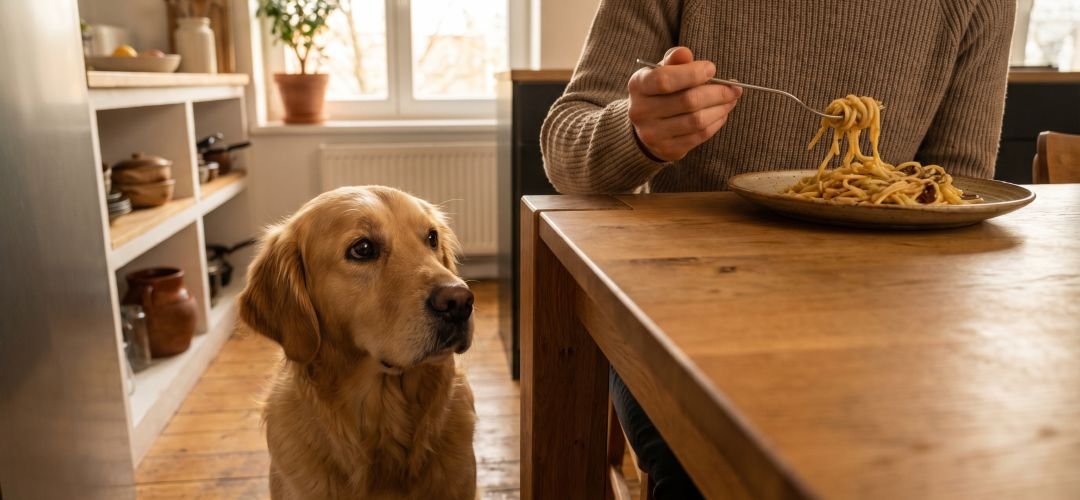
Why Does My Dog Stare at Me While I Eat?

Why Does My Dog Stare at Me While I Eat? The 5 Real Reasons (and How to Tell Which One)

You sit down to dinner. Fork halfway to your mouth. And there they are: two brown eyes locked on you with the focused intensity of a sniper. Your dog has not blinked in what feels like an hour. It is one of the most universal moments of dog ownership — and one of the most misread. People assume their dog is just begging. Sometimes that is true. But the same stare can also mean your dog is bonding with you, feeling anxious, or simply trying to figure out what you are up to. And the difference matters, because how you respond shapes the behaviour for years. This article walks through the five real reasons dogs stare at you during meals, how to tell them apart by reading body language, and what to do in each case. The 5 Real Reasons Dogs Stare at You During Meals 1. They Want Your Food (Classic Begging) This is the obvious one. Your dog smells something that is not in their bowl, and they want in. Even a dog who has just eaten will stare — food is one of the most powerful motivators in a canine brain, and the smells coming off your plate are information-rich enough to override a full belly. The begging stare usually comes with a cluster of other signals: drool, a fixed gaze that tracks your hand rather than your face, a tight body, and sometimes whining or pawing. It is not subtle once you know what to look for. Begging has a biological root. Dogs evolved alongside humans, scavenging the edges of our camps and meals for thousands of years. Waiting near food that belonged to someone else, hoping for scraps, is essentially their ancestral job description. 2. They've Been Rewarded for Staring Before (Learned Behavior) Dogs are exceptional at spotting patterns. If staring has ever — even once — produced food, attention, or a reaction, they will repeat it. "Dogs learn to stare and beg based on how their owner responds," explains Erin Askeland, animal health and behavioural expert at Camp Bow Wow, in an interview with Adopt a Pet . "If their behavior results in getting them food, they're likely to repeat it." That "reward" does not have to be a piece of chicken. It can be eye contact, talking to them, pushing them away, laughing at their expression, or getting up to move them. To your dog, any response is reinforcement. Silence and lack of engagement is often the most powerful correction. 3. They're Bonding With You (The Oxytocin Connection) Here is where it gets scientifically interesting. Not every mealtime stare is about the food — some of it is about you. A 2015 study published in Science by Nagasawa and colleagues at Azabu University found that when dogs and their owners make sustained mutual eye contact, both release oxytocin — the same hormone involved in the bond between a human mother and her baby. The longer the gaze, the bigger the spike. Wolves, tellingly, do not show the same effect with humans. This is something dogs evolved specifically to share with us. What that means in practical terms: some of the quiet, calm staring you see at mealtimes is your dog's version of sitting on the couch with you. They are watching a routine they associate with you, releasing feel-good chemicals, and strengthening the attachment. The food on your plate…

Hanna FurHanna Fur
Why Do Dogs Sleep So Much?

Why Do Dogs Sleep So Much?

Many dog owners notice their pets sleeping for large parts of the day. A dog might be playing one minute and then fast asleep the next. This can make people ask, why do dogs sleep so much? It's a normal question, and the answer is that a dog's need for sleep is very different from a human's. Their age, the kind of dog they are, and even their daily life play a big part in how much they rest. For dogs, sleeping a lot is not a sign of being lazy. It is a natural behavior that is important for their health. Sleep helps their bodies grow, repair themselves, and save energy. An average adult dog can sleep for 12 to 14 hours a day, and this is completely normal. Understanding their sleep helps owners know what is normal for their furry friend. The Way Dogs Sleep Dogs do not sleep in one long stretch like most people do at night. Instead, they sleep in shorter periods throughout the day and night. This is because their sleep cycles are much shorter than human sleep cycles. A dog can go through a full sleep cycle in about 45 minutes, while a person's cycle is much longer. This means that even if it looks like a dog is sleeping all the time, much of that sleep is light. They are often just dozing and can wake up very quickly if they hear something interesting, like the sound of a food bag opening. This ability to wake up fast comes from their ancestors, who needed to be ready for danger at any moment. Because they get less deep sleep, they need more total sleep time to feel rested. Different Stages of Sleep Just like people, dogs have different stages of sleep. They start with a light sleep where their breathing slows down and they relax. After about 10 minutes, they can enter a deeper sleep called REM sleep. This is the stage where dogs often dream. During REM sleep, a dog might twitch its legs, wag its tail, or make little noises. This is all a normal part of dreaming. However, dogs spend only about 10% of their sleep time in this deep REM stage, while humans spend much more. Because they spend less time in the deepest, most restful stage of sleep, they need to sleep for more total hours to make up for it. The Role of Boredom Sometimes, a dog sleeps simply because there is nothing else to do. If the house is quiet and everyone is busy or away, a dog will often choose to nap. This is a way for them to pass the time until something more exciting happens, like when their owner comes home. This doesn't mean the dog is unhappy. It's just a normal way for them to save energy when things are calm. Giving a dog enough playtime and exercise can help make sure their waking hours are more active, but it will not change their basic need for a lot of rest. Why Do Dogs Sleep So Much? Here Are The Answers The main reasons why dogs sleep so much are their age, breed, level of activity, and natural sleep patterns. Puppies and older dogs need much more sleep than healthy adult dogs. The type of dog also matters, as very large breeds and certain working breeds have different energy needs that affect their sleep. Dogs are also designed to be ready for action at a moment's notice, which means a lot of their sleep is light dozing. To get the deep rest they need to…

Hanna FurHanna Fur
Homemade Dog Food

Homemade Dog Food Recipes and Benefits

Many dog owners want to know exactly what is in their dog's food bowl. This has made some people think about making food for their dogs at home. The idea of using fresh ingredients is appealing, and it allows owners to control every part of their dog's meal. Learning about homemade dog food is the first step for anyone thinking about this option. Making food for a dog at home is more than just sharing leftovers. It requires a good understanding of what dogs need to be healthy. A dog's diet must be balanced with the right amounts of different nutrients. Without this balance, a dog can get sick. This article will provide information about the key parts of homemade food for dogs. What Dogs Need in Their Food A dog's body needs a mix of different things to work correctly. Just like people, dogs need protein, fats, and carbohydrates for energy and to keep their bodies strong. They also need very small amounts of vitamins and minerals for their overall health. When food is made at home, it is very important that it has all of these parts in the right amounts. If something is missing, it can cause problems over time. For example, a lack of calcium can lead to weak bones. It is a big responsibility to make sure a homemade diet is complete. The Role of Protein Protein is one of the most important parts of a dog's diet. It helps build and repair muscles and other body parts. Good sources of protein for dogs are lean meats. Safe protein choices include: Chicken Turkey Lean beef Fish like salmon Eggs (cooked) These foods give dogs the building blocks their bodies need to stay strong and active. It is important to cook meat well to kill any bad bacteria. Fats and Carbohydrates for Energy Fats give dogs a lot of energy. They also help the dog's body absorb some vitamins and keep their skin and coat healthy. Good fats can come from fish oil or flaxseed oil. Carbohydrates also give dogs energy and fiber, which helps with digestion. Not all dogs need a lot of carbs, but they can be a helpful part of a balanced meal. Safe carbohydrates include brown rice, sweet potatoes, and oatmeal. Understanding Homemade Dog Food Homemade dog food is a diet for dogs made at home from fresh ingredients that people might also eat. This is different from buying dog food in a bag or can from a store. The main idea is to give the dog a meal that is fresh and has no extra fillers or artificial ingredients. Creating a balanced meal is the most important part of this process. A common mistake is not providing all the needed nutrients. A simple mix of chicken and rice, for example, is not enough for a dog to eat every day for a long time. It would be missing key vitamins and minerals. A lot of care and knowledge is needed to make proper homemade dog food. Important Vitamins and Minerals Vitamins and minerals are necessary for a dog's health, even though they are needed in small amounts. For example, calcium and phosphorus work together to build strong bones and teeth. Zinc helps keep a dog's skin healthy and their immune system strong. These nutrients are often where homemade diets can go wrong. Many recipes found online do not have the right balance of vitamins and minerals. This…

John SpencerJohn Spencer

Give Your Dog the Care They Deserve

Join a growing community of dog owners who trust AI to keep their pets healthy, happy, and safe. Download free today.

Free to download. Pro AI Plan available for unlimited features.