Why Does My Dog Stare at Me While I Eat? The 5 Real Reasons (and How to Tell Which One)
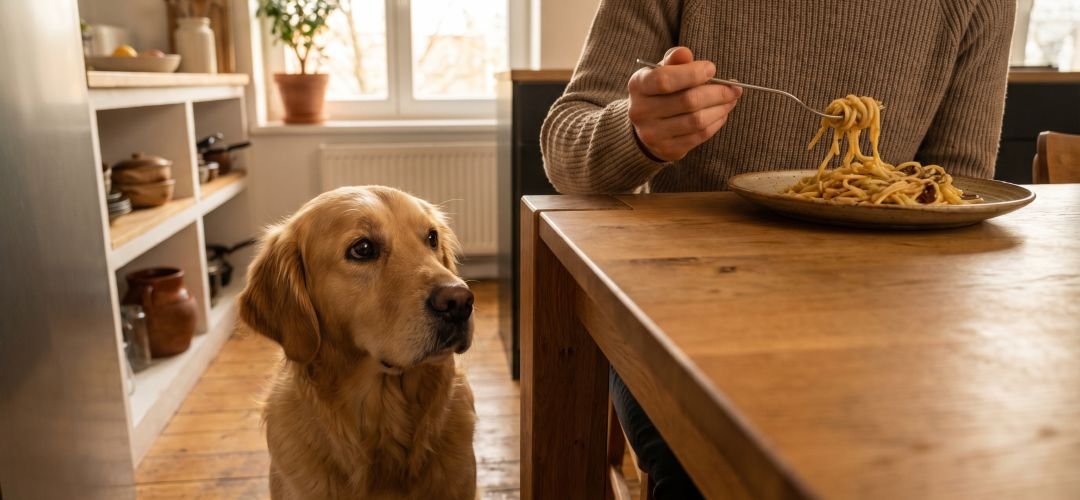
You sit down to dinner. Fork halfway to your mouth. And there they are: two brown eyes locked on you with the focused intensity of a sniper. Your dog has not blinked in what feels like an hour.
It is one of the most universal moments of dog ownership — and one of the most misread. People assume their dog is just begging. Sometimes that is true. But the same stare can also mean your dog is bonding with you, feeling anxious, or simply trying to figure out what you are up to. And the difference matters, because how you respond shapes the behaviour for years.
This article walks through the five real reasons dogs stare at you during meals, how to tell them apart by reading body language, and what to do in each case.
The 5 Real Reasons Dogs Stare at You During Meals
1. They Want Your Food (Classic Begging)
This is the obvious one. Your dog smells something that is not in their bowl, and they want in. Even a dog who has just eaten will stare — food is one of the most powerful motivators in a canine brain, and the smells coming off your plate are information-rich enough to override a full belly.
The begging stare usually comes with a cluster of other signals: drool, a fixed gaze that tracks your hand rather than your face, a tight body, and sometimes whining or pawing. It is not subtle once you know what to look for.
Begging has a biological root. Dogs evolved alongside humans, scavenging the edges of our camps and meals for thousands of years. Waiting near food that belonged to someone else, hoping for scraps, is essentially their ancestral job description.
2. They've Been Rewarded for Staring Before (Learned Behavior)
Dogs are exceptional at spotting patterns. If staring has ever — even once — produced food, attention, or a reaction, they will repeat it.
"Dogs learn to stare and beg based on how their owner responds," explains Erin Askeland, animal health and behavioural expert at Camp Bow Wow, in an interview with Adopt a Pet. "If their behavior results in getting them food, they're likely to repeat it."
That "reward" does not have to be a piece of chicken. It can be eye contact, talking to them, pushing them away, laughing at their expression, or getting up to move them. To your dog, any response is reinforcement. Silence and lack of engagement is often the most powerful correction.
3. They're Bonding With You (The Oxytocin Connection)
Here is where it gets scientifically interesting. Not every mealtime stare is about the food — some of it is about you.
A 2015 study published in Science by Nagasawa and colleagues at Azabu University found that when dogs and their owners make sustained mutual eye contact, both release oxytocin — the same hormone involved in the bond between a human mother and her baby. The longer the gaze, the bigger the spike. Wolves, tellingly, do not show the same effect with humans. This is something dogs evolved specifically to share with us.
What that means in practical terms: some of the quiet, calm staring you see at mealtimes is your dog's version of sitting on the couch with you. They are watching a routine they associate with you, releasing feel-good chemicals, and strengthening the attachment. The food on your plate is almost incidental.
You can often spot a bonding stare by what is absent: no tension, no drool, no whining. The dog looks soft, the eyes blink naturally, the body is relaxed.
4. They're Anxious or Stressed
This is the reason most owners miss — and it matters the most. An anxious stare can look almost identical to a bonding stare at first glance, but the body language underneath is completely different.
A stressed dog may stare at you during meals because mealtime is a transition point in the day (you sit still, then you get up, then something changes), because the household is tense, or because they are genuinely uncomfortable and do not know where else to go. Dogs with separation anxiety in particular often shadow their owners most during routines that signal "you are about to leave me" — and the end of a meal can be one of those cues.
Signs the stare is anxious rather than bonding or begging include:
- Ears flattened back or pinned down
- Lip-licking or repeated tongue flicks (a precursor to nausea and a common stress signal)
- "Whale eye" — the white of the eye visible at the edge
- Stiff posture, weight shifted back
- Pacing before or after the meal
- Yawning out of context
If you see these, the answer is not more training. It is figuring out what is making your dog uncomfortable.
5. They're Simply Curious or Bored
Sometimes the stare is nothing dramatic at all. Dogs are observant, social animals who live in the same room as you. If the most interesting thing happening in the kitchen is you chewing, they will watch you chew.
This is especially true of under-stimulated dogs. A dog who has had a long walk, a training session, and a chew toy is usually not glued to your fork. A dog who has been indoors all day often is.
How to Tell Which Reason Applies to Your Dog
Here is the honest truth: you cannot identify the reason from the stare alone. The eyes look similar across all five causes. The answer is always in the rest of the body.
Body Posture Cues to Watch For
| What You See | Likely Meaning | What to Do |
| Relaxed body, soft eyes, still or slow-wagging tail | Bonding or curiosity | Acknowledge calmly. Do not feed |
| Drooling, whining, pawing, tracking your hand | Begging for food | Redirect to a mat. Ignore the stare. |
| Ears back, lip-licking, whale eye, tense body | Anxiety or stress | Check the environment. Consider a vet. |
| Stiff body, hard unblinking stare, low growl | Resource guarding | Consult a certified trainer. |
| Dog also hesitates with their own food | Possible pain or nausea | Contact your vet. |
Tail, Ears, and Eye Signals
Dogs communicate with their whole body, and the three most diagnostic zones are the tail, the ears, and the eyes.
- Tail — a neutral, loose tail (wagging or still) reads relaxed. A high, stiff tail reads alert or aroused. A tucked tail reads anxious or fearful.
- Ears — forward and soft means interested and comfortable. Pinned back or low means stressed or submissive. Rigid and forward can mean fixated or aroused.
- Eyes — soft, blinking, slightly narrowed eyes are calm. Wide, unblinking, hard eyes are tense. If you can see the whites at the edges (whale eye), that is a reliable stress signal.
The tricky part? These cues happen in fractions of a second, and most owners only consciously register the obvious ones.
When Staring Becomes a Problem
Occasional mealtime staring is completely normal. It becomes something to address when:
- It is paired with whining, barking, pawing, or jumping at the table
- Your dog is clearly anxious rather than curious
- It escalates into counter-surfing or stealing food
- Guests cannot eat in peace
- It is new, sudden, or paired with other behavioural changes
Sudden changes in behaviour are the ones to take seriously. A dog who has never stared before and now stares intensely may be telling you something about how they feel physically.
Not sure if it's bonding or anxiety?
Body language cues happen in fractions of a second — easy to miss in real time. Smart Dog Care's AI Video Behaviour Analysis reads your dog's micro-signals (ear position, tail movement, posture, gaze direction) from a short 30-second video and tells you exactly what emotional state your dog is in.
Breed and Personality Matter Too
Not every dog is equally likely to stare, and some breeds are practically designed for it.
Food-motivated breeds — Labradors, Beagles, Bulldogs, and Corgis — are famous for relentless mealtime attention. Their reward systems are wired around food in a way that makes begging almost hardwired.
Herding breeds like Border Collies and Australian Shepherds use prolonged eye contact as part of how they work sheep. That same intense stare often shows up around the dinner table, even when food is not really the point.
Personality layers on top of breed. A confident dog plants themselves directly in front of you. A more timid dog watches from across the room. Both are staring. Neither is wrong — they are just telling you about themselves.
How to Handle the Stare (Without Breaking the Bond)
The right response depends entirely on what is driving the behaviour. Three scenarios, three different approaches.
If It's Begging: 4 Steps to Redirect
- Feed your dog at the same time you eat. A dog working on their own meal is not watching yours. This is the single most effective change most owners can make.
- Teach a "place" cue. Train your dog to go to a specific mat or bed when you sit down to eat. Reward calm behaviour on the mat — after the meal, not during.
- Never reward the stare, even once. One slipped crust teaches a lesson that takes weeks to undo. Consistency beats perfection.
- Get the whole household aligned. Mixed messages from different family members are the number one reason begging training fails.
If It's Bonding: Honor the Moment
If your dog's stare is soft, relaxed, and calm, you do not need to fix anything. You can simply acknowledge it with a quiet word, continue eating, and reward them with a calm pat or a word of praise *after* the meal is over — not with food from the plate.
This turns mealtime into a shared routine rather than a battle over scraps. The oxytocin loop works both ways: the more calmly you respond, the more the bond reinforces itself.
If It's Anxiety: Signs You Shouldn't Ignore
If the body language is telling you the stare is anxious, training techniques for begging will not help — and may make things worse. Anxious staring usually points to one of three things:
- Separation-related distress, if the stare intensifies near departure cues
- General environmental stress (new household member, recent move, loud environment)
- Physical discomfort your dog cannot communicate another way
In each case, the fix is addressing the root cause, not the stare itself. That may mean more structured exercise, desensitisation work, environmental adjustments, or a vet check.
When to Check With a Vet or Behaviourist
Most mealtime staring is completely normal and needs no intervention. But there are a few red flags worth taking seriously:
- Sudden, new obsessive staring in a dog who did not do it before
- Excessive drooling that seems disproportionate to the situation
- Pairing with appetite changes — staring at your food but losing interest in their own
- Intense fixation that seems closer to compulsion than interest
- Resource guarding signs — stiffness, hard eyes, low growling near food
When in doubt, a 10-minute video of your dog at mealtime, shown to a vet or a certified behaviourist, is often enough to tell them what is going on. Many people never take that step because they assume the behaviour is "just begging." Sometimes it is not.
The Takeaway: Read the Whole Dog, Not Just the Stare
Your dog staring at you during meals is not one thing. It is at least five things, and often a blend of several at once. The eyes on their own tell you almost nothing. The ears, tail, posture, tension, and context tell you almost everything.
The good news is that once you learn to read the whole picture, the stare stops being mysterious. You know when to ignore it, when to acknowledge it, and when it is worth paying closer attention. And the dog at your feet gets what they actually need — not always a bite of your food, but consistently, the right kind of response.
Frequently Asked Questions
Why does my dog stare at me but not at other people when eating?
Dogs direct begging behaviour at whoever has historically shared food, even just once. If you are the person most likely to drop a crumb, slip a scrap, or react to their stare, you become the target. Other household members who have never rewarded the behaviour are simply less interesting to watch.
Is it ok to feed my dog while I eat?
Feeding your dog their own meal at the same time you eat is a great idea — it keeps them occupied and reinforces that food comes from their bowl. Feeding them from your plate is a different story. Even occasional scraps teach them that staring works, and many common human foods (chocolate, onions, grapes, xylitol) are toxic to dogs.
Can staring mean my dog is in pain?
It can. A dog in pain may stare at their owner looking for reassurance, avoid their own food, or show other subtle signs like reluctance to jump, changes in sleep position, or sudden grumpiness. If the staring is new and paired with any of these, book a vet check.
Does eye contact really release oxytocin in dogs?
Yes. Research published in *Science* by Nagasawa et al. (2015) showed that sustained mutual gaze between dogs and their owners raises oxytocin levels in both species, mirroring the human mother-infant bonding mechanism. It is one of the most remarkable findings in dog behavioural science.
How do I teach my dog to stop staring at me during meals?
Three things, in order of effectiveness: (1) never reward the stare with food, even once; (2) feed your dog their own meal at the same time you eat; (3) train a "place" cue so they go to a mat on command, and reward calm behaviour on the mat after the meal ends.
Decode every stare, wag, and glance
Smart Dog Care turns your phone into a behaviour specialist. Video Analysis, a 24/7 Pet Health Assistant, breed-specific training plans, and GPS walks with hazard alerts — all in one app. Core features are free.
Download for iOS · Download for Android
This article is informational and does not replace advice from a certified dog behaviourist or veterinarian. If your dog's behaviour has changed suddenly or you have concerns about their health, contact your vet.
Share this article
Continue Reading
Why Does My Dog Snore? (When It's Normal vs When It's a Problem)
Snoring is the most under-investigated symptom in dog ownership. Owners hear it, smile, post a video, and move on. And most of the time, that's fine — most snoring is harmless. But not all of it. A 2022 survey published in The Veterinary Quarterly found that around 75% of brachycephalic-breed owners believed loud snoring was normal for the breed — when in fact many of those dogs were living with chronic low oxygen levels and a quietly progressive airway disease. If you've already read our piece on why dogs sleep so much , you know that long, fragmented sleep is normal for dogs. Snoring is the next layer — it's what's happening during all those hours of rest, and it's where small changes in the airway show up first. So this article is the honest version. The eight most common causes of dog snoring, ranked from "let your dog sleep" to "call the vet today". A 30-second test you can do tonight to know which one you're looking at. The truth about BOAS and dog sleep apnea. And the small adjustments that often make snoring better. If your dog has snored their entire life and nothing has changed — you'll probably finish this and feel relieved. If something has shifted in the last few months — you'll know what to do next. Either way, you'll never hear that night-time sound the same way again. How dog snoring actually works VCA Animal Hospitals defines it cleanly: snoring is the vibration of soft tissues in the upper airway as air passes during breathing. The structures involved — according to The Animal Medical Center of New York — include the tongue, tonsils, soft palate, larynx, and small pouches near the vocal cords called laryngeal saccules. The principle is simple. Anything that narrows or partially blocks the airway makes those tissues vibrate more, which makes the sound louder. The narrowing can be anatomical (born with it), positional (only when sleeping on the back), inflammatory (allergies, infection, swelling), mechanical (obesity, foreign object, growth), or hormonal (hypothyroidism slowing tissues and adding weight). That's why the change matters more than the snoring itself. A dog who has always snored softly is telling you about their anatomy. A dog who started snoring three months ago — or whose snoring is steadily getting louder — is telling you about something new. The 30-second snore test (do this tonight) Wait until your dog is properly asleep. Then run these seven questions. Yes or no, in your head. Has my dog snored since they were a puppy, with no real change? Yes → probably anatomical, monitor only. No, it started in the last 1–3 months → keep going. Is the snoring getting louder over time? No, it's the same as ever → reassuring. Yes → investigate. Does my dog only snore in one specific position (usually on their back)? Yes → probably positional, low concern. No, in any position → keep going. 🚩 Are there silences where my dog seems to stop breathing for 5–10 seconds, then gasps? Yes → possible sleep apnea, see vet. 🚩 Does my dog wake up suddenly choking, gasping, or making panicked noises? Yes → vet today. 🚩 Are the lips or gums ever bluish or purplish during sleep? Yes → emergency vet now (this is cyanosis). 🚩 Is my dog…
How to Find Safe Walking Routes for My Dog (and the 60-Second Pre-Walk Check Nobody Does)
Most dog owners don't choose walking routes. They inherit them. The block they happen to live on, the park their old neighbour mentioned, the corner store loop they did on day one — and then those routes calcify. Three years later the same dog is still walking the same pavement, past the same construction site, around the same off-leash terrier who lives on the corner. That's a problem, because the route isn't neutral. The route shapes how much your dog walks, how stressed they are when they get home, whether their paws come back intact, and whether you actually enjoy the walk or just survive it. Pavement reaches 125°F (52°C) when the air is only 25°C — hot enough to burn paw pads in 60 seconds, according to Mills Animal Hospital . And research published in the International Journal of Environmental Research and Public Health found that owners in less walkable neighbourhoods walk their dogs 55 minutes less per week on-leash. The route, in other words, decides whether the walk even happens. This article is what nobody taught you about choosing where to walk. Five things, specifically: A 60-second pre-walk check you can do every time before opening the door 12 hazards to scan for, organised by season 7 rules of route design — not "what to avoid", but how to build a route that works How to read a route from your dog's eye-level (the part most people miss) How GPS and hazard alerts turn route choice from guesswork into a system Let's start at the doorstep. The 60-second pre-walk check (do this every time) Before you clip the leash, run this mental checklist. It takes less time than putting on your shoes and prevents 90% of the bad outcomes I see. 1. Test the ground. Place the back of your hand flat on the pavement and count seven seconds. If you can't hold it there, your dog can't walk on it. The Royal Kennel Club made this the official rule for a reason — paw pads are skin, not leather, and burns from hot tarmac are one of the most common summer vet emergencies. 2. Check the weather (all of it). Not just temperature. Humidity above 70% triples heat stress because dogs cool through panting and panting evaporates water. Wind chill in winter changes the felt temperature by 5–10°C. And air quality matters: when wildfire smoke or urban smog spikes AQI above 150, brachycephalic dogs (Pugs, Bulldogs, Frenchies) shouldn't go further than the kerb. 3. Pick the time. In summer, that's early — before 9 a.m. — or late, after 7 p.m. In winter, the warmest hour of the day, usually between 12 and 3 p.m. The middle of the day in July is not a walking time; it's a heatstroke window. 4. Decide the goal. Is this a sniff walk (low pace, dog leads, decompression), an exercise walk (steady pace, cardio), or a training walk (focus, recall, loose-leash work)? The goal changes the route. A sniff walk wants tall grass and slow corners; an exercise walk wants a loop with rhythm; a training walk wants a low-distraction zone. 5. Check the dog. Are they bright-eyed, loose-bodied, food motivated? Or are they hiding under the table, off their breakfast, stiff getting up? A dog that doesn't want to walk is telling you something. Listen to it. 6. Equipment audit. Lead — not…
My Dog Has No Dog Friends — Is That a Problem? (Honestly, Probably Not)
You watch other people at the park. Their dogs sprint into the gate, get instantly absorbed into a wagging, sniffing, bouncing pile of fur, and emerge twenty minutes later with what looks like five new best friends. Then there's your dog. Your dog walks the perimeter. Your dog avoids eye contact. Your dog has a polite but firm opinion that other dogs are a thing that exists — not a thing that needs to be hugged. And so you start to wonder. Is something wrong with my dog? Is he lonely? Did I fail him somewhere? Here's the part nobody tells you at the park: most adult dogs are exactly like yours. The social butterflies you see are not the rule. They're the visible minority. The American Kennel Club's own framework on canine sociability puts most adult dogs in the "tolerant" or "selective" zone — not the "loves every dog" end of the spectrum. And a 2026 review in the journal Animals describes urban pet dogs as living in "socially crowded yet relationally sparse worlds" — they meet many dogs but know almost none ( Bonacci et al., 2026 ). What dogs actually need, the science says, isn't more dogs. It's the right dogs. This article will give you: Why "every dog needs lots of dog friends" is a myth — and where it came from The dog selectivity scale, and why your dog probably belongs in the middle Why your dog changed at 12–18 months (you didn't break anything) The honest line where it actually is a problem A 5-minute self-assessment to know if your dog is genuinely fine What to do instead of forcing friendships Let's take the guilt off the table. The myth: "every dog needs lots of dog friends" The idea that a healthy dog should have a wide, rotating cast of canine pals is surprisingly modern. It traces back to two cultural shifts: the explosion of off-leash dog parks in the 1990s and 2000s, and the rise of the doggy daycare industry. Both rest on a simple commercial premise — dogs need socialisation, daycare and parks provide socialisation, therefore daycare and parks make dogs happy. That logic conflates two completely different things: Puppy socialisation — the developmental process of safe exposure to people, dogs, sounds, surfaces, and environments during the first three to four months of life. This is essential. The American Veterinary Society of Animal Behavior calls it "the standard of care" and warns that incomplete socialisation in this window predicts lifelong fear, anxiety, and aggression problems ( AVSAB Position Statement ). Adult canine friendships — what your two-year-old dog does or doesn't do at the park. This is not the same thing. Adult sociability is shaped by genetics, breed, individual temperament, life experiences, and natural social maturation. Some adult dogs love crowds. Most don't. The worst part of the myth is that it actively harms the dogs caught in the middle of it. Dragging a dog-selective adult into a chaotic dog park "to make friends" doesn't build friendships. It builds stress, then avoidance, then sometimes reactivity. Pushing a quiet introvert into daycare so he "isn't lonely" can produce the exact opposite of the calm, confident dog you wanted. Your goal as an owner isn't to manufacture a wide social circle.…