Why Does My Dog Snore? (When It's Normal vs When It's a Problem)
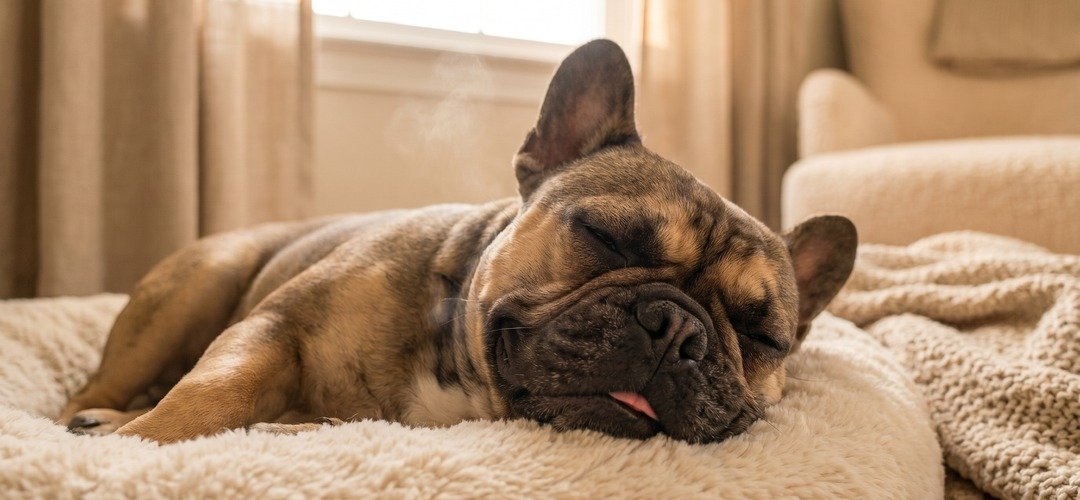
Snoring is the most under-investigated symptom in dog ownership. Owners hear it, smile, post a video, and move on. And most of the time, that's fine — most snoring is harmless. But not all of it. A 2022 survey published in The Veterinary Quarterly found that around 75% of brachycephalic-breed owners believed loud snoring was normal for the breed — when in fact many of those dogs were living with chronic low oxygen levels and a quietly progressive airway disease.
If you've already read our piece on why dogs sleep so much, you know that long, fragmented sleep is normal for dogs. Snoring is the next layer — it's what's happening during all those hours of rest, and it's where small changes in the airway show up first.
So this article is the honest version. The eight most common causes of dog snoring, ranked from "let your dog sleep" to "call the vet today". A 30-second test you can do tonight to know which one you're looking at. The truth about BOAS and dog sleep apnea. And the small adjustments that often make snoring better.
If your dog has snored their entire life and nothing has changed — you'll probably finish this and feel relieved. If something has shifted in the last few months — you'll know what to do next. Either way, you'll never hear that night-time sound the same way again.
How dog snoring actually works
VCA Animal Hospitals defines it cleanly: snoring is the vibration of soft tissues in the upper airway as air passes during breathing. The structures involved — according to The Animal Medical Center of New York — include the tongue, tonsils, soft palate, larynx, and small pouches near the vocal cords called laryngeal saccules.
The principle is simple. Anything that narrows or partially blocks the airway makes those tissues vibrate more, which makes the sound louder. The narrowing can be anatomical (born with it), positional (only when sleeping on the back), inflammatory (allergies, infection, swelling), mechanical (obesity, foreign object, growth), or hormonal (hypothyroidism slowing tissues and adding weight).
That's why the change matters more than the snoring itself. A dog who has always snored softly is telling you about their anatomy. A dog who started snoring three months ago — or whose snoring is steadily getting louder — is telling you about something new.
The 30-second snore test (do this tonight)
Wait until your dog is properly asleep. Then run these seven questions. Yes or no, in your head.
- Has my dog snored since they were a puppy, with no real change? Yes → probably anatomical, monitor only. No, it started in the last 1–3 months → keep going.
- Is the snoring getting louder over time? No, it's the same as ever → reassuring. Yes → investigate.
- Does my dog only snore in one specific position (usually on their back)? Yes → probably positional, low concern. No, in any position → keep going.
- 🚩 Are there silences where my dog seems to stop breathing for 5–10 seconds, then gasps? Yes → possible sleep apnea, see vet.
- 🚩 Does my dog wake up suddenly choking, gasping, or making panicked noises? Yes → vet today.
- 🚩 Are the lips or gums ever bluish or purplish during sleep? Yes → emergency vet now (this is cyanosis).
- 🚩 Is my dog less tolerant of even short walks or play sessions? Yes, especially in a brachycephalic breed → BOAS evaluation needed.
Two or more "yes" on questions 1–3 with no red flags → most likely benign anatomy. Any "yes" on questions 4–7 → book a vet appointment. The test takes 30 seconds; the peace of mind lasts much longer.
The 8 most common causes of dog snoring
These are the causes vets see most often, drawn from Herndon Animal Medical Center, VCA, GoodRx, and SleepApnea.org. The table below gives the urgency level for each.
| # | Cause | Typical signs | Urgency |
|---|---|---|---|
| 1 | Brachycephalic anatomy | Always snored; flat-faced breed; loud breathing awake too | Baseline; monitor for BOAS |
| 2 | Sleeping position (on the back) | Only snores in this position; quiet on side or curled | Harmless |
| 3 | Upper respiratory infection | Recent onset; sneezing, nasal discharge, cough, lethargy | Vet this week |
| 4 | Allergies (seasonal or food) | Paw licking, itchy belly, recurrent ear infections, watery eyes | Vet check |
| 5 | Obesity / weight gain | Snoring worsening with weight; fat around the neck | Weight plan + vet |
| 6 | Dental disease / tooth abscess | Bad breath, dropping food, reluctance to chew, swollen jaw | Vet 1–2 weeks |
| 7 | Hypothyroidism | Dull coat, weight gain, cold intolerance, low energy | Vet (blood test) |
| 8 | Airway obstruction (foreign object, polyp, tumour) | Sudden onset; unilateral; nasal blood or discharge | Urgent vet |
Some of these overlap. An overweight French Bulldog can have causes 1, 5, and 4 all at once — that's a vet conversation, not a guessing game.
1. Brachycephalic anatomy
If your dog is a Pug, French Bulldog, English Bulldog, Boston Terrier, Boxer, Shih Tzu, Pekingese, Lhasa Apso, Cavalier King Charles Spaniel, or a Mastiff — you're in the brachycephalic camp. According to Cornell University's Riney Canine Health Center, these breeds have anatomical variations of the skull that create abnormalities in the upper airway: narrow nostrils (stenotic nares), an elongated soft palate, everted laryngeal saccules, sometimes a narrower windpipe. All of them obstruct airflow. The snoring is the audible result.
This isn't "breed personality". It's structural. And it has consequences — which we'll cover in detail in the BOAS section.
2. Sleeping position
The simplest cause. When a dog sleeps on its back with the head tilted, the tongue can fall toward the throat and partially block the airway. The same thing happens to humans. Snoring stops when the dog rolls onto their side. If this is your situation — your dog snores like a chainsaw on their back but is silent curled up — you can stop worrying. A slightly elevated, bolstered bed often does the trick.
3. Upper respiratory infection
Like in us, a cold or viral infection inflames the nasal passages and increases mucus, narrowing the airway. The give-away is recent onset combined with sneezing, watery or thick nasal discharge, coughing, or general lethargy. Kennel cough is a common culprit. Most cases resolve in 1–2 weeks; a vet visit is warranted if there's no improvement, if there's coloured discharge, or if your dog goes off food.
4. Allergies
Allergens inflame the nasal mucosa and throat. The snoring tends to coincide with other allergy signs: paw licking, itchy belly, red ear canals, watery eyes, and sometimes recurrent ear or skin infections. Seasonal pollen, dust mites, food sensitivities, and even cleaning products can be the trigger. A vet allergy work-up is worthwhile if the pattern is persistent.
5. Obesity
Herndon Veterinary makes this point clearly: weight gain doesn't only sit on the belly. It also accumulates as soft tissue around the neck and throat, narrowing the airway and increasing snoring. Worse, obesity makes existing BOAS dramatically more dangerous — the PMC review notes the link directly. The good news: weight loss is one of the most effective single interventions for reducing snoring, often within weeks. Our dog walking tips guide covers how to build sustainable activity for an overweight dog.
6. Dental disease
Severe dental infection can produce inflammation that spreads into nearby tissues, narrowing the throat and increasing snoring. Bad breath is the early signal; reluctance to eat hard kibble and visible swelling around the jaw come later. Dental disease is also linked to broader systemic health problems, so it's never just an oral issue.
7. Hypothyroidism
An under-active thyroid slows the metabolism, causes weight gain, dulls the coat, lowers energy, and produces a generalised swelling of soft tissues — including those in the throat. Hypothyroidism is one of the more under-diagnosed causes of new-onset snoring in middle-aged and older dogs. A blood panel diagnoses it; once on daily thyroid medication, dogs typically improve dramatically.
8. Airway obstruction
The cause to take most seriously. A foreign object lodged in the nasal cavity, a nasal polyp, or — rarely but importantly — a tumour can all produce sudden, unilateral, often progressive snoring. Warning signs include blood or discoloured discharge from one nostril, sneezing fits, and visible facial swelling. This is a vet visit you don't postpone.
BOAS — when snoring is the tip of the iceberg
If your dog is brachycephalic, this section matters. BOAS — Brachycephalic Obstructive Airway Syndrome — is the cluster of upper-airway abnormalities present from birth in flat-faced breeds. According to Cornell, the components usually include:
- Stenotic nares — abnormally narrow nostrils that may collapse inward when the dog inhales
- Elongated soft palate — a soft palate too long for the mouth, partially blocking the larynx
- Everted laryngeal saccules — tissue near the vocal cords pulled inward during inhalation
- Hypoplastic trachea — a windpipe that is proportionally too narrow
Over time, the constant effort to breathe makes the affected tissues swell, which makes breathing even harder. It's a slow-motion compounding problem.
Here's the part that catches owners off-guard: in the 2022 survey, about three-quarters of brachycephalic dog owners considered loud snoring, snorting, and noisy breathing to be normal for the breed. But the same paper notes that extreme brachycephaly is associated with chronic hypoxia — the same low-oxygen state that affects humans with sleep apnoea. The "lazy" Frenchie who naps all day may not be lazy; they may be tired because they aren't oxygenating properly during sleep.
Red flags for BOAS that need a vet evaluation:
- Loud breathing even at rest, awake
- Quick exhaustion during walks or play (poor exercise tolerance)
- Difficulty breathing in hot or humid weather
- Frequent regurgitation, especially after exercise
- Bluish gums during exertion or sleep
- Episodes of collapse
There's a clinical test — the six-minute walk test — that vets use to grade BOAS severity. And treatment can be transformative. According to Cascade Veterinary Clinics, corrective surgery (widening the nostrils, shortening the soft palate, removing everted saccules) can eliminate or dramatically reduce snoring in most BOAS dogs, plus measurably improve quality of life. Some mild snoring may remain — that's fine — but the dangerous breathing patterns resolve.
If you have a brachycephalic breed and you've never had a BOAS evaluation, that conversation with your vet is worth having before your next hot summer. Combined with our heat walks guide, it can prevent the kind of crisis that ends up in emergency surgery.
Dog sleep apnea — does it really exist?
Yes — and no, it's not common in most dogs.
Canine sleep apnea is almost always obstructive sleep apnea (OSA), the same mechanism as in humans: the airway repeatedly collapses or narrows during sleep, breathing pauses for several seconds, and the dog briefly wakes to gasp. GoodRx and SleepApnea.org both note that the condition is overwhelmingly concentrated in two populations: brachycephalic breeds and obese dogs (especially when both apply).
The classic signs include:
- Breathing pauses of more than 5 seconds during sleep
- Loud gasping or sudden waking, often with a startled expression
- Sleeping in unusual upright or propped positions (the dog is unconsciously trying to keep the airway open)
- Day-time sleepiness disproportionate to age and activity
- Restless sleep, frequent position changes
There is no canine equivalent of the human CPAP machine. Treatment for clinically significant sleep apnea in dogs is, typically, BOAS surgery, aggressive weight loss, or both. If you suspect sleep apnea — particularly in a Frenchie, Bulldog, or Pug — the right next step is a video of the breathing pattern (your phone, in the dark, with sound on) plus a vet visit. The video alone often gets the diagnostic ball rolling immediately.
Other sleep disorders worth knowing about
For completeness — these are much rarer than snoring or BOAS, but worth recognising.
Narcolepsy. Sudden, brief episodes of falling asleep, often triggered by excitement or food. It runs in certain breeds — Labrador Retrievers, Doberman Pinschers, and Poodles — and is linked to problems with hypocretin, a brain chemical that regulates the sleep-wake cycle. Episodes can include muscle collapse (cataplexy). Diagnosed by a vet through observation and ruling out other causes.
Insomnia. Inability to settle and sleep. In dogs, it's almost always secondary to something else: pain (arthritis is the classic), an underlying medical issue causing increased thirst or urination, cognitive dysfunction in senior dogs (canine dementia), or insufficient daytime exercise. Sudden onset insomnia in an adult dog is a vet visit; chronic restlessness in a senior often responds to a combination of medication, environmental adjustments, and a more enriched daytime routine.
REM Sleep Behaviour Disorder. Rare. The dog acts out vivid dreams — running, biting, vocalising — sometimes violently, sometimes injuring themselves. This is distinct from the normal twitching and quiet vocalising of dreaming. If your dog is leaping up, snarling, or appearing to attack while asleep, video it and consult a vet.
When to go to the vet — the 3-tier guide
The most common owner question: "Is this a vet visit, or am I overreacting?" Here's a clean way to decide.
🟢 Mention at next routine visit
- Snoring since puppyhood, with no change
- Only snores when on the back
- Brachycephalic breed, no other symptoms, no exercise intolerance
🟡 Book a vet within 1–2 weeks
- Snoring started recently (within the last 1–3 months)
- Snoring is gradually getting louder
- Mild associated symptoms: occasional sneezing, slight weight gain, more paw licking
- New unexplained tiredness in an adult dog
- Brachycephalic breed never previously evaluated for BOAS
🔴 Vet today / Emergency
- Breathing pauses lasting more than 5 seconds during sleep
- Cyanosis (bluish lips or gums)
- Choking or gasping awake from sleep
- Blood or coloured discharge from one nostril
- Sudden exercise intolerance, especially with collapse
- Persistent cough alongside snoring
- Visible facial swelling
If you're unsure between yellow and red, video the breathing during sleep, take a phone video of any awake breathing noise, and call the vet for guidance. Most veterinary practices will triage over the phone.
How to make snoring better (what actually works)
The right intervention depends on the cause. These are the approaches that produce measurable improvement.
Adjust sleeping position. A bolstered or U-shaped bed encourages side-sleeping rather than back-sleeping. Slightly elevating the head with a small dog-safe pillow or rolled towel can help positional snorers. The improvement, if positional is the cause, is usually obvious within a few nights.
Lose weight (if applicable). Of all the interventions, weight loss has the strongest evidence and the biggest effect on snoring intensity. Even 5–10% body weight loss often reduces snoring noticeably. Work with your vet on a target weight and a feeding plan; pair it with a sustainable exercise rhythm.
Improve the sleeping environment. A humidifier in the bedroom adds moisture to dry air, reducing nasal irritation. Avoid smoking around dogs — second-hand smoke is a well-documented respiratory irritant. Keep the sleeping area free of heavy dust, perfumes, and aerosol sprays. Wash bedding regularly to reduce dust mites.
Treat allergies properly. If the cause is allergic, identifying the trigger (with vet-led testing if necessary) is more effective than masking symptoms. Some dogs benefit from prescription antihistamines or modern allergy treatments — but only on vet recommendation.
Treat dental disease. A proper dental cleaning under anaesthetic, plus daily home dental care, eliminates a common hidden cause of snoring in older dogs.
Treat hypothyroidism. Diagnosed by blood test, treated with daily synthetic thyroid hormone. Many owners notice within weeks that the snoring quietens along with coat regrowth and renewed energy.
Discuss BOAS surgery if relevant. This is the conversation many flat-faced breed owners postpone for years. According to Vetcetera, early correction tends to produce better outcomes than waiting for severe symptoms. If your Frenchie or Bulldog snores loudly, struggles with heat, and tires quickly — the surgery conversation is worth having now, not in five years.
Sleep hygiene basics. A consistent bedtime routine, a quiet dedicated sleeping space, and adequate but not excessive exercise during the day all support better-quality sleep. If your dog is also restless or anxious at night, our stress when I leave guide covers related signs and what to do.
How Smart Dog Care tracks snoring patterns
Most owners describe snoring to their vet from memory — "I think it's been getting worse" — without data. That's the wrong way to discuss a symptom that develops slowly and quietly over months.
Here's where the app helps:
- Health Scan + PHA lets you log snoring as a baseline observation, with intensity scoring, frequency, and triggers (after a hot day, after exercise, only in summer). Over six months you have a real curve, not a guess.
- Behaviour AI correlates fragmented sleep — interrupted by snoring — with day-time signs like low activity, lethargy, or stress markers. If your "lazy" dog is actually sleeping badly, the app spots the link.
- GPS Walks quietly tracks exercise tolerance. A gradual drop in pace, distance, or willingness to walk is one of the earliest signs of progressing BOAS — and it's easy to miss without data.
- Health timeline gives your vet a six-month view to look at, instead of relying on what you can recall in a stressed consultation.
And for the related context — like our safe walking routes guide — pairing route choice with breathing data is exactly how flat-faced breed owners avoid the dangerous summer walk that goes wrong.
Cheat sheet — quick reference
| Signal | Likely normal | Investigate |
|---|---|---|
| Snored since puppy | ✓ | |
| Recent onset (1–3 months) | ✓ | |
| Only on back | ✓ | |
| In any sleeping position | ✓ | |
| Same intensity over years | ✓ | |
| Gradually louder | ✓ | |
| No other symptoms | ✓ | |
| Cough, sneeze, discharge | ✓ | |
| Breathing pauses during sleep | 🚨 Vet today | |
| Bluish gums or lips | 🚨 Emergency | |
| Tires fast in hot weather (brachy) | 🚨 BOAS eval |
FAQs
Is dog snoring normal?
Often yes. Many dogs snore softly throughout life with no underlying problem — usually because of breed anatomy or sleeping position. What matters is the change. New-onset snoring, gradually louder snoring, or snoring accompanied by other signs should be checked by a vet.
Why is my dog snoring all of a sudden?
Sudden snoring most often comes from an upper respiratory infection, seasonal allergies, recent weight gain, or an irritant in the environment. Less commonly but more seriously: a foreign object in the nose, dental infection, hypothyroidism, or in older dogs a nasal mass. If the snoring is new and persistent for more than a couple of weeks, book a vet visit.
Can a dog die from sleep apnea?
Severe untreated obstructive sleep apnea — almost always in dogs with significant BOAS or marked obesity — can be life-threatening, particularly during stressful moments like high heat or anaesthesia. The good news is that the conditions causing it are treatable. The risk is in not knowing it's happening. If you see breathing pauses, a vet evaluation is essential.
Do brachycephalic dogs always snore?
Almost always to some extent, yes. The flatter the face, the more likely. But snoring loudness and consistency tell you about severity — a Frenchie who snores quietly is in much better airway shape than one who can be heard from the next room. The Cambridge BOAS team and many specialist vets use the six-minute walk test to grade severity objectively.
Can I give my dog something to stop snoring?
There is no over-the-counter "anti-snore" product proven to work for dogs, and many human snoring aids are unsafe for them. The right approach is to identify the cause and treat that — weight, allergies, dental issues, hypothyroidism, BOAS — rather than mask the sound.
The bottom line
Most dog snoring is harmless. Some dog snoring isn't. The distinction comes down to four things: how long it's been happening, whether it's getting worse, whether it appears in any position, and whether there are red flags during sleep or by day.
Run the 30-second test tonight. Mentally place your dog into one of the three vet-visit tiers — green, yellow, red. If they're green, sleep easy. If they're yellow, book a non-urgent appointment in the next two weeks. If they're red, don't wait.
And from there, the right tools track the rest. Sleep, breathing, exercise tolerance, and behaviour all leave traces. The earlier you spot a pattern, the more options you and your vet have.
Track the snore, spot the pattern, talk to your vet with data. Smart Dog Care's Health Scan + Behaviour AI turns night-time noise into a six-month timeline — baseline normal, see what changes, and walk into the vet with evidence, not a guess.
Share this article
Continue Reading
How to Find Safe Walking Routes for My Dog (and the 60-Second Pre-Walk Check Nobody Does)
Most dog owners don't choose walking routes. They inherit them. The block they happen to live on, the park their old neighbour mentioned, the corner store loop they did on day one — and then those routes calcify. Three years later the same dog is still walking the same pavement, past the same construction site, around the same off-leash terrier who lives on the corner. That's a problem, because the route isn't neutral. The route shapes how much your dog walks, how stressed they are when they get home, whether their paws come back intact, and whether you actually enjoy the walk or just survive it. Pavement reaches 125°F (52°C) when the air is only 25°C — hot enough to burn paw pads in 60 seconds, according to Mills Animal Hospital . And research published in the International Journal of Environmental Research and Public Health found that owners in less walkable neighbourhoods walk their dogs 55 minutes less per week on-leash. The route, in other words, decides whether the walk even happens. This article is what nobody taught you about choosing where to walk. Five things, specifically: A 60-second pre-walk check you can do every time before opening the door 12 hazards to scan for, organised by season 7 rules of route design — not "what to avoid", but how to build a route that works How to read a route from your dog's eye-level (the part most people miss) How GPS and hazard alerts turn route choice from guesswork into a system Let's start at the doorstep. The 60-second pre-walk check (do this every time) Before you clip the leash, run this mental checklist. It takes less time than putting on your shoes and prevents 90% of the bad outcomes I see. 1. Test the ground. Place the back of your hand flat on the pavement and count seven seconds. If you can't hold it there, your dog can't walk on it. The Royal Kennel Club made this the official rule for a reason — paw pads are skin, not leather, and burns from hot tarmac are one of the most common summer vet emergencies. 2. Check the weather (all of it). Not just temperature. Humidity above 70% triples heat stress because dogs cool through panting and panting evaporates water. Wind chill in winter changes the felt temperature by 5–10°C. And air quality matters: when wildfire smoke or urban smog spikes AQI above 150, brachycephalic dogs (Pugs, Bulldogs, Frenchies) shouldn't go further than the kerb. 3. Pick the time. In summer, that's early — before 9 a.m. — or late, after 7 p.m. In winter, the warmest hour of the day, usually between 12 and 3 p.m. The middle of the day in July is not a walking time; it's a heatstroke window. 4. Decide the goal. Is this a sniff walk (low pace, dog leads, decompression), an exercise walk (steady pace, cardio), or a training walk (focus, recall, loose-leash work)? The goal changes the route. A sniff walk wants tall grass and slow corners; an exercise walk wants a loop with rhythm; a training walk wants a low-distraction zone. 5. Check the dog. Are they bright-eyed, loose-bodied, food motivated? Or are they hiding under the table, off their breakfast, stiff getting up? A dog that doesn't want to walk is telling you something. Listen to it. 6. Equipment audit. Lead — not…
My Dog Has No Dog Friends — Is That a Problem? (Honestly, Probably Not)
You watch other people at the park. Their dogs sprint into the gate, get instantly absorbed into a wagging, sniffing, bouncing pile of fur, and emerge twenty minutes later with what looks like five new best friends. Then there's your dog. Your dog walks the perimeter. Your dog avoids eye contact. Your dog has a polite but firm opinion that other dogs are a thing that exists — not a thing that needs to be hugged. And so you start to wonder. Is something wrong with my dog? Is he lonely? Did I fail him somewhere? Here's the part nobody tells you at the park: most adult dogs are exactly like yours. The social butterflies you see are not the rule. They're the visible minority. The American Kennel Club's own framework on canine sociability puts most adult dogs in the "tolerant" or "selective" zone — not the "loves every dog" end of the spectrum. And a 2026 review in the journal Animals describes urban pet dogs as living in "socially crowded yet relationally sparse worlds" — they meet many dogs but know almost none ( Bonacci et al., 2026 ). What dogs actually need, the science says, isn't more dogs. It's the right dogs. This article will give you: Why "every dog needs lots of dog friends" is a myth — and where it came from The dog selectivity scale, and why your dog probably belongs in the middle Why your dog changed at 12–18 months (you didn't break anything) The honest line where it actually is a problem A 5-minute self-assessment to know if your dog is genuinely fine What to do instead of forcing friendships Let's take the guilt off the table. The myth: "every dog needs lots of dog friends" The idea that a healthy dog should have a wide, rotating cast of canine pals is surprisingly modern. It traces back to two cultural shifts: the explosion of off-leash dog parks in the 1990s and 2000s, and the rise of the doggy daycare industry. Both rest on a simple commercial premise — dogs need socialisation, daycare and parks provide socialisation, therefore daycare and parks make dogs happy. That logic conflates two completely different things: Puppy socialisation — the developmental process of safe exposure to people, dogs, sounds, surfaces, and environments during the first three to four months of life. This is essential. The American Veterinary Society of Animal Behavior calls it "the standard of care" and warns that incomplete socialisation in this window predicts lifelong fear, anxiety, and aggression problems ( AVSAB Position Statement ). Adult canine friendships — what your two-year-old dog does or doesn't do at the park. This is not the same thing. Adult sociability is shaped by genetics, breed, individual temperament, life experiences, and natural social maturation. Some adult dogs love crowds. Most don't. The worst part of the myth is that it actively harms the dogs caught in the middle of it. Dragging a dog-selective adult into a chaotic dog park "to make friends" doesn't build friendships. It builds stress, then avoidance, then sometimes reactivity. Pushing a quiet introvert into daycare so he "isn't lonely" can produce the exact opposite of the calm, confident dog you wanted. Your goal as an owner isn't to manufacture a wide social circle.…
Dog Park Etiquette: 12 Rules Nobody Tells You (and How to Spot a Dangerous Park in 30 Seconds)
In a single year, insurer Nationwide paid out claims for almost 24,000 dogs treated for soft-tissue injuries, with the average head trauma costing owners $591 ( DVM360 ). Most of those injuries didn't happen on dangerous mountain trails. They happened at the local dog park. That stat isn't here to scare you off the park. Dog parks are still one of the best places for a confident, well-socialised dog to burn energy, sniff new things, and read other dogs. But here's the part nobody puts on the welcome sign: a dog park is a self-organising social experiment with no referee, no entrance exam, and no guarantee that the other humans there know what their own dog is doing. This guide is not another "always pick up after your dog" listicle. It's the field manual you wish someone had handed you the first time you stood at the gate, leash in hand, wondering if this was a good idea. You'll get: A 30-second safety scan to run before you even unclip the leash 12 etiquette rules most owners never get told (because they're inconvenient) 7 red flags that mean leave right now, no apology An honest answer to: is the dog park even right for your dog? Let's go. The 30-second safety scan (do this BEFORE you walk in) Stand outside the fence. Don't go in yet. Run this checklist in your head — it takes about half a minute and it will save you a vet bill. Is there a double gate (air lock)? A single gate means the second you open it, every dog inside will rush you and your dog while you're trapped. That's how fights start. How many dogs are inside? Sweet spot is roughly 4 to 8. Above 12 starts to feel like a mosh pit. Three or four loose social groups beats one chaotic mob every time. Are the humans watching, or scrolling? A park full of phone-zombies is a park where the next altercation will go on for 30 seconds before anyone notices. Is one dog being chased by three or more others, with no breaks? That isn't play. That's mobbing. More on this below. Do you see any dog with a high, stiff tail and a forward, frozen body? That's a loaded gun in a furry costume. Is there a separate area for small dogs? If your dog is under 10 kg and there isn't, this might not be your park today. Is the ground clean? Visible poop = nobody's paying attention to the basics, which means nobody's paying attention to the bigger stuff either. Vibe check. Are humans relaxed? Are dogs moving in loose, curving paths and taking breaks to sniff and shake off? Or is it tense and loud? If three or more answers are bad, walk your dog somewhere else. There's no medal for entering a sketchy park. The 12 etiquette rules nobody tells you Some of these are obvious in theory and ignored in practice. A few will be unpopular. All of them are backed either by veterinary consensus, behaviour science, or hard-earned park experience. Before you even leave the house 1. Vaccinated, dewormed, and (ideally) desexed. No exceptions. The American Veterinary Medical Association and the RSPCA both list this as the non-negotiable baseline. Shared water bowls, mouth-on-mouth play, and group sniffing of the same patch of grass make the park an extremely efficient delivery system for kennel cough, parvo, parasites, and…