Dog Park Etiquette: 12 Rules Nobody Tells You (and How to Spot a Dangerous Park in 30 Seconds)
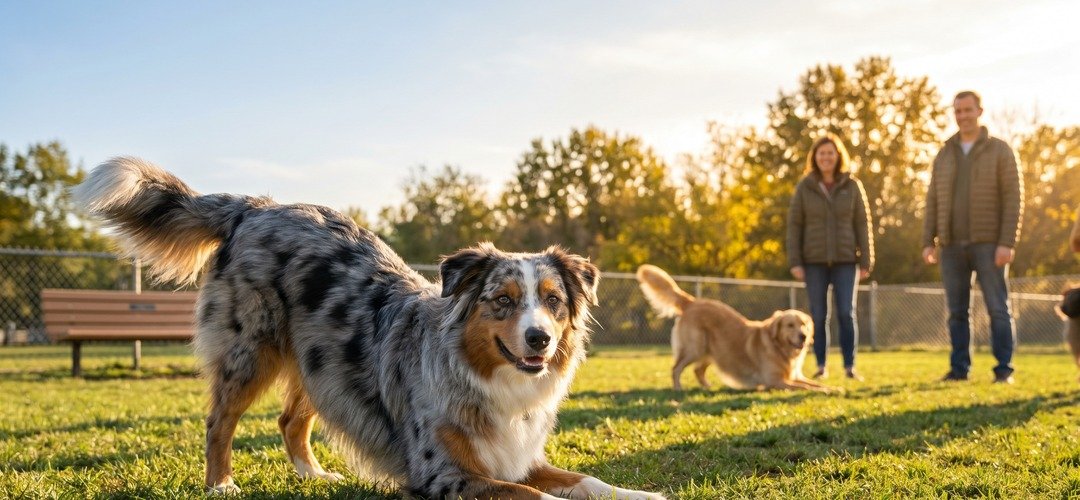
In a single year, insurer Nationwide paid out claims for almost 24,000 dogs treated for soft-tissue injuries, with the average head trauma costing owners $591 (DVM360). Most of those injuries didn't happen on dangerous mountain trails. They happened at the local dog park.
That stat isn't here to scare you off the park. Dog parks are still one of the best places for a confident, well-socialised dog to burn energy, sniff new things, and read other dogs. But here's the part nobody puts on the welcome sign: a dog park is a self-organising social experiment with no referee, no entrance exam, and no guarantee that the other humans there know what their own dog is doing.
This guide is not another "always pick up after your dog" listicle. It's the field manual you wish someone had handed you the first time you stood at the gate, leash in hand, wondering if this was a good idea.
You'll get:
- A 30-second safety scan to run before you even unclip the leash
- 12 etiquette rules most owners never get told (because they're inconvenient)
- 7 red flags that mean leave right now, no apology
- An honest answer to: is the dog park even right for your dog?
Let's go.
The 30-second safety scan (do this BEFORE you walk in)
Stand outside the fence. Don't go in yet. Run this checklist in your head — it takes about half a minute and it will save you a vet bill.
- Is there a double gate (air lock)? A single gate means the second you open it, every dog inside will rush you and your dog while you're trapped. That's how fights start.
- How many dogs are inside? Sweet spot is roughly 4 to 8. Above 12 starts to feel like a mosh pit. Three or four loose social groups beats one chaotic mob every time.
- Are the humans watching, or scrolling? A park full of phone-zombies is a park where the next altercation will go on for 30 seconds before anyone notices.
- Is one dog being chased by three or more others, with no breaks? That isn't play. That's mobbing. More on this below.
- Do you see any dog with a high, stiff tail and a forward, frozen body? That's a loaded gun in a furry costume.
- Is there a separate area for small dogs? If your dog is under 10 kg and there isn't, this might not be your park today.
- Is the ground clean? Visible poop = nobody's paying attention to the basics, which means nobody's paying attention to the bigger stuff either.
- Vibe check. Are humans relaxed? Are dogs moving in loose, curving paths and taking breaks to sniff and shake off? Or is it tense and loud?
If three or more answers are bad, walk your dog somewhere else. There's no medal for entering a sketchy park.
The 12 etiquette rules nobody tells you
Some of these are obvious in theory and ignored in practice. A few will be unpopular. All of them are backed either by veterinary consensus, behaviour science, or hard-earned park experience.
Before you even leave the house
1. Vaccinated, dewormed, and (ideally) desexed. No exceptions.
The American Veterinary Medical Association and the RSPCA both list this as the non-negotiable baseline. Shared water bowls, mouth-on-mouth play, and group sniffing of the same patch of grass make the park an extremely efficient delivery system for kennel cough, parvo, parasites, and giardia. Bringing an unvaccinated puppy or an undesexed dog in heat isn't bold — it's anti-social.
2. If your dog's recall isn't reliable, don't go.
"Reliable recall" doesn't mean your dog comes back when you call from across the kitchen. It means your dog comes back when there's another dog tearing across the field, a squirrel up a tree, and a kid eating a sausage roll on a bench. If you don't have that yet, work on it first (we wrote a whole recall guide for this exact reason). The dog park rewards good recall and punishes bad recall, instantly and publicly.
3. Take the leash off at the gate. Then leave it off.
Leashed dogs inside an off-leash zone create what trainers call "barrier frustration." Your dog can't move freely, can't engage in normal greeting rituals, can't escape — and the off-leash dogs read that as weird. Tension goes up on both ends of the leash. If you don't trust your dog off-leash here, that's a sign to leave, not a sign to compromise.
Once you're inside
4. Eyes on your dog. Not on your phone.
Veterinary teams that see the aftermath of dog park incidents say the same thing every time: "the owner wasn't watching." Central Kentucky Veterinary Center puts it bluntly — eyes on your dog, not on your phone. You don't need to hover. You need to track. Where is your dog? Who are they with? What's their body doing? If you couldn't answer those three questions inside two seconds, you're not watching closely enough.
5. Toys and food stay in the car.
This one is unpopular and absolutely correct. Dogs guard things. Even dogs that don't guard things at home will guard a tennis ball in a park surrounded by twelve other dogs. The single most preventable cause of dog park fights is somebody pulling out a high-value resource — a toy, a treat pouch, a half-eaten sandwich — and watching the room converge.
6. Don't let three or more dogs chase one. Ever.
This is mobbing. It looks like play because it has running and barking and tail movement, but it's a fundamentally different social event. The dog being chased is not having fun. They're trying to escape. If your dog is the chaser, recall them. If your dog is the one being chased, get them out and shorten the visit. Repeated mobbing is how some dogs develop on-leash reactivity — they learn that other dogs mean "I'm about to be ganged up on."
7. Small dogs play with small dogs.
A 4 kg Yorkie and a 35 kg Boxer can be best friends at home. At the park, surrounded by stimulation, with the Boxer in full chase drive, the size mismatch is dangerous. It's called "predatory drift" — when fast movement from a much smaller animal flips a switch in a larger dog. Even friendly dogs can hurt or kill a much smaller one without intending malice. If your park doesn't have a separate small-dog section, go at off-peak hours, or find a different park.
Read what your dog is actually saying
8. Learn the difference between a play bow and a stalk.
A play bow is the universal canine "let's go" — front legs extended, bum in the air, tail loose, mouth open and slightly relaxed. The whole body looks bouncy and a little goofy. A stalk looks similar at a glance — low body, focused — but the tail is rigid, the eyes are locked, the mouth is closed, and there's no bounce. One is an invitation. The other is a warning.
9. Lip-licks, yawns, head turns, and "whale eye" all mean the same thing: stress.
Dogs have a whole vocabulary of subtle signals long before they ever growl or snap. Best Friends Animal Society lists these "displacement behaviours" clearly: yawning when not tired, lip-licking when no food is around, lifting a paw, turning the head away, scratching when not itchy, shaking off after an interaction. A 2024 review in the International Journal of Research and Innovation in Applied Science synthesised the same picture: ear posture, tail movement, and posture micro-shifts are reliable indicators of stress and arousal.
If you only learn one thing from this article, learn this: a dog showing four or more of those signs in a minute is asking for help. Not later — now.
How and when you leave
10. Leave before your dog falls apart.
Twenty to thirty minutes is plenty for most dogs. The longer the visit, the more arousal stacks, and the worse decisions both your dog and other dogs start making. Leave on a high note. A short, successful visit is worth ten chaotic ones.
11. If something bad just happened, don't bolt for the gate.
If there was a scuffle, a scary chase, or your dog got snapped at, take one calm lap of the perimeter on a loose leash before leaving. Otherwise your dog learns a brutal little equation: "fight = leave." Suddenly your dog has a reason to start fights at every park. A calm decompression walk reframes the experience.
12. Pick it up. Always.
Not just because it's polite. A 2017 review in the Journal of Community Health connected unmanaged dog faeces in public spaces to slips, falls, and the spread of zoonotic agents — meaning bugs that move from dogs to humans. Bring two bags. One for your dog, one for the dog whose owner "forgot."
The 7 red flags that mean "leave now"
Some situations don't need a discussion. If you see any of the following, leash up and walk out without apologising to anyone.
- A dog being chased by a group with no break in the action. Not play. Mobbing.
- Two dogs in a face-to-face freeze, bodies stiff, mouths shut. They are seconds away from contact. Interrupt with a clap, a body block, or a loud voice — then leave.
- An owner saying "he's fine, he's just playing" while another dog is yelping or showing whale eye. That owner isn't reading their dog. You can't fix that. You can leave.
- Hackles up + high stiff tail + closed mouth. Hackles alone aren't always aggression, but combined with tail and mouth posture, this is a loaded warning.
- Someone pulling out a ball, a chuck-it, or treats and a group converging on it. Walk away from the resource immediately, recall your dog, decide whether to stay.
- Hot weather and zero shade. Heatstroke is fast and fatal. We covered this in how hot is too hot to walk your dog — same logic applies double at the park, where dogs run harder than they should.
- Your own dog seeking you out, hiding behind your legs, or moving toward the gate. Listen to them. They're telling you something. Leave.
When the dog park is NOT for your dog
This is the section every other article skips, and it's the most important one.
The dog park is genuinely fantastic for some dogs. It's actively harmful for others. The Association of Professional Dog Trainers has been clear about this for years — dog parks can amplify fear, frustration, and reactivity in dogs that aren't suited for them (Dog Parks: the Good, the Bad, and the Ugly). Behaviour scientist Marc Bekoff makes the same point in Psychology Today: dog parks are not universal goods, and the dogs who do best there are a self-selecting subset (Dog Park Dilemmas).
Your dog probably shouldn't be at the park if any of these apply:
- They're already reactive on leash. The park will make it worse. Work on the underlying behaviour first — we wrote about this in how to train a reactive dog on walks.
- They're a puppy under 16 weeks — or before they've completed their core vaccine series. Read your vet, not the internet.
- They're a senior dog with arthritis, sensory decline, or low patience for being bumped into.
- They're recovering from surgery, illness, or a recent injury.
- They're a flat-faced (brachycephalic) breed on a warm day. Bulldogs, Pugs, French Bulldogs, and Boston Terriers overheat fast and can't pant their way out of trouble.
- They've recently been in a fight. Give them weeks, not days.
- They simply don't enjoy it. Some dogs are introverts. That's allowed.
If any of those describe your dog, you haven't failed at dog parenting. You've upgraded. Now you need different tools.
Building real dog community without the park
The dog park is one tool. It's not the only one — and for many dogs, it's not even the best one. Here's what dog social life can also look like:
- Curated playdates with one or two compatible dogs. Calm, structured, the same friends each week. This is what most behaviourists actually recommend over open parks.
- Pack walks or walking groups. Parallel walking with other dogs is a much more natural form of socialising than the chaos of an open enclosure. Look on Meetup, local Facebook groups, or in your neighbourhood.
- Local breed clubs. Even if you have no interest in showing your dog, breed clubs are full of people who understand exactly what your specific dog needs — and they organise socials, walks, and meetups.
- Training classes. Group reward-based classes are how the American Veterinary Society of Animal Behavior recommends socialising dogs in a controlled environment.
- Apps that filter by temperament. Random meetups don't work for every dog. Curated ones do.
Smart Dog Care's Community feed is built around this idea: real dog friendships, not random chaos. You can find vetted playdate partners with compatible temperament, energy level, and play style — and skip the lottery of the open park entirely.
Quick reference: the cheat sheet
| Stage | What to do |
|---|---|
| Before entering | 30-second scan. Vaccinated. Recall solid. Leash on at the car, off at the gate. |
| Inside | Eyes on dog. No toys. No food. Move around. Don't camp on a bench. |
| Reading the room | Play bow = good. Stalk = bad. 4+ stress signals/minute = leave. |
| Leaving | 20–30 min max. Calm lap before exit if anything bad happened. Pick up. |
| Red flags | Mobbing. Freeze. Resource convergence. Heat. Your dog asking to leave. |
FAQs
At what age can my puppy start going to the dog park?
Most veterinarians recommend waiting until at least two weeks after the final puppy vaccine in the core series — usually around 16 weeks, though it varies by region and protocol. Before then, your puppy's immune system is still developing and exposure to other dogs' faeces and saliva is genuinely risky. The first three months are the critical socialisation window (AVSAB Position Statement) — but you can do that safely through puppy classes, controlled playdates with vaccinated dogs, and exposure walks. The open dog park is for later.
My dog seems shy at the park. What should I do?
Don't push. A dog who hides behind your legs, stays glued to the fence, or refuses to engage is telling you the environment is too much. Leash up, leave, and try a calmer setting — one playmate, a quieter time of day, or a different park entirely. Forcing a shy dog into the chaos doesn't build confidence. It builds avoidance.
How long should a dog park visit last?
Twenty to thirty minutes is plenty for most dogs. Arousal stacks the longer they stay, and tired dogs make worse social decisions. Leave on a high note.
What do I do if my dog is attacked?
Don't grab collars — you'll get bitten. Use a barrier (a jacket, a backpack, a chair) to separate the dogs. If you can lift the rear legs of the attacking dog and pull it back, do it. Get clear, then check your dog for puncture wounds — even small ones can cause deep damage and need same-day veterinary attention. Document everything: photos, the other owner's contact info, witnesses. Report to park management and animal control.
Can I bring my dog in heat?
No. Beyond the obvious risk of unplanned mating, a female in heat in an open park changes the entire social dynamic and dramatically raises the chance of fights between males. Skip the park for the cycle.
The bottom line
The dog park isn't dangerous because it's a dog park. It's dangerous when nobody's reading the room. With the 30-second scan, the 12 rules, and the 7 red flags, you're now reading it better than 80% of the people standing around you.
But here's the honest truth: even the best human eye misses things. Dogs throw stress signals in fractions of a second, and the early ones — the lip-lick, the head turn, the soft yawn — are exactly the ones we miss because we're looking for the dramatic ones.
Body language is a language. The app speaks it fluently.
Smart Dog Care's Behaviour AI watches video of your dog at the park and tells you exactly when arousal is climbing — before it tips into trouble. And the Community feed helps you skip the lottery of the open park entirely, with vetted playdate partners matched on temperament and play style.
Share this article
Continue Reading

Why Does My Dog Snore? (When It's Normal vs When It's a Problem)
Snoring is the most under-investigated symptom in dog ownership. Owners hear it, smile, post a video, and move on. And most of the time, that's fine — most snoring is harmless. But not all of it. A 2022 survey published in The Veterinary Quarterly found that around 75% of brachycephalic-breed owners believed loud snoring was normal for the breed — when in fact many of those dogs were living with chronic low oxygen levels and a quietly progressive airway disease. If you've already read our piece on why dogs sleep so much , you know that long, fragmented sleep is normal for dogs. Snoring is the next layer — it's what's happening during all those hours of rest, and it's where small changes in the airway show up first. So this article is the honest version. The eight most common causes of dog snoring, ranked from "let your dog sleep" to "call the vet today". A 30-second test you can do tonight to know which one you're looking at. The truth about BOAS and dog sleep apnea. And the small adjustments that often make snoring better. If your dog has snored their entire life and nothing has changed — you'll probably finish this and feel relieved. If something has shifted in the last few months — you'll know what to do next. Either way, you'll never hear that night-time sound the same way again. How dog snoring actually works VCA Animal Hospitals defines it cleanly: snoring is the vibration of soft tissues in the upper airway as air passes during breathing. The structures involved — according to The Animal Medical Center of New York — include the tongue, tonsils, soft palate, larynx, and small pouches near the vocal cords called laryngeal saccules. The principle is simple. Anything that narrows or partially blocks the airway makes those tissues vibrate more, which makes the sound louder. The narrowing can be anatomical (born with it), positional (only when sleeping on the back), inflammatory (allergies, infection, swelling), mechanical (obesity, foreign object, growth), or hormonal (hypothyroidism slowing tissues and adding weight). That's why the change matters more than the snoring itself. A dog who has always snored softly is telling you about their anatomy. A dog who started snoring three months ago — or whose snoring is steadily getting louder — is telling you about something new. The 30-second snore test (do this tonight) Wait until your dog is properly asleep. Then run these seven questions. Yes or no, in your head. Has my dog snored since they were a puppy, with no real change? Yes → probably anatomical, monitor only. No, it started in the last 1–3 months → keep going. Is the snoring getting louder over time? No, it's the same as ever → reassuring. Yes → investigate. Does my dog only snore in one specific position (usually on their back)? Yes → probably positional, low concern. No, in any position → keep going. 🚩 Are there silences where my dog seems to stop breathing for 5–10 seconds, then gasps? Yes → possible sleep apnea, see vet. 🚩 Does my dog wake up suddenly choking, gasping, or making panicked noises? Yes → vet today. 🚩 Are the lips or gums ever bluish or purplish during sleep? Yes → emergency vet now (this is cyanosis). 🚩 Is my dog…

How to Find Safe Walking Routes for My Dog (and the 60-Second Pre-Walk Check Nobody Does)
Most dog owners don't choose walking routes. They inherit them. The block they happen to live on, the park their old neighbour mentioned, the corner store loop they did on day one — and then those routes calcify. Three years later the same dog is still walking the same pavement, past the same construction site, around the same off-leash terrier who lives on the corner. That's a problem, because the route isn't neutral. The route shapes how much your dog walks, how stressed they are when they get home, whether their paws come back intact, and whether you actually enjoy the walk or just survive it. Pavement reaches 125°F (52°C) when the air is only 25°C — hot enough to burn paw pads in 60 seconds, according to Mills Animal Hospital . And research published in the International Journal of Environmental Research and Public Health found that owners in less walkable neighbourhoods walk their dogs 55 minutes less per week on-leash. The route, in other words, decides whether the walk even happens. This article is what nobody taught you about choosing where to walk. Five things, specifically: A 60-second pre-walk check you can do every time before opening the door 12 hazards to scan for, organised by season 7 rules of route design — not "what to avoid", but how to build a route that works How to read a route from your dog's eye-level (the part most people miss) How GPS and hazard alerts turn route choice from guesswork into a system Let's start at the doorstep. The 60-second pre-walk check (do this every time) Before you clip the leash, run this mental checklist. It takes less time than putting on your shoes and prevents 90% of the bad outcomes I see. 1. Test the ground. Place the back of your hand flat on the pavement and count seven seconds. If you can't hold it there, your dog can't walk on it. The Royal Kennel Club made this the official rule for a reason — paw pads are skin, not leather, and burns from hot tarmac are one of the most common summer vet emergencies. 2. Check the weather (all of it). Not just temperature. Humidity above 70% triples heat stress because dogs cool through panting and panting evaporates water. Wind chill in winter changes the felt temperature by 5–10°C. And air quality matters: when wildfire smoke or urban smog spikes AQI above 150, brachycephalic dogs (Pugs, Bulldogs, Frenchies) shouldn't go further than the kerb. 3. Pick the time. In summer, that's early — before 9 a.m. — or late, after 7 p.m. In winter, the warmest hour of the day, usually between 12 and 3 p.m. The middle of the day in July is not a walking time; it's a heatstroke window. 4. Decide the goal. Is this a sniff walk (low pace, dog leads, decompression), an exercise walk (steady pace, cardio), or a training walk (focus, recall, loose-leash work)? The goal changes the route. A sniff walk wants tall grass and slow corners; an exercise walk wants a loop with rhythm; a training walk wants a low-distraction zone. 5. Check the dog. Are they bright-eyed, loose-bodied, food motivated? Or are they hiding under the table, off their breakfast, stiff getting up? A dog that doesn't want to walk is telling you something. Listen to it. 6. Equipment audit. Lead — not…
My Dog Has No Dog Friends — Is That a Problem? (Honestly, Probably Not)
You watch other people at the park. Their dogs sprint into the gate, get instantly absorbed into a wagging, sniffing, bouncing pile of fur, and emerge twenty minutes later with what looks like five new best friends. Then there's your dog. Your dog walks the perimeter. Your dog avoids eye contact. Your dog has a polite but firm opinion that other dogs are a thing that exists — not a thing that needs to be hugged. And so you start to wonder. Is something wrong with my dog? Is he lonely? Did I fail him somewhere? Here's the part nobody tells you at the park: most adult dogs are exactly like yours. The social butterflies you see are not the rule. They're the visible minority. The American Kennel Club's own framework on canine sociability puts most adult dogs in the "tolerant" or "selective" zone — not the "loves every dog" end of the spectrum. And a 2026 review in the journal Animals describes urban pet dogs as living in "socially crowded yet relationally sparse worlds" — they meet many dogs but know almost none ( Bonacci et al., 2026 ). What dogs actually need, the science says, isn't more dogs. It's the right dogs. This article will give you: Why "every dog needs lots of dog friends" is a myth — and where it came from The dog selectivity scale, and why your dog probably belongs in the middle Why your dog changed at 12–18 months (you didn't break anything) The honest line where it actually is a problem A 5-minute self-assessment to know if your dog is genuinely fine What to do instead of forcing friendships Let's take the guilt off the table. The myth: "every dog needs lots of dog friends" The idea that a healthy dog should have a wide, rotating cast of canine pals is surprisingly modern. It traces back to two cultural shifts: the explosion of off-leash dog parks in the 1990s and 2000s, and the rise of the doggy daycare industry. Both rest on a simple commercial premise — dogs need socialisation, daycare and parks provide socialisation, therefore daycare and parks make dogs happy. That logic conflates two completely different things: Puppy socialisation — the developmental process of safe exposure to people, dogs, sounds, surfaces, and environments during the first three to four months of life. This is essential. The American Veterinary Society of Animal Behavior calls it "the standard of care" and warns that incomplete socialisation in this window predicts lifelong fear, anxiety, and aggression problems ( AVSAB Position Statement ). Adult canine friendships — what your two-year-old dog does or doesn't do at the park. This is not the same thing. Adult sociability is shaped by genetics, breed, individual temperament, life experiences, and natural social maturation. Some adult dogs love crowds. Most don't. The worst part of the myth is that it actively harms the dogs caught in the middle of it. Dragging a dog-selective adult into a chaotic dog park "to make friends" doesn't build friendships. It builds stress, then avoidance, then sometimes reactivity. Pushing a quiet introvert into daycare so he "isn't lonely" can produce the exact opposite of the calm, confident dog you wanted. Your goal as an owner isn't to manufacture a wide social circle.…