How to Stop Your Puppy Pulling on the Leash
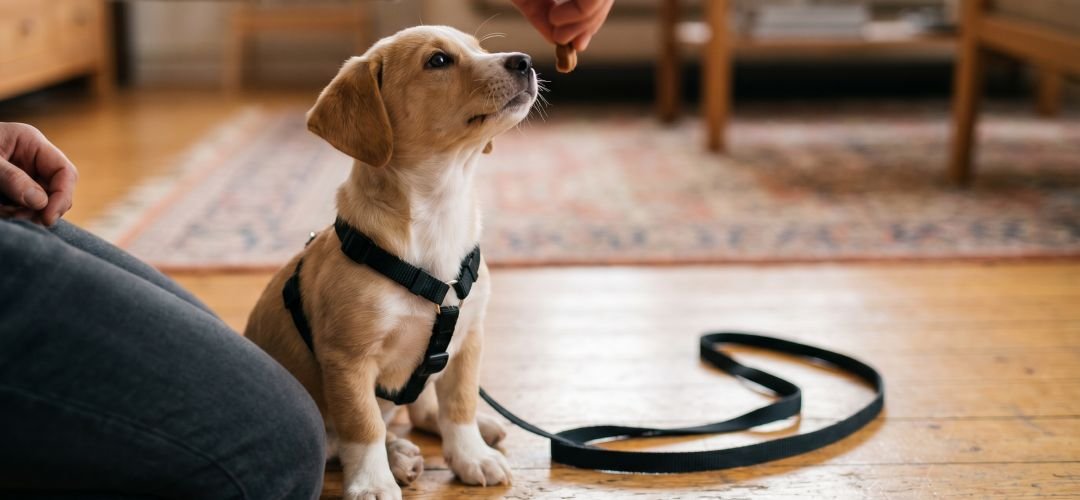
Most puppies don't pull because they are stubborn, dominant, or "testing you". They pull because they are puppies, the world is full of incredible smells, and their walking speed is faster than yours. Pulling works — it gets them to the lamppost, the dog across the road, the leaf they desperately need to investigate — and behaviour that works gets repeated.
The good news: two weeks is enough. Not to produce a dog who heels like a Crufts finalist, but enough to flip the basic equation in your puppy's head from "pulling = forward" to "a loose leash = forward". That is the only thing you actually need to teach. Everything else is polish.
This plan is built on what reward-based trainers and modern behaviour science actually agree on, condensed into 10-minute sessions you can do twice a day. No prong collars, no leash pops, no "balanced" methods that promise results in one walk. The American Veterinary Society of Animal Behavior position statement is unambiguous on this: reward-based methods are at least as effective as aversive ones and produce no welfare cost. Your puppy doesn't need to be punished. They need to be taught.
Why Puppies Pull — The Three Things Working Against You
Before the plan, the diagnosis. Pulling is rarely a single behaviour with a single cause. It is the predictable result of three forces stacking up.
1. Pulling has been reinforced — every single time. Behaviour analysts call this the central problem. As Kiki Yablon writes, when you attach a curious puppy to a 6-foot rope and march them down a sidewalk 8–10 feet from everything they find interesting, "we are setting them up to learn to pull. We tempt them with treasure just out of reach, and then when they hit the end of the leash, they learn that a little extra oomph will get them closer." Every successful pull is a training rep — for the wrong behaviour.
2. Opposition reflex is doing half the work. The moment a leash goes tight, most dogs instinctively brace and lean into the pressure. This is called the opposition reflex, and it is involuntary. If you pull back, your puppy pulls forward harder — not out of defiance, but because their nervous system is wired that way. The implication is uncomfortable for handlers: a constantly tight leash creates more pulling, not less.
3. Their walking speed is faster than yours. Even small breeds trot faster than humans saunter, and adolescent puppies are running on a brain full of dopamine and a body that just wants to move. The AKC notes that mismatched pace is one of the most under-recognised causes of pulling. If your walks feel like dragging a kite, part of the answer is to walk faster.
The plan below addresses all three: it teaches your puppy that loose-leash behaviour earns forward progress, it eliminates leash tension as the default state, and it asks you to set a brisker pace from day one.
Equipment — Get These Three Things Right
You can't out-train bad equipment. Before Day 1, set yourself up properly.
- A flat collar or, better, a Y-shaped harness with both a back clip and a front clip. Front-clip harnesses (Easy Walk, Freedom No-Pull, Perfect Fit) gently redirect a pulling puppy back toward you and, according to the San Diego Humane Society, can reduce pulling on their own by up to 98% — though the remaining 2% still has to be taught.
- A 1.8 m to 3 m flat leash. No retractables. A retractable leash is taut almost continuously by design and trains the exact reflex you are trying to undo.
- Tiny, soft, high-value treats. Small cubes of cheese, hot-dog slices, freeze-dried liver, or boiled chicken — pea-sized so your puppy can swallow them in one second and keep moving. Boring kibble will not compete with the smell of another dog. Use the dog's regular meal kibble at home and bring out the good stuff for outside.
The 2-Week Plan at a Glance
Two sessions per day, 5–10 minutes each. Indoors or in your garden first, the street second, the busy street third — in that order, never out of order. Skip ahead and you will undo the previous day's work.
| Day | Where | Focus |
|---|---|---|
| 1–2 | Living room | Charging the marker + name response |
| 3–4 | Living room / hallway | Pay-the-position (the "magnet" game) |
| 5–7 | Garden or quiet front yard | Red Light / Green Light |
| 8–10 | Quiet street, off-peak | Real walks, slow and short |
| 11–14 | Normal walking route | Adding distractions, generalising |
That is the entire plan. What changes day to day is the environment, not the criteria. The behaviour your puppy is learning — "stay near me on a slack leash; that's how forward happens" — is the same on day 1 and day 14.
Days 1–2: Charge the Marker and the Name
No leash yet. Inside, you are building two things your puppy will need on the street.
The marker word. Pick a short word — "yes" works, or a clicker if you prefer. The rule: marker word → treat, every time, no exceptions, for the rest of your puppy's life. Do 15 reps in a row, twice. Marker, treat. Marker, treat. After 30 reps your puppy's head will whip toward you the instant you say it. That is the bridge you will use to mark good leash decisions later, when treats can't be delivered fast enough to catch the moment.
The name check-in. Say your puppy's name. The half-second they look at you — marker, treat. Repeat 20 times a day in short bursts, in different rooms. You are not asking for sustained attention; you are buying yourself a one-second look, which is all you need to redirect a puppy on a walk.
If you skip these two days, the rest of the plan will work, but slower. The marker is the most important word in modern reward-based training and the single highest-leverage thing you can do in a 10-minute session.
Days 3–4: The Magnet Game (Pay-the-Position)
Still indoors. Leash optional.
Stand still. Whenever your puppy is on the side you want them to walk on (typically your left), within a leg-length of you — marker, treat delivered at your knee. Say nothing else. Don't lure. Just wait, mark, and pay when they happen to be in position.
Within a few minutes most puppies start orbiting around you, parking themselves at your knee, looking up. That is the position you want on every walk. You are paying them for being there, not for following a cue. Trainers call this "loading the reinforcement zone" — making the area beside your leg the most rewarding square metre in your puppy's world.
Now add one step forward. If they follow into position — marker, treat at your knee. Two steps. Three. By the end of day 4 you should be able to take 5–10 steps in a slow indoor circle with a puppy glued to your leg. No commands. No leash tension. Just a puppy who has decided that your knee is where the food lives.
Inside the Smart Dog Care app, the AI Training Plans break this exact protocol into daily 10-minute drills personalised to your puppy's breed and age — and the AI Video Behaviour Analysis lets you upload a 30-second clip to check whether your puppy is heading into position from frustration or focus. Get the breed-specific plan →
Days 5–7: Red Light / Green Light, Outside
Move to a quiet, low-distraction outdoor space — your garden, an empty parking lot, the quietest end of your street at the quietest hour. Leash on.
The game, as taught by the San Francisco SPCA, is brutally simple:
- Start walking.
- The instant the leash goes tight — stop. Plant your feet. Don't yank, don't speak.
- Wait. Your puppy will eventually look back at you, take a half-step toward you, or simply stop pulling out of confusion. The leash will go slack.
- The instant the leash is slack — marker, treat at your knee, and walk on.
- Repeat. For the entire walk. Every single time.
The first 5-minute session can take 20 minutes to cover 50 metres. This is normal. You are not on a walk; you are running a training protocol that happens to be moving forward sometimes. By session three or four most puppies stop pulling within a step or two, because the consequence is consistent: pulling stops the walk, slack restarts it. As Best Friends Animal Society bluntly puts it: "if you stop when your dog pulls four out of five times, they'll learn that pulling can still result in the intended reward."
Two non-obvious tips that make a disproportionate difference:
- Walk faster than feels natural. A dog at full puppy energy on a slow human pace will pull. Lengthen your stride.
- Pre-empt the sniff. If you see a fire hydrant 5 metres ahead and you can already see your puppy lock onto it — say a release word ("go sniff") before the leash tightens, and let them have it. The sniff becomes a reward you delivered, not a victory they pulled out of you.
Days 8–10: Real Walks, Short and Boring
Move to your normal walking route, but at the quietest hour and for half your usual distance. The criterion is unchanged: tight leash = stop, slack leash = forward, marker + treat at the knee for any voluntary check-in.
Three things will happen this week and you should expect all of them.
1. You will get worse before you get better. New environment, new smells, more dogs, more distractions. Your puppy may pull more on day 8 than they did on day 7. This is generalisation failure, not regression — they learned the rule in the garden, not in the street, and now they are re-learning it under harder conditions. Stay consistent for two days and the curve flips.
2. You will be tempted to "just get the walk over with" once. Don't. Single inconsistent reps are how reward-based plans fail. If you give in and let your puppy drag you the last 100 metres home because you're late for work, you have just rewarded pulling on a high-value, real-world variable schedule — the most durable kind of reinforcement learning. One gave-in walk costs you about three days.
3. You will start adding "life rewards". As soon as your puppy is offering 80%+ loose-leash walking, swap out some treats for the AKC's recommended life rewards: "Walk 10 steps without pulling → release to sniff for 30 seconds." Sniffing, greeting, exploring — these are what your puppy actually wants. Use them.
Days 11–14: Generalise and Proof
By day 11 your puppy understands the contract. The remaining work is generalisation — making the behaviour reliable across distractions and contexts that haven't been trained yet.
Add one variable per session, never two:
- A new street.
- A walk during the post-school dog rush.
- Walking past a cat, a child, a runner.
- A different family member holding the leash.
- The same route in the rain.
If your puppy fails — meaning they pull and don't recover within 2–3 reps of the red-light/green-light routine — that environment is too hard for the current skill level. Step back. Do tomorrow's session in a simpler place. You haven't lost progress; you've just discovered the edge of where the behaviour is reliable.
By day 14, expectations matter. A 2-week plan, run honestly, will give you:
- Reliable loose-leash walking on familiar, low-to-moderate distraction routes.
- A puppy who self-corrects within a second of leash tension, most of the time.
- A name response that works at 5 metres of distraction.
It will not give you bombproof heeling past an off-leash dog at 1 metre. That is months of work, and it should be — your puppy's brain is still building the impulse-control circuitry that makes high-distraction work possible.
What Not to Do — Even Once
A short list of things that look like progress and are not:
- Leash pops, jerks, or "stop-and-pop" corrections. They suppress pulling in the moment and create opposition reflex plus a rising association between the leash, the trigger, and discomfort. The AVSAB position statement is direct: aversive methods are not more effective than reward-based methods and carry welfare costs.
- Prong, choke, or e-collars on a puppy. Setting aside ethics, the evidence on long-term outcomes is unfavourable: surveyed dogs trained with aversive tools score higher on aggression and anxiety scales than dogs trained with rewards.
- Yelling "no" when the leash tightens. The leash tightening is already information. Adding a verbal punisher does nothing your stopping doesn't already do, and it pollutes the walk with a bad mood.
- Skipping ahead. A puppy who can do red-light/green-light in the garden cannot necessarily do it on the high street, and neither version transfers to the dog park. Train the environment, not just the dog.
When 2 Weeks Won't Be Enough
This plan assumes a typical 8–18-week-old puppy with no specific behavioural issues. The timeline stretches if any of the following are in play:
- Adolescent dog (6–18 months). Add a week. Adolescents pull harder, have shorter attention spans, and are simultaneously fighting hormones. The protocol still works; it just takes 3–4 weeks instead of 2.
- Reactivity on the lead — barking, lunging at other dogs, joggers, bikes. Loose-leash walking cannot be trained while a dog is over threshold. Read our reactive-dog plan and resolve the reactivity first; pulling is a downstream symptom, not the cause.
- Pain or orthopaedic issues — sudden pulling, lunging, or refusing to walk in a previously polite dog can signal hip, elbow, or back pain. Vet visit before behaviour plan.
How Smart Dog Care Helps
Two-week plans live or die on consistency, and consistency is the part most owners struggle with — not because they don't care, but because it's hard to remember which session is next and whether yesterday went well.
Smart Dog Care's AI Training Plans generate a daily 10-minute drill calibrated to your puppy's breed, age, and current pulling pattern. The plan adjusts automatically: if you log a setback session, tomorrow's drill steps back; if you log three clean sessions in a row, tomorrow adds one variable. Less guessing, more progress.
The AI Video Behaviour Analysis lets you upload a 30-second clip from any walk and reads the body language a human eye can miss in real time — leash tension, head position, where your puppy is looking, micro-stress signals. Useful when day 9 isn't going well and you can't tell whether your puppy is overstimulated, frustrated, or just under-trained for that street.
Core training plans are free. The Pro AI plan unlocks unlimited video analysis and the Pet Health Assistant 24/7. See features →
FAQ
1. Can I start this plan with an 8-week-old puppy? Yes. The protocol is age-appropriate from the moment a puppy is comfortable wearing a collar or harness — typically 8 weeks. Keep sessions to 3–5 minutes (not 10) and expect the timeline to stretch slightly.
2. My puppy refuses to walk at all and just sits down — is that pulling? No, and this plan is not what you need. A puppy who plants and refuses is showing fear, overstimulation, or under-confidence with the equipment. Spend a week pairing the harness/leash with high-value treats indoors, then very short, choice-led garden sessions, before any walk-training plan.
3. Should I use a head halter (Halti, Gentle Leader)? For some puppies, yes — especially large breeds whose owner can't physically stop a pull. They reduce pulling immediately while you train. Two caveats: introduce them slowly with food pairing over several days; and never let your puppy hit the end of the leash hard while wearing one, because the design pivots their head sideways.
4. What if my puppy is fine until they see another dog, then loses it? That is reactivity, not pulling. The red-light/green-light protocol won't work over threshold. Read our reactive-dog guide — distance and threshold come first; loose-leash walking layers on once the dog can think near triggers.
5. How do I keep the loose-leash habit after the 2 weeks? Two rules. First, never reward pulling — meaning never let a tight leash result in forward movement, ever, for the rest of the dog's life. Second, keep paying. Treats can fade to once every 5–10 minutes on familiar routes, but they should never disappear entirely; loose-leash walking is a behaviour you maintain, not a milestone you tick off.
Smart Dog Care content is reviewed by certified canine behaviourists and is intended to support, not replace, hands-on professional advice. If your puppy's pulling is paired with reactivity, fear, or pain, please consult a force-free trainer or your veterinarian.
Share this article
Continue Reading
Why Does My Dog Snore? (When It's Normal vs When It's a Problem)
Snoring is the most under-investigated symptom in dog ownership. Owners hear it, smile, post a video, and move on. And most of the time, that's fine — most snoring is harmless. But not all of it. A 2022 survey published in The Veterinary Quarterly found that around 75% of brachycephalic-breed owners believed loud snoring was normal for the breed — when in fact many of those dogs were living with chronic low oxygen levels and a quietly progressive airway disease. If you've already read our piece on why dogs sleep so much , you know that long, fragmented sleep is normal for dogs. Snoring is the next layer — it's what's happening during all those hours of rest, and it's where small changes in the airway show up first. So this article is the honest version. The eight most common causes of dog snoring, ranked from "let your dog sleep" to "call the vet today". A 30-second test you can do tonight to know which one you're looking at. The truth about BOAS and dog sleep apnea. And the small adjustments that often make snoring better. If your dog has snored their entire life and nothing has changed — you'll probably finish this and feel relieved. If something has shifted in the last few months — you'll know what to do next. Either way, you'll never hear that night-time sound the same way again. How dog snoring actually works VCA Animal Hospitals defines it cleanly: snoring is the vibration of soft tissues in the upper airway as air passes during breathing. The structures involved — according to The Animal Medical Center of New York — include the tongue, tonsils, soft palate, larynx, and small pouches near the vocal cords called laryngeal saccules. The principle is simple. Anything that narrows or partially blocks the airway makes those tissues vibrate more, which makes the sound louder. The narrowing can be anatomical (born with it), positional (only when sleeping on the back), inflammatory (allergies, infection, swelling), mechanical (obesity, foreign object, growth), or hormonal (hypothyroidism slowing tissues and adding weight). That's why the change matters more than the snoring itself. A dog who has always snored softly is telling you about their anatomy. A dog who started snoring three months ago — or whose snoring is steadily getting louder — is telling you about something new. The 30-second snore test (do this tonight) Wait until your dog is properly asleep. Then run these seven questions. Yes or no, in your head. Has my dog snored since they were a puppy, with no real change? Yes → probably anatomical, monitor only. No, it started in the last 1–3 months → keep going. Is the snoring getting louder over time? No, it's the same as ever → reassuring. Yes → investigate. Does my dog only snore in one specific position (usually on their back)? Yes → probably positional, low concern. No, in any position → keep going. 🚩 Are there silences where my dog seems to stop breathing for 5–10 seconds, then gasps? Yes → possible sleep apnea, see vet. 🚩 Does my dog wake up suddenly choking, gasping, or making panicked noises? Yes → vet today. 🚩 Are the lips or gums ever bluish or purplish during sleep? Yes → emergency vet now (this is cyanosis). 🚩 Is my dog…
How to Find Safe Walking Routes for My Dog (and the 60-Second Pre-Walk Check Nobody Does)
Most dog owners don't choose walking routes. They inherit them. The block they happen to live on, the park their old neighbour mentioned, the corner store loop they did on day one — and then those routes calcify. Three years later the same dog is still walking the same pavement, past the same construction site, around the same off-leash terrier who lives on the corner. That's a problem, because the route isn't neutral. The route shapes how much your dog walks, how stressed they are when they get home, whether their paws come back intact, and whether you actually enjoy the walk or just survive it. Pavement reaches 125°F (52°C) when the air is only 25°C — hot enough to burn paw pads in 60 seconds, according to Mills Animal Hospital . And research published in the International Journal of Environmental Research and Public Health found that owners in less walkable neighbourhoods walk their dogs 55 minutes less per week on-leash. The route, in other words, decides whether the walk even happens. This article is what nobody taught you about choosing where to walk. Five things, specifically: A 60-second pre-walk check you can do every time before opening the door 12 hazards to scan for, organised by season 7 rules of route design — not "what to avoid", but how to build a route that works How to read a route from your dog's eye-level (the part most people miss) How GPS and hazard alerts turn route choice from guesswork into a system Let's start at the doorstep. The 60-second pre-walk check (do this every time) Before you clip the leash, run this mental checklist. It takes less time than putting on your shoes and prevents 90% of the bad outcomes I see. 1. Test the ground. Place the back of your hand flat on the pavement and count seven seconds. If you can't hold it there, your dog can't walk on it. The Royal Kennel Club made this the official rule for a reason — paw pads are skin, not leather, and burns from hot tarmac are one of the most common summer vet emergencies. 2. Check the weather (all of it). Not just temperature. Humidity above 70% triples heat stress because dogs cool through panting and panting evaporates water. Wind chill in winter changes the felt temperature by 5–10°C. And air quality matters: when wildfire smoke or urban smog spikes AQI above 150, brachycephalic dogs (Pugs, Bulldogs, Frenchies) shouldn't go further than the kerb. 3. Pick the time. In summer, that's early — before 9 a.m. — or late, after 7 p.m. In winter, the warmest hour of the day, usually between 12 and 3 p.m. The middle of the day in July is not a walking time; it's a heatstroke window. 4. Decide the goal. Is this a sniff walk (low pace, dog leads, decompression), an exercise walk (steady pace, cardio), or a training walk (focus, recall, loose-leash work)? The goal changes the route. A sniff walk wants tall grass and slow corners; an exercise walk wants a loop with rhythm; a training walk wants a low-distraction zone. 5. Check the dog. Are they bright-eyed, loose-bodied, food motivated? Or are they hiding under the table, off their breakfast, stiff getting up? A dog that doesn't want to walk is telling you something. Listen to it. 6. Equipment audit. Lead — not…
My Dog Has No Dog Friends — Is That a Problem? (Honestly, Probably Not)
You watch other people at the park. Their dogs sprint into the gate, get instantly absorbed into a wagging, sniffing, bouncing pile of fur, and emerge twenty minutes later with what looks like five new best friends. Then there's your dog. Your dog walks the perimeter. Your dog avoids eye contact. Your dog has a polite but firm opinion that other dogs are a thing that exists — not a thing that needs to be hugged. And so you start to wonder. Is something wrong with my dog? Is he lonely? Did I fail him somewhere? Here's the part nobody tells you at the park: most adult dogs are exactly like yours. The social butterflies you see are not the rule. They're the visible minority. The American Kennel Club's own framework on canine sociability puts most adult dogs in the "tolerant" or "selective" zone — not the "loves every dog" end of the spectrum. And a 2026 review in the journal Animals describes urban pet dogs as living in "socially crowded yet relationally sparse worlds" — they meet many dogs but know almost none ( Bonacci et al., 2026 ). What dogs actually need, the science says, isn't more dogs. It's the right dogs. This article will give you: Why "every dog needs lots of dog friends" is a myth — and where it came from The dog selectivity scale, and why your dog probably belongs in the middle Why your dog changed at 12–18 months (you didn't break anything) The honest line where it actually is a problem A 5-minute self-assessment to know if your dog is genuinely fine What to do instead of forcing friendships Let's take the guilt off the table. The myth: "every dog needs lots of dog friends" The idea that a healthy dog should have a wide, rotating cast of canine pals is surprisingly modern. It traces back to two cultural shifts: the explosion of off-leash dog parks in the 1990s and 2000s, and the rise of the doggy daycare industry. Both rest on a simple commercial premise — dogs need socialisation, daycare and parks provide socialisation, therefore daycare and parks make dogs happy. That logic conflates two completely different things: Puppy socialisation — the developmental process of safe exposure to people, dogs, sounds, surfaces, and environments during the first three to four months of life. This is essential. The American Veterinary Society of Animal Behavior calls it "the standard of care" and warns that incomplete socialisation in this window predicts lifelong fear, anxiety, and aggression problems ( AVSAB Position Statement ). Adult canine friendships — what your two-year-old dog does or doesn't do at the park. This is not the same thing. Adult sociability is shaped by genetics, breed, individual temperament, life experiences, and natural social maturation. Some adult dogs love crowds. Most don't. The worst part of the myth is that it actively harms the dogs caught in the middle of it. Dragging a dog-selective adult into a chaotic dog park "to make friends" doesn't build friendships. It builds stress, then avoidance, then sometimes reactivity. Pushing a quiet introvert into daycare so he "isn't lonely" can produce the exact opposite of the calm, confident dog you wanted. Your goal as an owner isn't to manufacture a wide social circle.…