How to Tell If Your Dog Is Stressed When You Leave (Without a Camera)
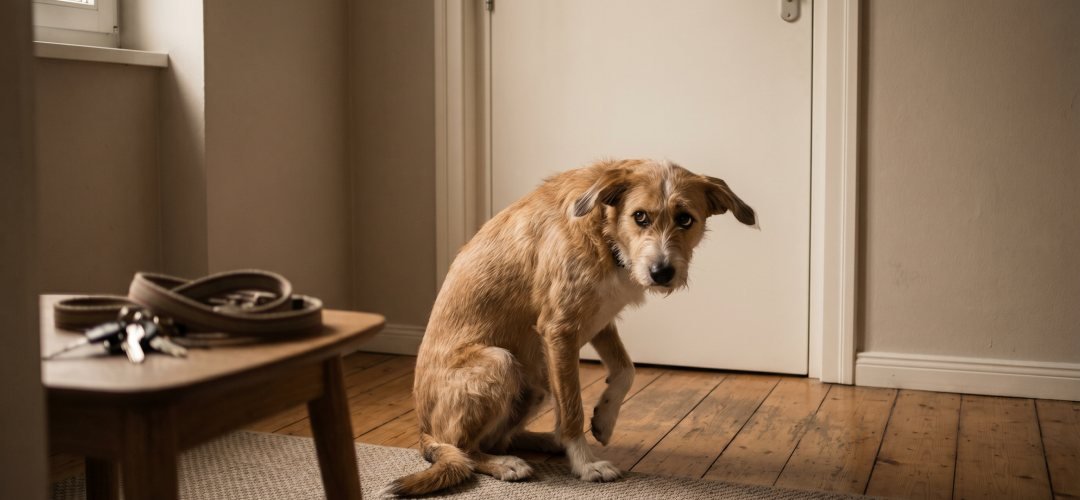
You pick up your keys. Your dog freezes. Their ears drop, the tail tucks, and they follow you to the door with the kind of quiet intensity that is hard to ignore. You tell yourself they will be fine once you are gone — and most of the time, you are probably right.
But here is the uncomfortable statistic: a 2025 study published in the Journal of Veterinary Behavior found that 85.9% of dogs in the US show moderate to severe separation-related issues. Research cited by the RSPCA puts it more simply: 8 out of 10 dogs struggle when left alone — and half of them never show obvious signs.
That is the real problem. Most articles list ten symptoms and assume you will notice them. You won't — because by the time the noisy stuff happens, you are not home. The good news is you do not need a camera to figure out if your dog is stressed when you leave. You just need to know when to look, and what to look for.
This guide walks you through the three moments that reveal almost everything, how to tell stress apart from simple boredom, and what the latest behaviour science says about why dogs bark, whine, or destroy things when their humans disappear.
The 3 Moments That Reveal Everything
Forget the idea that separation stress happens only while you are gone. The most diagnostic signals happen around the departure — and you are home for two out of the three.
Moment 1: Before You Leave (the 10-20 Minutes Before)
Dogs are pattern detectives. They know what shoes, keys, coats, bags, and alarms mean, and most anxious dogs start reacting well before you walk out the door. The ASPCA calls these predeparture cues, and how your dog reacts to them is often more telling than what happens after you leave.
Watch for:
- Shadowing. Your dog follows you from room to room, staying within a metre of you — especially on days you are getting ready to go out.
- Restlessness. Pacing, sitting, getting up, sitting again. Unable to settle.
- Displacement behaviours. Yawning out of context, lip licking, scratching themselves when they are not itchy.
- Refusing food. High-value treats go untouched when the coat comes on.
- Physical signs. Panting, trembling, dilated pupils, ears pinned back.
- Blocking. Sitting by the door, trying to prevent you from leaving, or pressing against your legs.
A calm dog at this stage does not do most of these things. They may lift their head, note that you are leaving, and go back to whatever they were doing. The difference between "aware" and "stressed" is how long the behaviour lasts and how intense it gets.
Moment 2: The Departure Itself
This is a 30-second window most owners don't pay attention to, but it carries a lot of information.
A relaxed dog may walk with you to the door, take a treat, and settle as you close it. A stressed dog often:
- Whines or barks as the door closes
- Scratches or jumps at the door
- Runs to the nearest window
- Stops eating the treat you just offered
- Shows "whale eye" (the whites of the eyes visible at the edge)
If you can, step just outside and listen for 30-60 seconds. Most separation-related behaviours peak within the first 10 minutes after departure, according to the research summarised in a 2016 review in the Journal of Veterinary Behavior. If your dog vocalises, paces, or escalates in those first minutes, that is a strong signal.
Moment 3: When You Come Home
The return is the most underrated diagnostic window — and the one most owners misread as "just excitement".
A dog who greets you, wags, does a lap, and then goes back to their bed within two minutes is probably fine. A dog who is still frantic five minutes later — jumping, spinning, vocalising, unable to eat or drink calmly, sometimes with loose stools or a wet patch on the floor — has been in a state of stress that they cannot shake off.
Other signs at homecoming:
- Intense, prolonged greeting that goes beyond happiness
- Shaking off repeatedly (dogs do this to release tension)
- Drooling visible on the floor or their chest
- Destruction concentrated near the door or windows
- Urine or faeces indoors (in a house-trained dog)
- Torn cushions, scratched doorframes, chewed shoes — especially near exits
Destruction patterns matter. A bored dog chews one thing — usually a toy or something that smells like you. A stressed dog tends to target exits: doors, window sills, blinds, anything that represents the barrier between them and you.
Signs You Can Check Without a Camera
If you have read this far and recognised several of the above, the next question is usually: "do I need to install a camera to confirm it?" You don't. You can build a reliable picture from things you can check before and after absences.
Physical traces when you return:
- Water bowl empty when it was full
- Food bowl untouched (especially high-value treats left behind)
- Drool on the floor, a bed, or near the door
- Indoor accidents in an otherwise house-trained dog
- Damage concentrated at exits rather than spread around
- Dog's coat damp in patches (from saliva or sweat through paws)
- Scratched paws, torn nails, or bleeding gums (severe cases)
Behavioural patterns over days:
- Your dog refuses to eat until you get home, then eats normally
- They follow you more on days you are clearly preparing to leave
- They react to specific triggers (keys, coat, alarm) not to others
- Neighbours report barking or howling in your absence
- They seem unusually tired or subdued for hours after you return
Any one of these on its own is not proof. Three or more across a week is a strong pattern.
Is It Stress or Just Boredom? (The Most Common Misdiagnosis)
Here is where most articles fall short. They list symptoms without explaining that a bored dog and a stressed dog can look remarkably similar at first glance. The difference matters because the treatments are completely different.
A groundbreaking 2020 study from the University of Lincoln, analysing over 2,700 dogs from more than 100 breeds, identified four distinct reasons dogs show distress when left alone:
- Wanting to get away from something in the house (a noise, a sight, a physical environment)
- Wanting to get to something outside (another dog, traffic, a visitor leaving)
- Reacting to external noises or events (delivery vans, thunder, neighbours)
- A form of boredom — not stress, but under-stimulation
The fourth category is the one that fools most owners. A bored dog destroys, vocalises, and paces — but without the physiological stress markers.
| Stressed Dog | Bored Dog | |
| Reacts to predeparture cues | Yes, intensely | Minimal or none |
| Peak of behaviour | First 10 minutes | Builds over time |
| Destruction target | Exits (doors, windows) | Random (toys, furniture) |
| Refuses food/treats | Often | Rarely |
| Drooling / panting | Common | Uncommon |
| Returns to normal after 5 min of homecoming | No | Yes |
| Reaction to confinement | Panic | Mild protest |
If your dog matches more of the left column, you are dealing with genuine stress. If they match more of the right, the answer is usually more enrichment — longer walks, puzzle feeders, training sessions — not desensitisation work.
Barking vs. Whining — What Each One Means
Most owners lump all vocalisation under "noise". Research suggests you shouldn't.
A 2021 study in Nature Scientific Reports looked at how different emotional states show up as different sounds in dogs experiencing separation. The findings are worth remembering:
- Barking is most often associated with frustration. A frustrated dog is trying to do something — get to you, get out, make something happen. The bark is a demand.
- Whining is more often associated with fear. A fearful dog is overwhelmed rather than demanding. The whine is closer to a plea.
- Escape attempts can be either. Dogs who are frustrated try to get to something. Dogs who are panicked try to get away from something.
This matters because frustration and fear call for different approaches. A frustrated dog often benefits from more structure, independence training, and gradual tolerance-building. A fearful dog often needs slower, gentler desensitisation and, in many cases, veterinary input for anxiety management.
If a neighbour describes your dog as "barking constantly" when you are out, you are probably dealing with frustration. If they describe "whining and crying", you are more likely looking at fear. Both are forms of distress, but the path forward is different.
The Timeline of a Stressed Dog
One of the most useful — and least known — pieces of behaviour science for dog owners is the **timeline of separation stress**. Multiple video-based studies cited in the 2016 review show a consistent pattern:
- 0-10 minutes after departure: peak intensity. This is when barking, scratching, pacing, panting, and destructive attempts are most likely.
- 10-30 minutes: partial decrease if the dog is not re-stimulated.
- 23-28 minute cycles: many stressed dogs experience recurring "waves" of anxiety, triggered by memory or external cues (a car passing, a sound upstairs).
- 1-4 hours: gradual decrease unless something re-triggers the cycle.
The practical takeaway: you don't need hours of footage to see if your dog is stressed. The first 10 minutes tell you most of what you need to know. Even a short 30-60 second recording of your dog immediately after the door closes — captured from the other side of the door with your phone — will usually reveal the pattern.
Not sure what you're looking at?
Separation stress shows up in micro-signals — ear position, weight distribution, breathing rhythm, where the dog focuses their gaze. Easy to miss in real time, even harder to interpret.
Smart Dog Care's AI Video Behaviour Analysis reads those signals from a 30-second video and tells you exactly what your dog is feeling — frustration, fear, boredom, or calm — with no camera install, no subscription, no guesswork.
→ Try Behaviour Analysis free
What to Do If You Suspect Your Dog Is Stressed
Immediate Steps
1. Do not punish the signs. Destruction, accidents, and vocalisation are distress responses, not misbehaviour. Punishing them reliably makes the anxiety worse, as the [ASPCA repeatedly emphasises](https://www.aspca.org/pet-care/dog-care/common-dog-behavior-issues/separation-anxiety).
2. Stop practicing the full absence for a while. Every time a stressed dog panics alone, the pattern strengthens. Arrange dog walkers, pet sitters, or day care where you can while you work on a real plan.
3. Rule out medical issues. Sudden behaviour changes, refusal to eat, or new accidents should be checked by a vet — gastrointestinal problems, pain, or cognitive changes can mimic or worsen separation stress.
Short-Term Plan (Desensitisation Basics)
- Break your predeparture routine. Pick up your keys at random times without leaving. Put on your coat while sitting on the sofa. The goal is to make these cues stop predicting departure.
- Practice very short absences — 30 seconds, a minute, two minutes — with calm returns. Reward the calm, not the excitement.
- Give a safe chew or food puzzle only when you leave. This creates a positive association and a distraction.
- Keep arrivals and departures low-key. No big greetings, no dramatic goodbyes.
When to Call a Vet or Behaviourist
- Self-harm (bleeding paws, damaged teeth, raw skin)
- Escape attempts that could injure your dog
- No improvement after 2-4 weeks of consistent work
- Signs that seem to be getting worse
- Sudden onset in a previously calm adult dog
For moderate to severe cases, a certified behaviourist and your vet may work together — sometimes with short-term anxiolytic medication to create space for the behavioural work to take hold. There is no shame in this; it is often the kindest and fastest path through.
Prevention — The Overlooked Win
Separation stress is much easier to prevent than to treat, and the research tells you exactly where to put the effort.
A 2021 UNL study on predictors of separation anxiety cited earlier research by Flannigan and Dodman showing that dogs living with a single owner were 2.5 times more likely to develop separation anxiety than dogs in multi-owner households. The variable isn't the dog — it's the pattern of attachment.
What actually helps, from puppyhood onward:
- Short, structured separations from day one. A puppy who is never alone for the first six months learns that alone = wrong.
- Multiple people involved in feeding and walking. Reduces single-point attachment.
- A designated "settled" space your dog actively chooses for naps — not imposed, offered.
- Independence drills while you are home. Sending your dog to their mat or bed for short rest periods while you remain in sight.
- Avoiding "velcro" habits — if your dog follows you to the bathroom, sometimes close the door gently. Small doses of distance build tolerance.
None of this is about being cold with your dog. It is about teaching them that distance is safe — which is the single most useful thing they can know about the human world.
When to Check With a Vet or Behaviourist
Most mild separation-related behaviours can be improved at home. Some cannot, and these are the ones to take seriously:
- Self-injury during absences
- Sudden onset in an adult dog who used to cope fine
- Urination, vomiting, or diarrhoea at every absence
- Refusing water or food for long stretches
- Escalation despite consistent training
- Signs that affect your dog's quality of life even when you are home (constant shadowing, inability to settle)
A 10-minute video of your dog from the first minutes after you leave, shared with your vet or a certified behaviourist, is often all they need to confirm what is going on and recommend next steps.
The Takeaway: Read the Pattern, Not the Symptom
Separation stress is not a single behaviour. It is a pattern that shows up in three moments — before, during, and after you leave — and across several days rather than a single absence. A destroyed cushion on its own tells you very little. A dog who refuses treats when the keys come out, scratches the door as you close it, and greets you frantically five minutes after you arrive home tells you a lot.
Most of the signals are visible without any technology. The ones that aren't — the micro-level body language during those critical first 10 minutes — are exactly what modern behaviour tools were built for.
Whether you decide to work on this yourself, with a behaviourist, or with help from an app, the starting point is the same: stop assuming your dog is fine just because the house looks untouched when you get home. Watch the three moments. That is where the truth is.
Frequently Asked Questions
How long does it take for a dog to calm down after I leave?
Research shows most separation-related behaviours peak within the first 10 minutes of departure, then decrease over the next 30 minutes if the dog is not re-stimulated. Many dogs go through recurring "waves" of anxiety roughly every 23-28 minutes when they are alone, triggered by external cues like a car passing or a sound upstairs.
Can a dog have separation anxiety without destroying things?
Yes — and it is far more common than most owners realise. The RSPCA notes that half of dogs with separation-related behaviours show no obvious signs like destruction or barking. Instead, they may pace, pant, drool, refuse food, or simply remain in a state of quiet distress that only shows up in subtle body language and physical markers (wet patches, empty water bowls, damp coat).
Is it separation anxiety or is my dog just bored?
Stress and boredom can look similar but differ in key ways. A stressed dog reacts intensely to predeparture cues, peaks in the first 10 minutes after you leave, targets exits when they destroy things, and often refuses high-value food. A bored dog typically shows less reaction to departure cues, destroys toys or random objects rather than exits, and eats normally while you are gone. If your dog matches more of the first pattern, it is stress, not boredom.
Does getting a second dog help with separation anxiety?
Sometimes, but not reliably. Separation anxiety is usually about attachment to a specific person, not just loneliness. A second dog may ease mild boredom but often does not resolve true separation anxiety — and in some cases creates a second anxious dog by modelling. Speak to a certified behaviourist before getting another pet specifically to "cure" the first one's anxiety.
Should I punish my dog for destruction or accidents when I get home?
No. Every major welfare organisation — ASPCA, RSPCA, Humane World — agrees on this. Destruction, accidents, and vocalisation caused by separation stress are not disobedience; they are panic responses. Punishing them reliably makes the anxiety worse because you are adding a second source of fear (you returning angry) to the first (you leaving).
See exactly what your dog feels when you leave
Smart Dog Care's AI reads your dog's body language, tracks anxiety signals, and turns a 30-second video into a clear answer: stressed, frustrated, fearful, or calm. Plus breed-specific training plans, 24/7 Pet Health Assistant, GPS walks, and a community of dog owners in one app. Core features are free.
Download for iOS · Download for Android
This article is informational and does not replace advice from a certified dog behaviourist or veterinarian. If your dog shows sudden behavioural changes or signs of self-injury, contact your vet.
Share this article
Continue Reading

Why Does My Dog Snore? (When It's Normal vs When It's a Problem)
Snoring is the most under-investigated symptom in dog ownership. Owners hear it, smile, post a video, and move on. And most of the time, that's fine — most snoring is harmless. But not all of it. A 2022 survey published in The Veterinary Quarterly found that around 75% of brachycephalic-breed owners believed loud snoring was normal for the breed — when in fact many of those dogs were living with chronic low oxygen levels and a quietly progressive airway disease. If you've already read our piece on why dogs sleep so much , you know that long, fragmented sleep is normal for dogs. Snoring is the next layer — it's what's happening during all those hours of rest, and it's where small changes in the airway show up first. So this article is the honest version. The eight most common causes of dog snoring, ranked from "let your dog sleep" to "call the vet today". A 30-second test you can do tonight to know which one you're looking at. The truth about BOAS and dog sleep apnea. And the small adjustments that often make snoring better. If your dog has snored their entire life and nothing has changed — you'll probably finish this and feel relieved. If something has shifted in the last few months — you'll know what to do next. Either way, you'll never hear that night-time sound the same way again. How dog snoring actually works VCA Animal Hospitals defines it cleanly: snoring is the vibration of soft tissues in the upper airway as air passes during breathing. The structures involved — according to The Animal Medical Center of New York — include the tongue, tonsils, soft palate, larynx, and small pouches near the vocal cords called laryngeal saccules. The principle is simple. Anything that narrows or partially blocks the airway makes those tissues vibrate more, which makes the sound louder. The narrowing can be anatomical (born with it), positional (only when sleeping on the back), inflammatory (allergies, infection, swelling), mechanical (obesity, foreign object, growth), or hormonal (hypothyroidism slowing tissues and adding weight). That's why the change matters more than the snoring itself. A dog who has always snored softly is telling you about their anatomy. A dog who started snoring three months ago — or whose snoring is steadily getting louder — is telling you about something new. The 30-second snore test (do this tonight) Wait until your dog is properly asleep. Then run these seven questions. Yes or no, in your head. Has my dog snored since they were a puppy, with no real change? Yes → probably anatomical, monitor only. No, it started in the last 1–3 months → keep going. Is the snoring getting louder over time? No, it's the same as ever → reassuring. Yes → investigate. Does my dog only snore in one specific position (usually on their back)? Yes → probably positional, low concern. No, in any position → keep going. 🚩 Are there silences where my dog seems to stop breathing for 5–10 seconds, then gasps? Yes → possible sleep apnea, see vet. 🚩 Does my dog wake up suddenly choking, gasping, or making panicked noises? Yes → vet today. 🚩 Are the lips or gums ever bluish or purplish during sleep? Yes → emergency vet now (this is cyanosis). 🚩 Is my dog…

How to Find Safe Walking Routes for My Dog (and the 60-Second Pre-Walk Check Nobody Does)
Most dog owners don't choose walking routes. They inherit them. The block they happen to live on, the park their old neighbour mentioned, the corner store loop they did on day one — and then those routes calcify. Three years later the same dog is still walking the same pavement, past the same construction site, around the same off-leash terrier who lives on the corner. That's a problem, because the route isn't neutral. The route shapes how much your dog walks, how stressed they are when they get home, whether their paws come back intact, and whether you actually enjoy the walk or just survive it. Pavement reaches 125°F (52°C) when the air is only 25°C — hot enough to burn paw pads in 60 seconds, according to Mills Animal Hospital . And research published in the International Journal of Environmental Research and Public Health found that owners in less walkable neighbourhoods walk their dogs 55 minutes less per week on-leash. The route, in other words, decides whether the walk even happens. This article is what nobody taught you about choosing where to walk. Five things, specifically: A 60-second pre-walk check you can do every time before opening the door 12 hazards to scan for, organised by season 7 rules of route design — not "what to avoid", but how to build a route that works How to read a route from your dog's eye-level (the part most people miss) How GPS and hazard alerts turn route choice from guesswork into a system Let's start at the doorstep. The 60-second pre-walk check (do this every time) Before you clip the leash, run this mental checklist. It takes less time than putting on your shoes and prevents 90% of the bad outcomes I see. 1. Test the ground. Place the back of your hand flat on the pavement and count seven seconds. If you can't hold it there, your dog can't walk on it. The Royal Kennel Club made this the official rule for a reason — paw pads are skin, not leather, and burns from hot tarmac are one of the most common summer vet emergencies. 2. Check the weather (all of it). Not just temperature. Humidity above 70% triples heat stress because dogs cool through panting and panting evaporates water. Wind chill in winter changes the felt temperature by 5–10°C. And air quality matters: when wildfire smoke or urban smog spikes AQI above 150, brachycephalic dogs (Pugs, Bulldogs, Frenchies) shouldn't go further than the kerb. 3. Pick the time. In summer, that's early — before 9 a.m. — or late, after 7 p.m. In winter, the warmest hour of the day, usually between 12 and 3 p.m. The middle of the day in July is not a walking time; it's a heatstroke window. 4. Decide the goal. Is this a sniff walk (low pace, dog leads, decompression), an exercise walk (steady pace, cardio), or a training walk (focus, recall, loose-leash work)? The goal changes the route. A sniff walk wants tall grass and slow corners; an exercise walk wants a loop with rhythm; a training walk wants a low-distraction zone. 5. Check the dog. Are they bright-eyed, loose-bodied, food motivated? Or are they hiding under the table, off their breakfast, stiff getting up? A dog that doesn't want to walk is telling you something. Listen to it. 6. Equipment audit. Lead — not…


My Dog Has No Dog Friends — Is That a Problem? (Honestly, Probably Not)
You watch other people at the park. Their dogs sprint into the gate, get instantly absorbed into a wagging, sniffing, bouncing pile of fur, and emerge twenty minutes later with what looks like five new best friends. Then there's your dog. Your dog walks the perimeter. Your dog avoids eye contact. Your dog has a polite but firm opinion that other dogs are a thing that exists — not a thing that needs to be hugged. And so you start to wonder. Is something wrong with my dog? Is he lonely? Did I fail him somewhere? Here's the part nobody tells you at the park: most adult dogs are exactly like yours. The social butterflies you see are not the rule. They're the visible minority. The American Kennel Club's own framework on canine sociability puts most adult dogs in the "tolerant" or "selective" zone — not the "loves every dog" end of the spectrum. And a 2026 review in the journal Animals describes urban pet dogs as living in "socially crowded yet relationally sparse worlds" — they meet many dogs but know almost none ( Bonacci et al., 2026 ). What dogs actually need, the science says, isn't more dogs. It's the right dogs. This article will give you: Why "every dog needs lots of dog friends" is a myth — and where it came from The dog selectivity scale, and why your dog probably belongs in the middle Why your dog changed at 12–18 months (you didn't break anything) The honest line where it actually is a problem A 5-minute self-assessment to know if your dog is genuinely fine What to do instead of forcing friendships Let's take the guilt off the table. The myth: "every dog needs lots of dog friends" The idea that a healthy dog should have a wide, rotating cast of canine pals is surprisingly modern. It traces back to two cultural shifts: the explosion of off-leash dog parks in the 1990s and 2000s, and the rise of the doggy daycare industry. Both rest on a simple commercial premise — dogs need socialisation, daycare and parks provide socialisation, therefore daycare and parks make dogs happy. That logic conflates two completely different things: Puppy socialisation — the developmental process of safe exposure to people, dogs, sounds, surfaces, and environments during the first three to four months of life. This is essential. The American Veterinary Society of Animal Behavior calls it "the standard of care" and warns that incomplete socialisation in this window predicts lifelong fear, anxiety, and aggression problems ( AVSAB Position Statement ). Adult canine friendships — what your two-year-old dog does or doesn't do at the park. This is not the same thing. Adult sociability is shaped by genetics, breed, individual temperament, life experiences, and natural social maturation. Some adult dogs love crowds. Most don't. The worst part of the myth is that it actively harms the dogs caught in the middle of it. Dragging a dog-selective adult into a chaotic dog park "to make friends" doesn't build friendships. It builds stress, then avoidance, then sometimes reactivity. Pushing a quiet introvert into daycare so he "isn't lonely" can produce the exact opposite of the calm, confident dog you wanted. Your goal as an owner isn't to manufacture a wide social circle.…