Skip to content

The Smartest Wayto Care forYour Dog

AI-powered health scanning, behaviour analysis, GPS walk tracking, and a vibrant community — all in one app.
Loved by a growing community of dog owners.

Good morning

Max

Health Score

0Excellent

Today's Walk

2.4 km

32 min

AI Insights

3 new

Tips for Max

Nearby walkers

+8 active
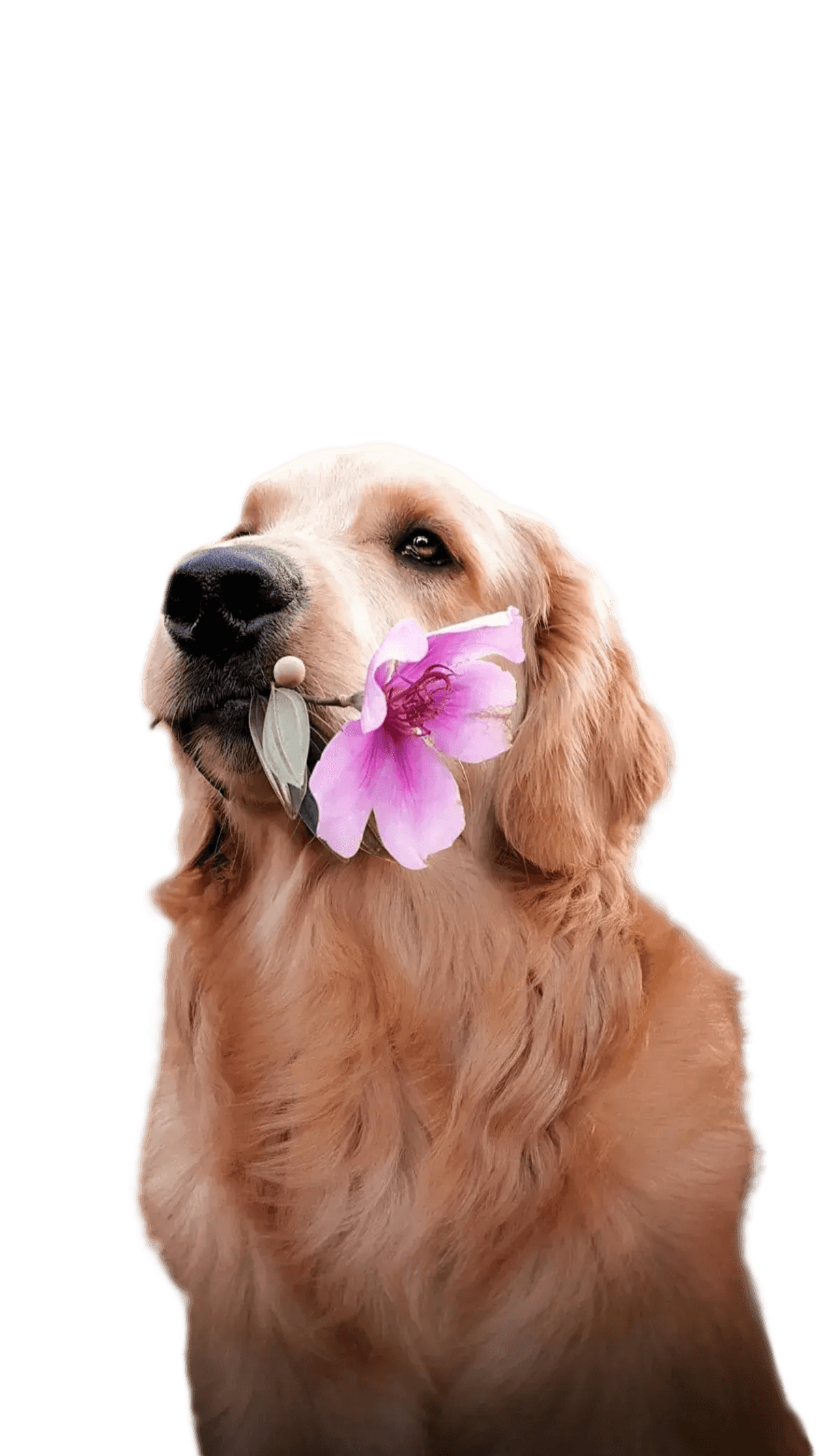
Golden retriever holding a pink flower in its mouth
Scroll

Everything Your Dog Needs

Five AI-powered modules working together for complete care.

Health

AI-Powered Veterinary Assistant

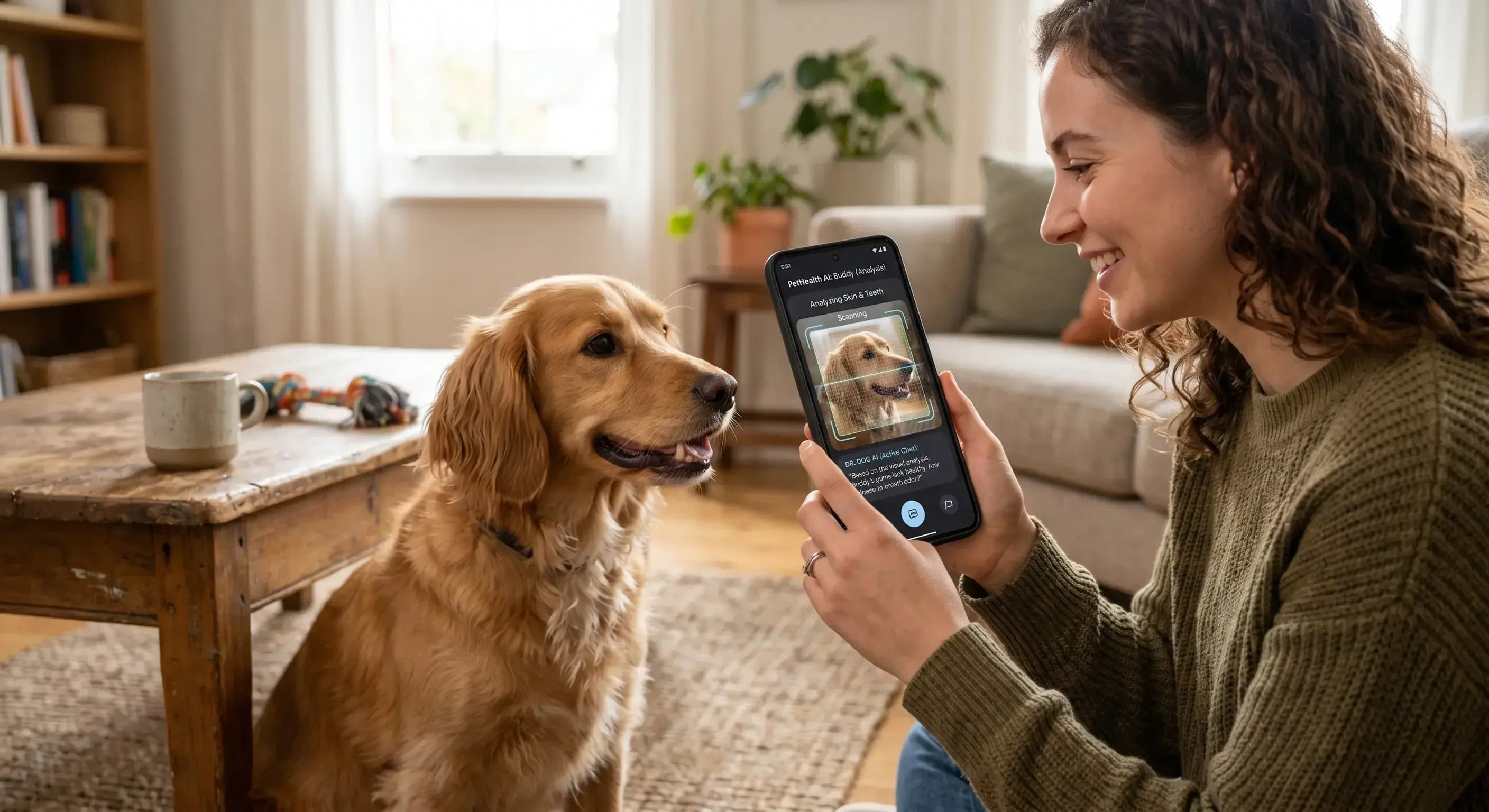
Take a photo and get instant AI analysis of your dog's skin, teeth, and body. Chat with Pet Health Assistant for real-time veterinary guidance.

  • AI Health Scanner
  • Pet Health Assistant
  • Health Dashboard
Continue Reading
Golden retriever holding a flower gently in its mouth
Happy dog running through ocean waves on a beach
Behaviour

Decode Your Dog's Body Language

Upload a video and our AI identifies emotional state, confidence signals, and body language. Get personalized training plans built around your goals.

  • Video Behaviour Analysis
  • AI Training Plans
  • Training Courses
Continue Reading
Walk

GPS Tracking & Community Safety

Real-time GPS walks with route maps, distance stats, and crowd-sourced hazard alerts from nearby walkers.

  • Live GPS Tracking
  • Hazard Alerts
  • Walk Statistics
Continue Reading
Social

Community & Clubs

Share moments, join breed-based clubs, discover local events, and connect with dog owners in your area.

  • Social Feed & Clubs
  • Local Events
  • Dog Profiles
Continue Reading

Plus: Multi-dog profiles, Pro AI Plan, and personalized notification preferences.

How does it work?

From download to daily use in four steps.

01

Download the App

Get Dog Care App free from the App Store or Google Play. Create your account in seconds with email, Google, or Apple Sign-In.

02

Add Your Dog

Create a profile for each of your dogs with their name, breed, age, weight, and a cute photo. AI features personalize to each dog.

03

Explore AI Features

Scan your dog's health, analyze behaviour from videos, get AI training plans, and chat with virtual specialists.

04

Join the Community

Connect with dog owners nearby, join breed-based clubs, share walks, report hazards, and attend local events.

What owners are saying

Bruno AI helped me understand why my dog was barking so much. The training plan worked in just two weeks. It’s amazing to have everything in Portuguese!

João Pereira with their dog
João Pereira Portuguese Water Dog Owner

With three dogs, keeping track of everything was chaos. Smart Dog Care lets me manage health records, walks, and training for all of them. The hazard alerts during walks are a game-changer.

Emily Roberts with their dog
Emily Roberts Multi-Dog Household

Frequently Asked Questions

Yes! Core features like walk tracking, the social feed, clubs, and events are completely free. AI-powered features (health scanner, vet chat, behaviour analysis, and training plans) include limited free uses. Upgrade to the Pro AI Plan for unlimited access to all AI features.

Our AI health scanner provides observation reports with confidence scores across categories like Skin & Coat, Oral Health, and Gastro System. While it's highly accurate for initial screening, it's designed to complement — not replace — professional veterinary care. Always consult your vet for serious concerns.

Absolutely! Smart Dog Care is built with multi-dog households in mind. You can create detailed profiles for each of your dogs, and every AI feature personalizes its responses based on the selected dog's breed, age, weight, and history.

Yes. Walk tracking with GPS, hazard reports, and cached data all work without an internet connection. Your data syncs automatically when you're back online. AI features that require server processing need connectivity.

Smart Dog Care supports English, Portuguese, and Spanish with full localization across all features, including AI conversations. More languages are planned for future releases.

During walks, you or other dog walkers can report hazards like broken glass, loose dogs, or flooding. Reports appear on the map for nearby walkers in real time. Others can confirm ('Still here') or clear ('All clear') reports, creating a crowd-sourced safety network.

We take privacy seriously. Your data is encrypted, and you have full control over notification preferences, privacy settings on posts (Public, Followers, Club, Private), and device management. You can view active sessions, revoke access, and delete your account at any time.

The Pro AI Plan unlocks unlimited access to Pet Health Assistant vet chat, Bruno behaviour specialist, health scans, behaviour video analysis, training plan generation, and trainer chat. It removes all usage limits on AI features while core features remain free for everyone.

Latest Articles

View all articles
Why Does My Dog Snore?

Why Does My Dog Snore? (When It's Normal vs When It's a Problem)

Snoring is the most under-investigated symptom in dog ownership. Owners hear it, smile, post a video, and move on. And most of the time, that's fine — most snoring is harmless. But not all of it. A 2022 survey published in The Veterinary Quarterly found that around 75% of brachycephalic-breed owners believed loud snoring was normal for the breed — when in fact many of those dogs were living with chronic low oxygen levels and a quietly progressive airway disease. If you've already read our piece on why dogs sleep so much , you know that long, fragmented sleep is normal for dogs. Snoring is the next layer — it's what's happening during all those hours of rest, and it's where small changes in the airway show up first. So this article is the honest version. The eight most common causes of dog snoring, ranked from "let your dog sleep" to "call the vet today". A 30-second test you can do tonight to know which one you're looking at. The truth about BOAS and dog sleep apnea. And the small adjustments that often make snoring better. If your dog has snored their entire life and nothing has changed — you'll probably finish this and feel relieved. If something has shifted in the last few months — you'll know what to do next. Either way, you'll never hear that night-time sound the same way again. How dog snoring actually works VCA Animal Hospitals defines it cleanly: snoring is the vibration of soft tissues in the upper airway as air passes during breathing. The structures involved — according to The Animal Medical Center of New York — include the tongue, tonsils, soft palate, larynx, and small pouches near the vocal cords called laryngeal saccules. The principle is simple. Anything that narrows or partially blocks the airway makes those tissues vibrate more, which makes the sound louder. The narrowing can be anatomical (born with it), positional (only when sleeping on the back), inflammatory (allergies, infection, swelling), mechanical (obesity, foreign object, growth), or hormonal (hypothyroidism slowing tissues and adding weight). That's why the change matters more than the snoring itself. A dog who has always snored softly is telling you about their anatomy. A dog who started snoring three months ago — or whose snoring is steadily getting louder — is telling you about something new. The 30-second snore test (do this tonight) Wait until your dog is properly asleep. Then run these seven questions. Yes or no, in your head. Has my dog snored since they were a puppy, with no real change? Yes → probably anatomical, monitor only. No, it started in the last 1–3 months → keep going. Is the snoring getting louder over time? No, it's the same as ever → reassuring. Yes → investigate. Does my dog only snore in one specific position (usually on their back)? Yes → probably positional, low concern. No, in any position → keep going. 🚩 Are there silences where my dog seems to stop breathing for 5–10 seconds, then gasps? Yes → possible sleep apnea, see vet. 🚩 Does my dog wake up suddenly choking, gasping, or making panicked noises? Yes → vet today. 🚩 Are the lips or gums ever bluish or purplish during sleep? Yes → emergency vet now (this is cyanosis). 🚩 Is my dog…

Hanna FurHanna Fur
How to Find Safe Walking Routes for My Dog

How to Find Safe Walking Routes for My Dog (and the 60-Second Pre-Walk Check Nobody Does)

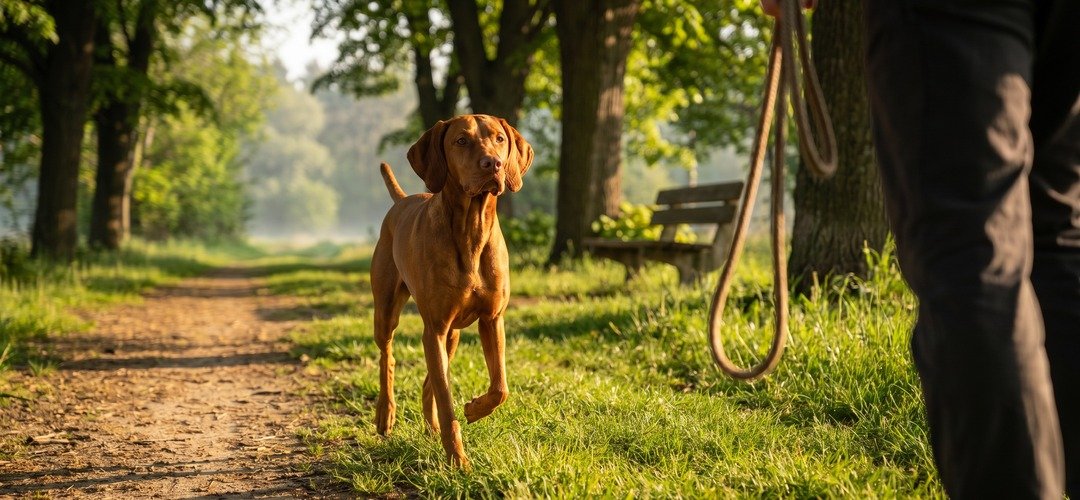
Most dog owners don't choose walking routes. They inherit them. The block they happen to live on, the park their old neighbour mentioned, the corner store loop they did on day one — and then those routes calcify. Three years later the same dog is still walking the same pavement, past the same construction site, around the same off-leash terrier who lives on the corner. That's a problem, because the route isn't neutral. The route shapes how much your dog walks, how stressed they are when they get home, whether their paws come back intact, and whether you actually enjoy the walk or just survive it. Pavement reaches 125°F (52°C) when the air is only 25°C — hot enough to burn paw pads in 60 seconds, according to Mills Animal Hospital . And research published in the International Journal of Environmental Research and Public Health found that owners in less walkable neighbourhoods walk their dogs 55 minutes less per week on-leash. The route, in other words, decides whether the walk even happens. This article is what nobody taught you about choosing where to walk. Five things, specifically: A 60-second pre-walk check you can do every time before opening the door 12 hazards to scan for, organised by season 7 rules of route design — not "what to avoid", but how to build a route that works How to read a route from your dog's eye-level (the part most people miss) How GPS and hazard alerts turn route choice from guesswork into a system Let's start at the doorstep. The 60-second pre-walk check (do this every time) Before you clip the leash, run this mental checklist. It takes less time than putting on your shoes and prevents 90% of the bad outcomes I see. 1. Test the ground. Place the back of your hand flat on the pavement and count seven seconds. If you can't hold it there, your dog can't walk on it. The Royal Kennel Club made this the official rule for a reason — paw pads are skin, not leather, and burns from hot tarmac are one of the most common summer vet emergencies. 2. Check the weather (all of it). Not just temperature. Humidity above 70% triples heat stress because dogs cool through panting and panting evaporates water. Wind chill in winter changes the felt temperature by 5–10°C. And air quality matters: when wildfire smoke or urban smog spikes AQI above 150, brachycephalic dogs (Pugs, Bulldogs, Frenchies) shouldn't go further than the kerb. 3. Pick the time. In summer, that's early — before 9 a.m. — or late, after 7 p.m. In winter, the warmest hour of the day, usually between 12 and 3 p.m. The middle of the day in July is not a walking time; it's a heatstroke window. 4. Decide the goal. Is this a sniff walk (low pace, dog leads, decompression), an exercise walk (steady pace, cardio), or a training walk (focus, recall, loose-leash work)? The goal changes the route. A sniff walk wants tall grass and slow corners; an exercise walk wants a loop with rhythm; a training walk wants a low-distraction zone. 5. Check the dog. Are they bright-eyed, loose-bodied, food motivated? Or are they hiding under the table, off their breakfast, stiff getting up? A dog that doesn't want to walk is telling you something. Listen to it. 6. Equipment audit. Lead — not…

John SpencerJohn Spencer
My Dog Has No Dog Friends

My Dog Has No Dog Friends — Is That a Problem? (Honestly, Probably Not)

You watch other people at the park. Their dogs sprint into the gate, get instantly absorbed into a wagging, sniffing, bouncing pile of fur, and emerge twenty minutes later with what looks like five new best friends. Then there's your dog. Your dog walks the perimeter. Your dog avoids eye contact. Your dog has a polite but firm opinion that other dogs are a thing that exists — not a thing that needs to be hugged. And so you start to wonder. Is something wrong with my dog? Is he lonely? Did I fail him somewhere? Here's the part nobody tells you at the park: most adult dogs are exactly like yours. The social butterflies you see are not the rule. They're the visible minority. The American Kennel Club's own framework on canine sociability puts most adult dogs in the "tolerant" or "selective" zone — not the "loves every dog" end of the spectrum. And a 2026 review in the journal Animals describes urban pet dogs as living in "socially crowded yet relationally sparse worlds" — they meet many dogs but know almost none ( Bonacci et al., 2026 ). What dogs actually need, the science says, isn't more dogs. It's the right dogs. This article will give you: Why "every dog needs lots of dog friends" is a myth — and where it came from The dog selectivity scale, and why your dog probably belongs in the middle Why your dog changed at 12–18 months (you didn't break anything) The honest line where it actually is a problem A 5-minute self-assessment to know if your dog is genuinely fine What to do instead of forcing friendships Let's take the guilt off the table. The myth: "every dog needs lots of dog friends" The idea that a healthy dog should have a wide, rotating cast of canine pals is surprisingly modern. It traces back to two cultural shifts: the explosion of off-leash dog parks in the 1990s and 2000s, and the rise of the doggy daycare industry. Both rest on a simple commercial premise — dogs need socialisation, daycare and parks provide socialisation, therefore daycare and parks make dogs happy. That logic conflates two completely different things: Puppy socialisation — the developmental process of safe exposure to people, dogs, sounds, surfaces, and environments during the first three to four months of life. This is essential. The American Veterinary Society of Animal Behavior calls it "the standard of care" and warns that incomplete socialisation in this window predicts lifelong fear, anxiety, and aggression problems ( AVSAB Position Statement ). Adult canine friendships — what your two-year-old dog does or doesn't do at the park. This is not the same thing. Adult sociability is shaped by genetics, breed, individual temperament, life experiences, and natural social maturation. Some adult dogs love crowds. Most don't. The worst part of the myth is that it actively harms the dogs caught in the middle of it. Dragging a dog-selective adult into a chaotic dog park "to make friends" doesn't build friendships. It builds stress, then avoidance, then sometimes reactivity. Pushing a quiet introvert into daycare so he "isn't lonely" can produce the exact opposite of the calm, confident dog you wanted. Your goal as an owner isn't to manufacture a wide social circle.…

Hanna FurHanna Fur

Give Your Dog the Care They Deserve

Join a growing community of dog owners who trust AI to keep their pets healthy, happy, and safe. Download free today.

Free to download. Pro AI Plan available for unlimited features.