How to Train a Reactive Dog on Walks — Starting at Home (A 4-Week Plan)
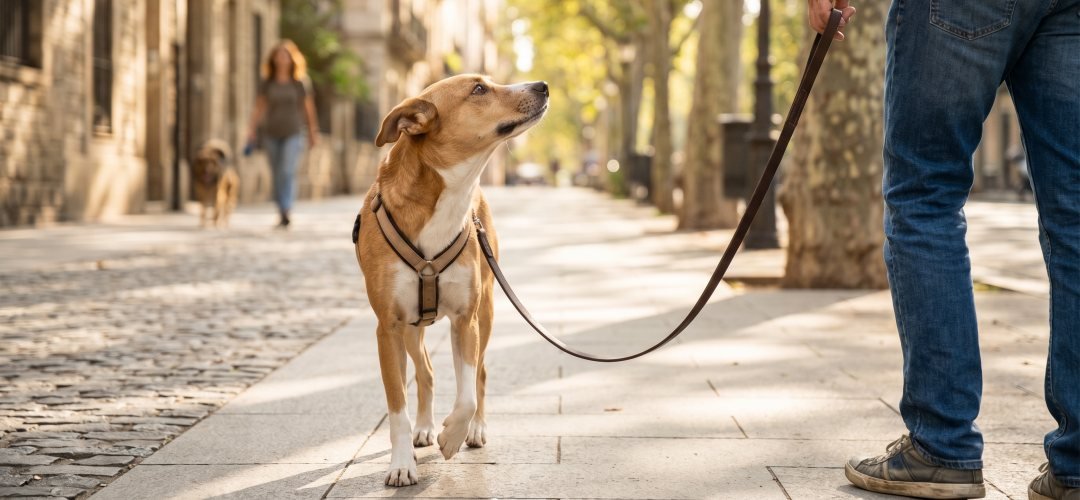
Here is the uncomfortable truth about training a reactive dog: you probably can't do it on a walk.
Walks are the final exam, not the classroom. The dog across the street is too close, the leash is too tense, your heart rate is too high, and your dog has already gone from "alert" to "unable to think" in under two seconds. Trying to teach new skills in that state is like trying to teach algebra to someone who is drowning.
The good news is that the real work — the part that actually reduces reactivity — happens in your living room. You build the foundation on the sofa. You practise threshold games in the hallway. You rehearse emergency cues in the kitchen. By the time you take your dog outside, they already know what to do; the walk is just generalisation.
This guide is a 4-week, force-free plan that rebuilds reactivity from the ground up. It is based on the same protocols certified behaviourists use — Leslie McDevitt's Look at That, Karen Overall's relaxation work, counterconditioning and desensitisation — and on current research into canine impulse control. No prong collars, no corrections, no "dominance". Just distance, duration, intensity — the three levers that actually change behaviour.
Reactivity vs. Aggression — Why the Distinction Matters
Before anything else, know what you are working with. The terms get used interchangeably, and they shouldn't be.
According to the American Kennel Club, reactivity is an exaggerated emotional response to a stimulus — barking, lunging, growling, spinning — that is out of proportion to the situation. A reactive dog is overwhelmed, not malicious. Their nervous system has overridden their impulse control.
Aggression, by contrast, is behaviour aimed at causing harm — biting, snapping, sustained threat. Aggression has intent; reactivity has volume.
The distinction matters because the training plans are different. Most reactive dogs can be worked with at home by a committed owner using the methods in this article. Dogs showing true aggression — bite history, stalking behaviour, predatory silence, bloodshot fixated stares — need hands-on professional help before any home plan is safe to run.
One nuance that the AKC makes clear: reactivity can become aggression if left unmanaged, particularly fear-based reactivity. A dog whose barking and lunging fail to make the scary thing go away learns, over time, to escalate. Growling becomes snapping. Snapping becomes biting. This is why "ignore it, he'll grow out of it" is the single worst advice anyone can give a reactive-dog owner.
Fear vs. Frustration — The First Diagnosis
Within reactivity itself, there are two very different underlying emotions, and your training plan has to match.
Fear-based reactivity. The dog is trying to create distance. The barking, growling, and lunging are defensive — they are saying, "go away". Classic signs: the dog leans backwards even as they lunge forward, hackles may be raised, the tail is tucked or low, and the reactions often stop the moment the trigger disappears.
Frustration-based reactivity. The dog is trying to close distance. They want to reach the other dog, the jogger, the squirrel. Classic signs: whining, pulling towards the trigger, tail high, body forward. Many owners misread this as aggression because the sound is loud, but the motivation is wanting to engage, not to harm.
Why it matters:
- A fearful dog needs more distance, slower progressions, and careful desensitisation. Pushing them too fast confirms that the world is scary.
- A frustrated dog needs more impulse control work, structured thresholds, and teaching that calm attention — not pulling — earns access.
You can't tell which kind you have during a full-blown reaction. You can usually tell by looking at body language in the 5-10 seconds before the reaction — which is exactly what you'll practise reading in Week 1.
The 3Ds of Reactivity: Distance, Duration, Distraction
Every training session with a reactive dog is an equation with three variables. Get any of them wrong and the session collapses.
Distance is how far your dog is from the trigger. Further away = easier. Every dog has a threshold distance for each trigger — the closest point at which they can still see the trigger and think clearly. Inside that distance, the thinking brain switches off and you are training nothing.
Duration is how long your dog is exposed to the trigger. Even at a safe distance, 20 minutes of staring at triggers will exhaust the nervous system. Short reps beat long sessions.
Distraction is how stimulating the trigger itself is. A sleeping Labrador behind a fence is low intensity. An off-leash Jack Russell zig-zagging toward you is high intensity. Moving triggers > stationary. Multiple triggers > single. Noisy > silent.
The cardinal rule: only push one D at a time. If you want to get closer (decrease distance), keep duration short and intensity low. If you want to work longer (increase duration), keep distance generous and intensity low. Trying to improve all three at once is how most home plans fail.
Write your dog's current threshold distance for their main trigger on a sticky note on the fridge. Everything in this plan starts from that number.
Week 1 — Foundation Skills in the Living Room
No walks this week. Or rather: walks are just for relieving bladders and sniffing, no training attempted. The entire training effort this week happens indoors, where triggers are zero.
The Marker + High-Value Reward
Pick a marker word — "yes" works — or a clicker. The rule: marker is immediately followed by a treat, every single time, forever. Charge it up over two sessions of 10-15 reps: sit quietly, say "yes", deliver a high-value treat (small pieces of chicken, cheese, or dried liver — not kibble). You're building a Pavlovian bridge that will later mark split-second good choices in chaotic environments.
Attention Game: The Name Check-In
Say your dog's name. The instant they look at you — mark, treat. Repeat 20 times a day, in short bursts, in different rooms. The goal: "name = eye contact" becomes automatic, not thought-out. This is the cue you'll deploy in emergencies later.
Impulse Control: The Closed-Fist Game
Hold treats in a closed fist at dog nose level. Your dog will lick, paw, and nibble at your hand. Say nothing. The moment they pull back, even for a half-second — mark, open your hand, treat. Repeat until they understand: pressure doesn't work, patience does. Research published in Frontiers in Veterinary Science found that dogs with better performance on delay-of-gratification tasks showed significantly lower aggressive reactivity. Impulse control is not a personality trait; it is a trainable skill that directly reduces reactivity.
The 1-2-3 Pattern Game (Leslie McDevitt)
Say "one" — take a step. Say "two" — take another. Say "three" — drop a treat by your feet. Walk, count, treat. The dog learns the rhythm: 3 = food. This game becomes a rescue tool on walks: when you see a trigger in the distance, starting "one, two, three" gives your dog something predictable to focus on instead of the trigger.
Relaxation on a Mat
Put a small mat or blanket in the living room. Reward any calm behaviour on it — lying down, chin on paws, a deep sigh. Build up to 10 minutes of calm. This teaches that "the mat = relaxation", a place your dog can mentally retreat to later, even on a porch or café patio.
Week 1 goal: your dog responds to their name inside the house with near-100% reliability, holds a closed-fist pause for 3 seconds, and will settle on their mat for 5 minutes.
Week 2 — Quiet Outside Practice
Now take the same skills outside. Not into the chaos — into the edge of it.
Pick the Right Location
Find a low-trigger environment: an empty parking lot early in the morning, the edge of a park 200 metres from the main path, a quiet residential street at 6am. The criterion is simple: your dog can see occasional distractions in the distance but is not reacting to any of them.
Avoid: busy pavements, dog parks, school drop-off zones, and anywhere with narrow spaces where you can't create distance if needed.
Map Your Dog's Threshold
Find the distance at which your dog notices a trigger but can still take a treat, respond to their name, and look away. That is their threshold distance today. Mark it in your head — it may be 15 metres, 30 metres, or 100 metres. Every later session starts at or beyond this line, never inside it.
Practical tip: a dog that stops taking high-value treats has just crossed over threshold. Food refusal in the presence of a trigger is one of the most reliable early-warning signs you have.
Loose-Leash Basics
In your quiet location, practise the Week 1 attention game and the 1-2-3 pattern while walking. No triggers — just building the association: "walking with you = rewarding things happen." A loose, relaxed leash is non-negotiable from this point on. As behaviourists at Rover emphasise, tightening the leash when you spot a trigger increases tension in your dog and often triggers the reaction you were trying to avoid.
Week 2 goal: your dog performs Week 1 skills outdoors at threshold distance, eats treats willingly, and walks on a loose leash for 10-minute stretches.
Week 3 — Introducing Triggers with the Look at That Game
This is the core protocol. The Look at That game (LAT), developed by Leslie McDevitt in her Control Unleashed program, is the single most effective exercise for most reactive dogs. It does two things simultaneously: it changes the dog's emotional association with the trigger (classical conditioning) and it teaches a new behaviour to replace the reactive one (operant conditioning).
The LAT Protocol
1. Start at or beyond threshold distance. Your dog can see the trigger but isn't reacting.
2. Wait for your dog to look at the trigger. The instant they do — mark ("yes!") and treat.
3. Your dog will turn back to you to receive the treat. Great. That's the new pattern you're building: see trigger → look at it → check in with human → get paid.
4. Repeat 5-10 times, then end the session. Walk away. Sessions should be short — 3 to 5 minutes — not marathon stare-downs.
5. Gradually decrease distance over multiple sessions, one or two metres at a time. If your dog reacts, you moved too fast. Back up, try again another day at the previous distance.
Done well, you will see a shift within 2-3 weeks: your dog spots a trigger, looks at it, and immediately swings their head back to you for a treat. The trigger has become a cue to check in, not a cue to react.
Engage-Disengage as the Next Step
Once LAT is reliable, evolve it. Now, instead of marking the moment your dog looks at the trigger, wait for them to look at the trigger and then voluntarily look back at you. Mark the disengagement. You are teaching the dog to self-regulate — to manage their own attention. This is where real change happens.
The "Back One D" Rule
If your dog reacts during a session, don't fight it. Calmly move away until they calm down, and next session, adjust one D: back up 5-10 metres, shorten the session, or find a lower-intensity trigger. Failure in LAT isn't failure — it's information. It's telling you that one of the 3Ds was wrong.
Week 3 goal: your dog consistently looks at triggers at current threshold distance and disengages voluntarily in at least half the reps.
Week 4 — Real-World Walks with Escape Plans
Now you start using these skills on real walks. Not to "test" your dog — to set them up to succeed.
The Emergency U-Turn
Teach this at home first. Pick a cue ("this way" or "let's go"). Walk a few steps in the hallway. Say the cue and pivot 180 degrees, walking briskly the other way. The moment your dog follows — mark, treat, continue cheerfully. Practise until it's automatic. On walks, the U-turn becomes your escape hatch for when a trigger appears too suddenly to work through.
Scatter Feeds
When a trigger appears at the edge of your dog's threshold, scatter 10-15 small treats on the ground in front of them. Sniffing lowers arousal, occupies the nose, and prevents staring. This is emergency management, not training — but it keeps your dog under threshold while you create distance.
Sniff Walks Between Training Walks
Training walks and sniff walks are different activities. Training walks are short, focused, and structured around triggers you plan around. Sniff walks are long, leisurely, low-trigger walks where your dog decides the pace and direction — on a 5-metre long-line if possible. Research on decompression walks consistently shows that dogs who get regular sniff walks have lower baseline arousal and perform better in training. If every outing is a training session, your dog will burn out. Aim for a 1:2 ratio — one training walk for every two sniff walks.
Reading Early Warning Signs
The single most useful skill on a walk is reading your dog's body 5-10 seconds before a reaction. The signs are almost always there:
- Tension in the mouth — closed, tight, or pulled back
- Weight shifting forward onto the front paws
- Stillness — the kind of pause before a lunge
- Dilated pupils, hard stare
- Refusing a treat they normally eat
- Ears pinned forward and rigid
- Raised hackles (piloerection)
Spotting these gives you the 2-3 seconds you need to deploy a U-turn, a scatter feed, or LAT before the reaction explodes. Most owners never learn to see these — which is why professional apps that analyse body language from video are becoming standard tools for reactive-dog owners.
Week 4 goal: your dog can pass a known trigger at their current working distance with a brief look, a disengagement, and a loose leash. Not every time — but consistently enough that both of you leave the walk less stressed than you started.
Your dog is unique. Your training plan should be too.
Smart Dog Care's AI Training Plans build a personalised reactivity protocol for your dog — factoring in their breed, age, main triggers, and current threshold distance. Daily 5-10 minute sessions, adjusted weekly based on your progress. No generic YouTube routines, no guesswork.
The Video Behaviour Analysis reads the 5-second pre-reaction body language that human eyes usually miss, so you can intervene before the explosion, not after.
→ Start your free training plan
Reactivity Inside the House (The Overlooked Source)
One reason home training plans fail is that owners treat reactivity as a walk problem. It isn't. What your dog rehearses at home is what they bring to the walk.
Common in-home reactivity that directly fuels on-walk reactivity:
- Window barking. Every time your dog barks at the postman from the sofa and the postman leaves, they get a "win". That pattern — bark → threat goes away — is the exact rehearsal for leash reactivity.
- Door reactivity. The doorbell ringing, the door opening, someone arriving. If your dog explodes at the door, they are already primed for stranger-on-walk reactivity.
- Arousal stacking inside. High-intensity fetch, tug-of-war, chase games with no calming cool-down leave your dog's baseline arousal elevated for hours — meaning they start every walk closer to their threshold.
Practical fixes:
- Manage windows. Frosted film, a closed door, or a furniture rearrangement that blocks the view of the street. Prevention, not training.
- Counter-condition the doorbell. Record the sound on your phone. Play it at very low volume while you feed your dog. Gradually raise the volume over days. When the real doorbell rings, cue them to their mat, which you already trained in Week 1.
- Lower baseline arousal. Calm chew sessions, lick mats, snuffle mats, scent games. Aim for more nose-work, less chase. A dog whose baseline arousal is low has a higher threshold for everything.
Equipment — What Helps, What Hurts
What helps
- Well-fitted Y-front harness + a 6-foot (2-metre) flat leash. Distributes pressure across the chest, not the throat.
- Head halter (Gentle Leader, Halti) for strong dogs who outweigh you. Introduce slowly over a week with treats — never clip it on and hope for the best.
- Long-line (5-10 metres) for sniff walks in safe areas. Gives freedom without off-leash risk.
- Basket muzzle. The Rover team and most certified behaviourists are clear: a well-fitted, gradually introduced basket muzzle is not punishment. It is safety equipment that lets a dog with a bite history still access the world while training progresses. The unfair stigma around muzzles costs dogs their lives every year.
- High-value treats. Freeze-dried liver, cooked chicken, small cheese cubes. Not kibble. Your dog isn't being picky; their brain chemistry requires the reward to actually compete with the trigger.
What hurts
- Choke chains, prong collars, shock collars. The short-term suppression looks like progress. The long-term outcome, across multiple studies, is higher reactivity, higher anxiety, and a damaged relationship. Pain and fear are not substitutes for training.
- Retractable leashes. Inconsistent leash feedback, tangle hazard, and impossible to manage in a real reaction. Leave them at home.
- Yelling, scolding, or "correcting" the reaction. You're adding a second stressor (your anger) to the first (the trigger). As every major welfare organisation — AKC, ASPCA, RSPCA — makes clear, punishment for fear-based behaviour makes the fear worse.
Common Mistakes That Keep Dogs Reactive
1. Trigger stacking. Two reactions in an hour aren't twice as bad as one — they're five times as bad. Cortisol stays elevated for up to 72 hours after a significant stress event. Plan rest days between training walks.
2. Tightening the leash when you see a trigger. Your dog feels the tension instantly and reads it as danger confirmed.
3. "Wait and see" when a trigger appears. By the time your dog reacts, it's too late to train. Intervene early, at the first sign of alertness.
4. Forcing introductions. Meeting another dog nose-to-nose on leash is a high-stakes gamble. Most greetings should be parallel walks at a distance, not face-to-face.
5. Training above threshold. If your dog can't take a treat, you are not training. You are rehearsing the reaction. Back up.
6. Inconsistency across the household. The member of the family who lets the dog pull, bark at the window, or eat off the table undoes the rest of the household's work. Everyone agrees or nothing works.
When to Call a Professional
Most mild-to-moderate reactivity responds well to a home plan like this one, done consistently, over two to four months. Some cases need expert eyes sooner:
- Any bite history. Inhibited or not, any tooth contact with a human or another dog changes the risk calculus.
- Freezing, hard staring, predatory silence before a reaction. These are closer to aggression than reactivity and need specialist assessment.
- Reactivity that is getting worse despite 6+ weeks of consistent work.
- Signs of generalised anxiety — pacing at home, loss of appetite, sleep disruption, obsessive behaviours. The dog's nervous system may need medical support alongside training.
- Self-injury during reactions — broken teeth, raw paws, bleeding gums.
- You feel out of your depth. Reactive-dog guilt is intense and corrosive. A certified behaviourist (IAABC, CCPDT-KA, PPG) takes the pressure off and often gets you further in 6 sessions than 6 months alone.
The Takeaway: Reactivity Is a Skill Gap, Not a Character Flaw
Your dog isn't bad. They don't hate other dogs, or people, or skateboards. They have a nervous system that overshoots in specific situations, and they lack the skills to self-regulate when they do.
Both of those things are trainable. Not overnight — and often not perfectly. But dogs who were "impossible" on walks two years ago are now passing other dogs at three metres, taking chicken from their owners as they go. The difference isn't magic. It's the 4 weeks of work you start tonight, on your sofa, with a closed fist and a handful of chicken.
The walk is the final exam. The living room is the classroom. Start there.
Frequently Asked Questions
How long does it take to train a reactive dog?
Mild to moderate reactivity usually shows visible improvement within 4-8 weeks of consistent daily training, and meaningful change — passing triggers calmly at short distances — within 3-6 months. Severe cases, especially those with fear or bite history, often take a year or more, and many reactive dogs benefit from lifelong management rather than a single "cure".
Can I walk my reactive dog while training?
Yes, but change what "walking" means. During the first weeks of training, normal neighbourhood walks are counter-productive because every reaction rehearses the pattern you're trying to change. Shift to early-morning or late-evening low-trigger walks, sniff walks on long-lines in quiet areas, or dedicated training walks at specific locations where you can manage distance. It's better to have three quiet walks a week than seven stressful ones.
Should I punish my dog for lunging and barking on walks?
No. Every major welfare organisation — AKC, ASPCA, RSPCA, most certified behaviourists — agrees. Punishment in a reactive dog adds a second source of fear to the original one and often suppresses the warning signs (growling, stiffness) that come before a bite — which is dangerous, because you lose the early warnings without fixing the underlying emotion. Force-free desensitisation and counterconditioning outperform punishment in every longitudinal study on reactivity.
Can reactivity be cured or only managed?
Both, depending on severity and the dog. Many dogs with mild frustration-based reactivity can reach a point where they barely register old triggers. Dogs with deeper fear-based reactivity often improve dramatically but benefit from lifelong management — specific routes, specific times, known thresholds — rather than a full "cure". The goal is not a perfect dog. The goal is a dog who can live their life without daily distress.
Is my dog reactive because of something I did?
Almost never. Reactivity has three main roots: genetics (some breeds and lines are wired for higher arousal), early socialisation (or lack of it, especially in puppies raised under 16 weeks with limited exposure), and specific learning experiences (a bad encounter at the wrong age). Owners sometimes unintentionally reinforce the pattern after the fact, but the root cause is rarely "something you did". Guilt slows down training. Focus on the plan.
A trainer, a vet, and a community in your pocket
Smart Dog Care combines AI Training Plans personalised by breed and trigger, 24/7 Pet Health Assistant, Video Behaviour Analysis, GPS walks with hazard alerts, and a community of dog owners working through the same challenges. Core features are free.
Download for iOS · Download for Android
This article is informational and does not replace advice from a certified dog behaviourist or veterinarian. For any dog with a bite history, severe fear responses, or signs of generalised anxiety, seek a credentialed professional (IAABC, CCPDT, PPG, or similar) and consult your vet to rule out medical contributors.
Share this article
Continue Reading
Why Does My Dog Snore? (When It's Normal vs When It's a Problem)
Snoring is the most under-investigated symptom in dog ownership. Owners hear it, smile, post a video, and move on. And most of the time, that's fine — most snoring is harmless. But not all of it. A 2022 survey published in The Veterinary Quarterly found that around 75% of brachycephalic-breed owners believed loud snoring was normal for the breed — when in fact many of those dogs were living with chronic low oxygen levels and a quietly progressive airway disease. If you've already read our piece on why dogs sleep so much , you know that long, fragmented sleep is normal for dogs. Snoring is the next layer — it's what's happening during all those hours of rest, and it's where small changes in the airway show up first. So this article is the honest version. The eight most common causes of dog snoring, ranked from "let your dog sleep" to "call the vet today". A 30-second test you can do tonight to know which one you're looking at. The truth about BOAS and dog sleep apnea. And the small adjustments that often make snoring better. If your dog has snored their entire life and nothing has changed — you'll probably finish this and feel relieved. If something has shifted in the last few months — you'll know what to do next. Either way, you'll never hear that night-time sound the same way again. How dog snoring actually works VCA Animal Hospitals defines it cleanly: snoring is the vibration of soft tissues in the upper airway as air passes during breathing. The structures involved — according to The Animal Medical Center of New York — include the tongue, tonsils, soft palate, larynx, and small pouches near the vocal cords called laryngeal saccules. The principle is simple. Anything that narrows or partially blocks the airway makes those tissues vibrate more, which makes the sound louder. The narrowing can be anatomical (born with it), positional (only when sleeping on the back), inflammatory (allergies, infection, swelling), mechanical (obesity, foreign object, growth), or hormonal (hypothyroidism slowing tissues and adding weight). That's why the change matters more than the snoring itself. A dog who has always snored softly is telling you about their anatomy. A dog who started snoring three months ago — or whose snoring is steadily getting louder — is telling you about something new. The 30-second snore test (do this tonight) Wait until your dog is properly asleep. Then run these seven questions. Yes or no, in your head. Has my dog snored since they were a puppy, with no real change? Yes → probably anatomical, monitor only. No, it started in the last 1–3 months → keep going. Is the snoring getting louder over time? No, it's the same as ever → reassuring. Yes → investigate. Does my dog only snore in one specific position (usually on their back)? Yes → probably positional, low concern. No, in any position → keep going. 🚩 Are there silences where my dog seems to stop breathing for 5–10 seconds, then gasps? Yes → possible sleep apnea, see vet. 🚩 Does my dog wake up suddenly choking, gasping, or making panicked noises? Yes → vet today. 🚩 Are the lips or gums ever bluish or purplish during sleep? Yes → emergency vet now (this is cyanosis). 🚩 Is my dog…
How to Find Safe Walking Routes for My Dog (and the 60-Second Pre-Walk Check Nobody Does)
Most dog owners don't choose walking routes. They inherit them. The block they happen to live on, the park their old neighbour mentioned, the corner store loop they did on day one — and then those routes calcify. Three years later the same dog is still walking the same pavement, past the same construction site, around the same off-leash terrier who lives on the corner. That's a problem, because the route isn't neutral. The route shapes how much your dog walks, how stressed they are when they get home, whether their paws come back intact, and whether you actually enjoy the walk or just survive it. Pavement reaches 125°F (52°C) when the air is only 25°C — hot enough to burn paw pads in 60 seconds, according to Mills Animal Hospital . And research published in the International Journal of Environmental Research and Public Health found that owners in less walkable neighbourhoods walk their dogs 55 minutes less per week on-leash. The route, in other words, decides whether the walk even happens. This article is what nobody taught you about choosing where to walk. Five things, specifically: A 60-second pre-walk check you can do every time before opening the door 12 hazards to scan for, organised by season 7 rules of route design — not "what to avoid", but how to build a route that works How to read a route from your dog's eye-level (the part most people miss) How GPS and hazard alerts turn route choice from guesswork into a system Let's start at the doorstep. The 60-second pre-walk check (do this every time) Before you clip the leash, run this mental checklist. It takes less time than putting on your shoes and prevents 90% of the bad outcomes I see. 1. Test the ground. Place the back of your hand flat on the pavement and count seven seconds. If you can't hold it there, your dog can't walk on it. The Royal Kennel Club made this the official rule for a reason — paw pads are skin, not leather, and burns from hot tarmac are one of the most common summer vet emergencies. 2. Check the weather (all of it). Not just temperature. Humidity above 70% triples heat stress because dogs cool through panting and panting evaporates water. Wind chill in winter changes the felt temperature by 5–10°C. And air quality matters: when wildfire smoke or urban smog spikes AQI above 150, brachycephalic dogs (Pugs, Bulldogs, Frenchies) shouldn't go further than the kerb. 3. Pick the time. In summer, that's early — before 9 a.m. — or late, after 7 p.m. In winter, the warmest hour of the day, usually between 12 and 3 p.m. The middle of the day in July is not a walking time; it's a heatstroke window. 4. Decide the goal. Is this a sniff walk (low pace, dog leads, decompression), an exercise walk (steady pace, cardio), or a training walk (focus, recall, loose-leash work)? The goal changes the route. A sniff walk wants tall grass and slow corners; an exercise walk wants a loop with rhythm; a training walk wants a low-distraction zone. 5. Check the dog. Are they bright-eyed, loose-bodied, food motivated? Or are they hiding under the table, off their breakfast, stiff getting up? A dog that doesn't want to walk is telling you something. Listen to it. 6. Equipment audit. Lead — not…
My Dog Has No Dog Friends — Is That a Problem? (Honestly, Probably Not)
You watch other people at the park. Their dogs sprint into the gate, get instantly absorbed into a wagging, sniffing, bouncing pile of fur, and emerge twenty minutes later with what looks like five new best friends. Then there's your dog. Your dog walks the perimeter. Your dog avoids eye contact. Your dog has a polite but firm opinion that other dogs are a thing that exists — not a thing that needs to be hugged. And so you start to wonder. Is something wrong with my dog? Is he lonely? Did I fail him somewhere? Here's the part nobody tells you at the park: most adult dogs are exactly like yours. The social butterflies you see are not the rule. They're the visible minority. The American Kennel Club's own framework on canine sociability puts most adult dogs in the "tolerant" or "selective" zone — not the "loves every dog" end of the spectrum. And a 2026 review in the journal Animals describes urban pet dogs as living in "socially crowded yet relationally sparse worlds" — they meet many dogs but know almost none ( Bonacci et al., 2026 ). What dogs actually need, the science says, isn't more dogs. It's the right dogs. This article will give you: Why "every dog needs lots of dog friends" is a myth — and where it came from The dog selectivity scale, and why your dog probably belongs in the middle Why your dog changed at 12–18 months (you didn't break anything) The honest line where it actually is a problem A 5-minute self-assessment to know if your dog is genuinely fine What to do instead of forcing friendships Let's take the guilt off the table. The myth: "every dog needs lots of dog friends" The idea that a healthy dog should have a wide, rotating cast of canine pals is surprisingly modern. It traces back to two cultural shifts: the explosion of off-leash dog parks in the 1990s and 2000s, and the rise of the doggy daycare industry. Both rest on a simple commercial premise — dogs need socialisation, daycare and parks provide socialisation, therefore daycare and parks make dogs happy. That logic conflates two completely different things: Puppy socialisation — the developmental process of safe exposure to people, dogs, sounds, surfaces, and environments during the first three to four months of life. This is essential. The American Veterinary Society of Animal Behavior calls it "the standard of care" and warns that incomplete socialisation in this window predicts lifelong fear, anxiety, and aggression problems ( AVSAB Position Statement ). Adult canine friendships — what your two-year-old dog does or doesn't do at the park. This is not the same thing. Adult sociability is shaped by genetics, breed, individual temperament, life experiences, and natural social maturation. Some adult dogs love crowds. Most don't. The worst part of the myth is that it actively harms the dogs caught in the middle of it. Dragging a dog-selective adult into a chaotic dog park "to make friends" doesn't build friendships. It builds stress, then avoidance, then sometimes reactivity. Pushing a quiet introvert into daycare so he "isn't lonely" can produce the exact opposite of the calm, confident dog you wanted. Your goal as an owner isn't to manufacture a wide social circle.…