Great Dane
Summary
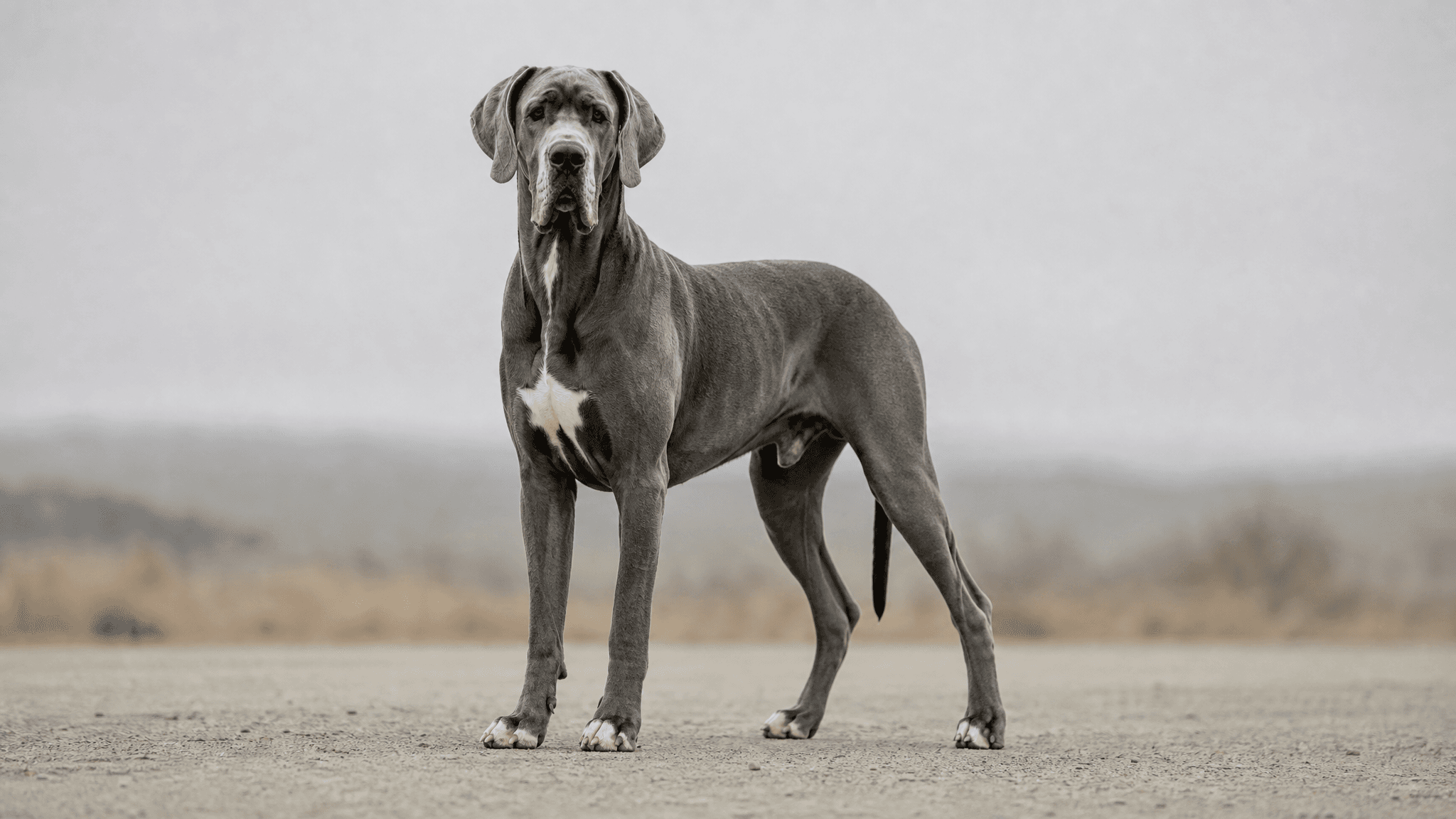
The Great Dane — paradoxically a German breed and not Danish — is the tallest dog in the world by height. Developed in Germany for wild boar hunting and as a noble court dog, it combines a majestic presence with a remarkably friendly and sociable temperament. It is called "the Apollo of the canine world" by German cynologists.
Physical Characteristics
- Size
- Giant
- Height (male)
- 85–92 cm
- Height (female)
- 72 cm
- Weight (male)
- 60–90 kg
- Weight (female)
- 45–65 kg
- Life Expectancy
- 7–10 years
- Coat
- Short, dense, glossy
- Common Colors
- Fawn with black mask, brindle, blue (blue-grey), black, white with black patches (harlequin), mantle (black with white)
Temperament & Personality
Contrary to what its imposing appearance might suggest, the Great Dane has a very friendly, sociable, and affectionate temperament. It is frequently described as "the world's largest lap dog" because it does not understand its own size and tries to sit on its owners' laps. It is good with children, sociable with other dogs, and generally friendly with strangers. It needs socialisation to avoid excessive shyness.
Activity & Exercise
- Energy Level
- Moderate
- Recommended Daily Exercise
- 60–90 minutes
- Suitable for Apartment
- Not recommended
Grooming & Care
- Grooming Needs
- Low
- Shedding
- Moderate
- Bathing Frequency
- Every 6–8 weeks
Health
- Common Health Issues
- Dilated cardiomyopathy (DCM)
- Gastric dilatation/torsion
- Hip dysplasia
- Myeloid degeneration
- Wobbler syndrome
- Recommended Health Tests
- Cardiac examination
- Hip radiography
- Neurological evaluation
Compatibility
- With Children
- Good
- With Other Dogs
- Good
- With Cats
- Moderate
- For First-Time Owners
- Not recommended
Is a Great Dane right for you?
A Great Dane may suit you if:
- You are prepared to provide 60 to 90 minutes of daily exercise to keep their moderate energy levels happily met.
- You enjoy a relaxed, social lifestyle that welcomes a giant, affectionate companion into your daily activities.
- You appreciate a gentle giant's friendly, sociable, and remarkably affectionate nature, often described as a "lap dog."
- You are committed to consistent early training and socialization to guide a large, powerful, yet sensitive breed.
- You are comfortable with moderate shedding and minimal grooming, requiring only occasional baths and brushing for their short coat.
- You are amused by a giant dog who genuinely believes they are a lap dog and will try to sit on you.
Think twice if:
- You expect instant obedience from a breed that, despite its intelligence, can have a stubborn streak.
- You frequently leave your dog alone for long periods, as Great Danes thrive on companionship and can suffer from loneliness.
- You are unwilling to manage careful introductions to smaller pets, despite their generally good nature with other animals.
- You dislike dealing with moderate shedding or providing the daily walks essential for their physical and mental well-being.
- You live in a small apartment or lack the secure, spacious environment a giant breed truly needs to thrive.
- You are not prepared for the physical demands of managing a powerful, playful giant during their boisterous adolescent phase.
Living with a Great Dane is a unique journey. They are magnificent, gentle giants who offer immense love and companionship, often forgetting their own impressive size as they try to snuggle. However, their short lifespan of 7-10 years and the significant commitment to their training, space, and daily exercise mean they are not a decision to be taken lightly. They truly are a big dog with a big heart and big needs.
Training a Great Dane
Great Danes are gentle giants who thrive on positive reinforcement and affection. Their sensitive nature means harsh corrections are counterproductive; they'll simply shut down. Keep training sessions short, fun, and consistent, using high-value treats and praise to motivate them. As "the world's largest lap dog," they love being close to their people, so make training a bonding experience. Inconsistent or overly strict handling can lead to confusion and a reluctance to engage, making progress much slower.
Begin with:
- Attention and name response around distractions
- Recall on a long line
- Loose-leash walking
- Leave it and drop it
- Calm greetings without jumping
- Settling on a mat or bed
- Cooperative handling for grooming, ears, feet and teeth
- Waiting at doors and gates
Prey Drive and Recall
Great Danes were originally bred for hunting wild boar, so they can have a strong prey drive. This instinct might kick in when they spot a squirrel or a fast-moving object, making recall challenging even for a well-trained Dane, especially when they reach their full giant size.
Focus on consistent recall training in various environments, starting with low distractions and gradually increasing the difficulty. Always use a long line for safety during practice in unfenced areas, and make coming back to you the most rewarding thing ever. Our guide on how to teach a dog to come when called can provide excellent tips.
Leash Pulling
Given their giant size and weight (males 60-90 kg, females 45-65 kg), a Great Dane pulling on the leash can be a significant problem, especially for their human. They don't always understand their own strength or size, often leaning into the leash without malice, which can quickly pull you off balance.
Start loose-leash training early and consistently. Use a front-clip harness or a head halter for better control, and reward heavily for walking politely beside you. Regular, moderate exercise (60-90 minutes daily) will also help them be calmer on walks. This article offers a force-free plan to stop leash pulling.
Destructive Boredom
Despite their moderate energy, Great Danes need their recommended 60-90 minutes of daily exercise and plenty of mental stimulation. Left alone too long, or without enough activity, these intelligent dogs can become bored and resort to destructive behaviors like chewing furniture, digging, or excessive barking, which can be quite impactful given their size.
Ensure your Dane gets consistent physical activity and engaging mental games. Puzzle toys, regular training sessions, and interactive play can keep their minds busy. If you suspect your Dane is struggling with being left alone, consider using a behaviour AI feature to help understand and address any signs of separation anxiety or boredom.
Great Dane — Frequently Asked Questions
Can a Great Dane live in an apartment?
Surprisingly, Great Danes are actually one of the more apartment-friendly giant breeds — they're calm and low-energy indoors, spending most of their time lounging. A large apartment with room to stretch out can work very well. The main requirements are access to outdoor space for daily walks, and making sure hallways, doorways, and furniture can accommodate their considerable size. A Dane who gets adequate daily exercise is remarkably peaceful indoors.
What is bloat (GDV) in Great Danes, and how serious is it?
Bloat — technically Gastric Dilatation-Volvulus (GDV) — is the most life-threatening health risk for Great Danes. The stomach fills with gas and twists on itself, cutting off blood supply; without emergency surgery within hours, it is fatal. Great Danes have the highest risk of GDV of any breed. Preventive gastropexy (surgical stomach tacking, often done at neutering) significantly reduces the risk and is strongly recommended by most vets. Know the signs: a distended abdomen, unproductive retching, restlessness, and pale gums require an emergency vet visit immediately.
Why shouldn't you over-exercise a Great Dane puppy?
Great Dane puppies grow extraordinarily fast, and their joints — particularly hips, elbows, and growth plates — are highly vulnerable during development. Over-exercising before 18–24 months can cause irreversible joint damage, exacerbate conditions like hip dysplasia, and lead to a lifetime of orthopaedic problems. Stick to the 5-minute-per-month rule (a 4-month puppy gets 20 minutes), avoid jumping, stairs, and rough play on hard surfaces. Once fully grown, Danes can handle moderate regular exercise comfortably.
How long do Great Danes live, and why is it so short?
Great Danes typically live only 6–8 years — one of the shortest lifespans of any breed. The 'giant dog paradox' is that larger body mass correlates with faster aging at a cellular level, and giant breeds accumulate age-related damage more rapidly. Bloat, heart conditions (DCM), bone cancer (osteosarcoma), and hip dysplasia all contribute. Choosing from long-lived lines, preventive gastropexy, cardiac screening, and maintaining a healthy weight are the best tools available for maximising their time with you.
Are Great Danes gentle with children?
Great Danes have a wonderfully gentle, patient temperament — they're sometimes called 'gentle giants' for good reason. They tend to be calm and careful around family children, often acting as guardians without any training to do so. However, their sheer size is the main consideration with young children: an accidentally enthusiastic tail wag or playful bump can knock a toddler flat. Supervision during interactions with very small children is always prudent, not because of aggression but because of the physics of a 70+ kg dog.
Are Great Danes expensive to own?
Great Danes are among the most expensive breeds to own — their food bills alone are substantial (they can eat 6–10 cups of premium kibble daily), and vet bills are higher for giant breeds both for routine care and emergencies. Preventive gastropexy at neutering adds cost but is a worthwhile investment. Beds, crates, and accessories all need giant-size versions. Pet insurance is very strongly recommended for a breed with this health profile. Budget carefully before committing to a Great Dane.
Do Great Danes need a lot of exercise?
Despite their size, Great Danes are moderate exercisers — around 30–45 minutes of walking daily is sufficient for most adults, ideally split across two outings. They're sprinters rather than endurance athletes and tire faster than you might expect. Avoid vigorous exercise immediately before or after meals (bloat risk), and limit strenuous activity in puppyhood to protect developing joints. A calm, consistent routine with daily walking and some outdoor exploration keeps a Dane healthy and content without overdoing it.
What health conditions besides bloat should Great Dane owners watch for?
Great Danes are prone to Dilated Cardiomyopathy (DCM — heart disease), hip dysplasia, wobbler syndrome (cervical vertebral instability causing hind leg weakness), and osteosarcoma (bone cancer). Cardiac screening annually from age 2 is recommended. Wobbler syndrome can be life-altering and may require surgery or long-term management. Any sudden changes in gait, difficulty rising, or weakness in the hindquarters warrants a prompt vet visit. Like all giant breeds, their health monitoring schedule should be more proactive than for a small dog.
Community
Talk to real Great Dane owners
This guide covers the breed on paper. In the app, the Great Dane community covers it in real life: photos from other owners, questions answered by people who live with the breed, and a directory of dogs you can browse.
- Photos & pollsSee what Great Dane owners are sharing today.
- Questions & answersAsk anything and hear from people who own one.
- Dog directoryBrowse Great Danes from around the world.
You join automatically when you add a Great Dane to your profile.