Dalmatian
Summary
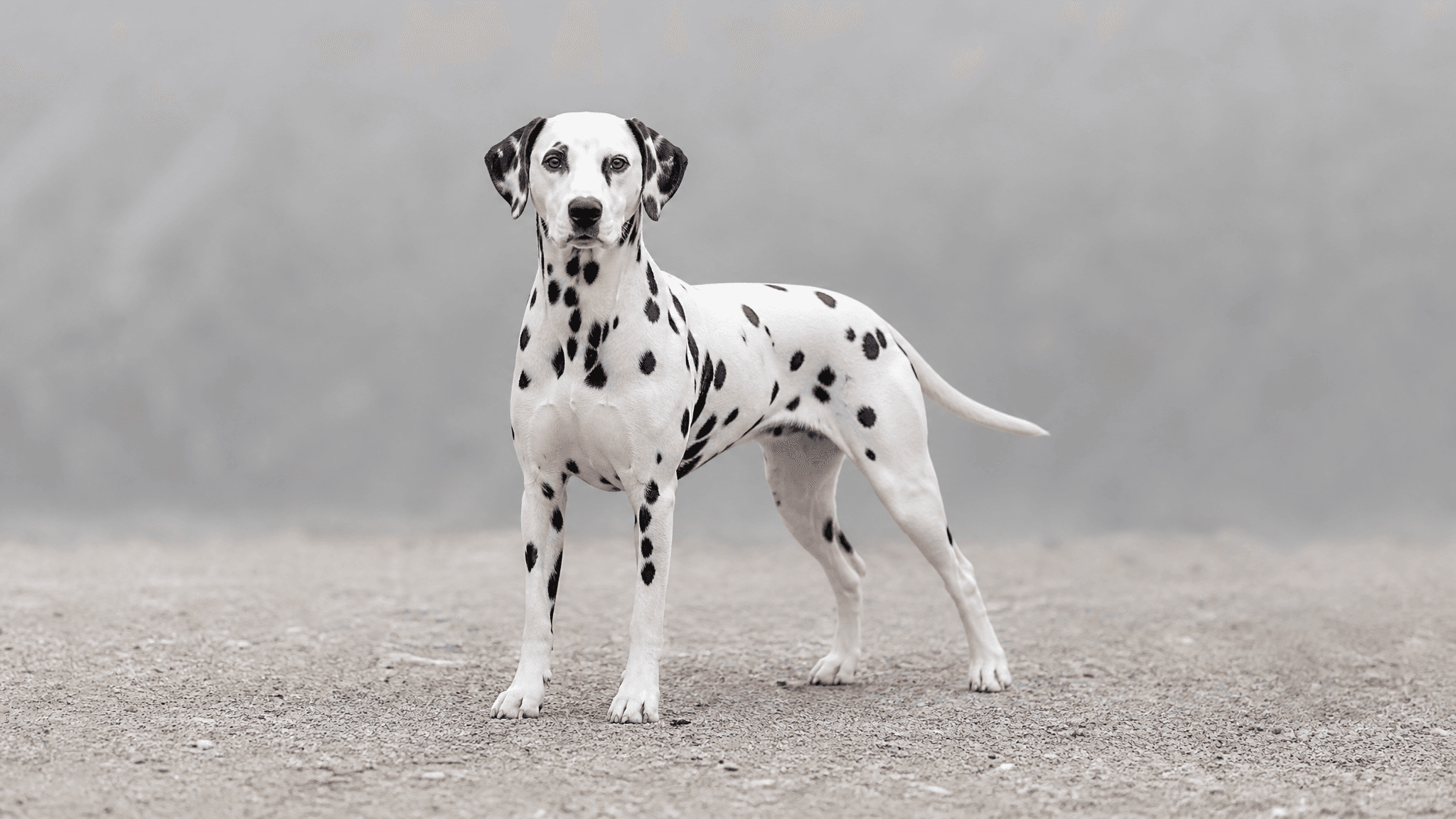
The Dalmatian is one of the most recognizable breeds in the world, famous for its white coat with black or liver spots distributed across the entire body. With origins in the historical region of Dalmatia (present-day Croatia), it has been used throughout history in very diverse roles: guard dog, hunting dog, circus dog, fire station dog (accompanying horse-drawn carriages), and companion dog. It is an athletic, hardy breed of great elegance.
Physical Characteristics
- Size
- Large
- Height (male)
- 56–61 cm
- Height (female)
- 54–59 cm
- Weight (male)
- 27–32 kg
- Weight (female)
- 24–29 kg
- Life Expectancy
- 10–13 years
- Coat
- Short, dense, very glossy, and close-fitting
- Common Colors
- Pure white with black or liver-brown spots with well-defined edges; orange and lemon spots exist but are not FCI standard
Temperament & Personality
The Dalmatian is an energetic, intelligent, and very active dog. It is extremely loyal and devoted to its family, especially to children it grew up with. It can be reserved with strangers and has a tendency to develop separation anxiety if not properly socialized. It is a sensitive dog that responds best to positive training.
Activity & Exercise
- Energy Level
- Very high
- Recommended Daily Exercise
- 120 minutes
- Suitable for Apartment
- Not recommended
Grooming & Care
- Grooming Needs
- Moderate
- Shedding
- Heavy
- Bathing Frequency
- Every 4 weeks
Health
- Common Health Issues
- Congenital deafness
- Epilepsy
- Hip dysplasia
- Skin allergies
- Uric acid urolithiasis (uric acid kidney stones — a metabolic disorder unique to the breed)
- Recommended Health Tests
- BAER test for deafness
- Orthopedic evaluation
- Urinalysis
Compatibility
- With Children
- Excellent
- With Other Dogs
- Good
- With Cats
- Moderate
- For First-Time Owners
- Not recommended
Is a Dalmatian right for you?
A Dalmatian may suit you if:
- You can commit to at least two hours of vigorous exercise daily to satisfy their very high energy.
- You enjoy an active, outdoorsy lifestyle that includes your dog in adventures and activities.
- You appreciate a loyal and devoted companion who thrives on being an integral part of your family life.
- You are prepared to invest in consistent, positive reinforcement training to nurture their intelligent nature.
- You are prepared for regular grooming sessions to manage their heavy shedding and keep their glossy coat pristine.
- You are willing to provide consistent socialization to help them be comfortable with new people and environments.
Think twice if:
- You expect immediate, effortless obedience from a breed known for its independent and intelligent spirit.
- You often leave your dog alone for long periods, as Dalmatians thrive on companionship and can develop separation anxiety.
- You are not prepared to carefully introduce and supervise them with cats, given their moderate compatibility.
- You are unable to commit to at least two hours of vigorous exercise daily or manage heavy shedding year-round.
- You live in an apartment or do not have a securely fenced yard for their exercise and safety.
- You are not prepared for the consistent guidance and firm, yet gentle, handling an energetic large breed puppy and adolescent requires.
Bringing a Dalmatian into your life is a commitment to an active, intelligent, and deeply loyal companion. They offer immense joy and devotion, thriving when integrated fully into family life. However, their high energy and need for consistent engagement mean they require an owner prepared for a significant investment of time and training. The reward is an elegant, sensitive, and truly unique family member.
Training a Dalmatian
Dalmatians are wonderfully intelligent and energetic dogs, eager to please but also quite sensitive. They thrive on positive reinforcement, so make every training session a fun, rewarding experience with plenty of praise, treats, and play. Keep sessions short, engaging, and consistent to hold their attention. If training becomes harsh or inconsistent, your Dalmatian may become confused, anxious, or simply switch off, making progress much harder. Remember, patience and understanding are key to unlocking their full potential and building a strong, trusting bond with your loyal companion.
Begin with:
- Attention and response to name around distractions
- Recall on a long line
- Loose-leash walking
- Leave it and drop it
- Calm greetings without jumping
- Settling on a mat or bed
- Cooperative handling for grooming, ears, feet and teeth
- Waiting at doors and gates
Prey drive and recall
Dalmatians, as part of the Scent Hound group, possess a strong prey drive that can make recall a real challenge, especially when they catch a scent or spot something interesting. Their very high energy means they can be off in a flash! To counter this, practice recall in increasingly distracting environments, always making coming back to you the most rewarding option. Use high-value treats and enthusiastic praise. Consider using a long line during walks in open areas until their recall is rock-solid. Our guide on teaching recall offers more tips.
Leash pulling
Given their large size and very high energy, Dalmatians can be quite strong on the leash, making walks less enjoyable if they haven't learned to walk politely. They need their full 120 minutes of daily exercise, and if that isn't met, they'll have even more pent-up energy to expend by pulling.
Start training loose-leash walking in quiet areas and gradually introduce more distractions. Use a front-clip harness for better control, and reward every moment they walk with a slack leash. Consistency is key, and remember that patience will pay off for many years of enjoyable walks together. This article on stopping leash pulling can help.
Alone time woes
Dalmatians are extremely loyal and devoted to their families, but this strong bond can unfortunately lead to a tendency to develop separation anxiety if they aren't properly socialized or taught to be comfortable alone. They are not recommended for apartment living precisely because they need constant engagement and companionship.
To prevent or manage this, gradually accustom your Dalmatian to short periods of alone time, slowly increasing the duration. Provide engaging puzzle toys or a stuffed Kong to keep them occupied. Ensure they receive ample mental and physical exercise before you leave, as a tired dog is a calm dog. Look for signs of stress when you leave, and consider using our Behaviour AI feature to understand and work on their emotional well-being.
Dalmatian — Frequently Asked Questions
Are Dalmatians high energy?
Dalmatians are one of the highest-energy breeds around — bred to run alongside horse-drawn carriages for miles, they have extraordinary stamina. They need at least 1.5–2 hours of vigorous daily exercise, not just casual walking. Running, cycling alongside them, agility, and off-leash play in a secure area are all ideal outlets. A Dalmatian with insufficient exercise becomes anxious, destructive, and difficult to live with. They're a breed for genuinely active people and families.
Are Dalmatians good family pets?
Dalmatians can be wonderful family dogs for the right family — active, patient, and willing to put in the time for training and exercise. They're loyal, affectionate, and love being part of family life. However, they can be a poor fit for families with very young children, as their high energy and exuberance can knock small kids over. They're also sensitive dogs that need calm, consistent handling. For active families who can meet their exercise needs, a Dalmatian is a joyful, devoted companion.
Why are Dalmatians prone to deafness?
Deafness is linked to the genetics behind Dalmatians' spotted coat — specifically the extreme piebald gene that creates white coat areas. Around 8% of Dalmatians are bilaterally deaf (both ears) and 22–24% are unilaterally deaf (one ear). Dogs with predominantly blue eyes have higher rates of deafness. Responsible breeders BAER-test all puppies at 5–6 weeks to identify deaf individuals. Unilaterally deaf Dalmatians can live normal lives; bilaterally deaf dogs require experienced owners and specific training approaches.
Do Dalmatians have special dietary needs?
Yes — Dalmatians have a unique urinary metabolism that puts them at high risk of forming uric acid stones (uroliths). Unlike most dogs, Dalmatians cannot fully convert uric acid to allantoin, so purines from high-protein foods accumulate. A low-purine diet (avoiding organ meats, game, anchovies, sardines, and very high-protein foods) combined with constant access to fresh water to encourage urination is essential for urinary health. Discuss diet specifics with a vet familiar with the breed.
Are Dalmatians easy to train?
Dalmatians are intelligent but can be independent and stubborn — they were bred to work somewhat autonomously alongside carriages rather than taking constant direction. They respond well to positive reinforcement with clear, consistent rules, but repetitive drills bore them. Early socialisation is particularly important as they can be wary of strangers without it. An under-exercised Dalmatian is almost impossible to train effectively — a tired dog is a trainable dog with this breed.
Do Dalmatians shed a lot?
Yes — Dalmatians shed constantly and quite heavily year-round. Their short, hard coat hairs work their way into fabric and are notoriously difficult to remove. Regular brushing (2–3 times per week) reduces shedding but doesn't eliminate it. Lint rollers, dog-hair-resistant furniture covers, and accepting that white and black hairs on dark and light clothing alike is part of Dalmatian ownership. They don't have the seasonal 'coat blow' of double-coated breeds but maintain a steady, persistent level of shedding.
How long do Dalmatians live?
Dalmatians typically live 11–13 years. Their longevity is best supported by managing their unique urinary health (low-purine diet, constant fresh water, urinary monitoring), ensuring they get sufficient exercise to maintain a healthy weight and mental health, regular hearing checks if deafness is present, and annual vet check-ups. Dalmatians from well-tested lines who receive excellent care regularly live into their early to mid-teens.
Are Dalmatians good with other dogs?
Well-socialised Dalmatians are generally friendly and playful with other dogs — they're social animals who enjoy company. Early socialisation with a wide variety of dogs is important to build confident, positive responses. Some Dalmatians can be assertive with dogs of the same sex, and intact males may have more conflict with other males. They tend to do well in multi-dog households where introductions are managed carefully and the dogs have compatible energy levels.
Community
Talk to real Dalmatian owners
This guide covers the breed on paper. In the app, the Dalmatian community covers it in real life: photos from other owners, questions answered by people who live with the breed, and a directory of dogs you can browse.
- Photos & pollsSee what Dalmatian owners are sharing today.
- Questions & answersAsk anything and hear from people who own one.
- Dog directoryBrowse Dalmatians from around the world.
You join automatically when you add a Dalmatian to your profile.